
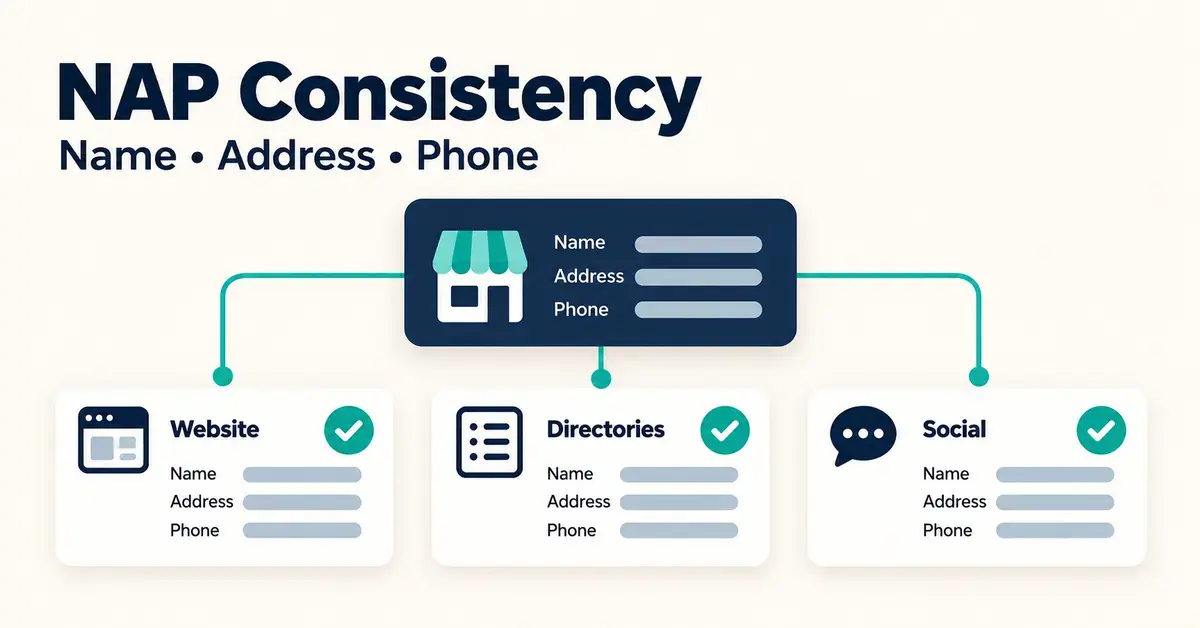
NAP consistency means your business Name, Address, and Phone number appear in exactly the same form everywhere they show up online — your website, your Google Business Profile, directories, review sites, and social pages. When those three details match across the web, search engines and customers can trust that they are all pointing at the same real business. When they drift apart, that trust erodes, and your visibility in local search can quietly suffer. This guide explains what NAP consistency is, why it matters, where your details need to match, and how to audit and fix the mismatches you are likely to find.
What is NAP consistency?
NAP stands for Name, Address, Phone number — the three pieces of information that identify a physical or local business. “Consistency” means every public listing of those three fields is written the same way, character for character, wherever it appears.
A single mention of your name, address, and phone number on another website is called a citation. You might have citations on Google, Apple Maps, Bing Places, Yelp, Facebook, industry directories, and dozens of local listing sites. Consistency is about making sure all of those citations agree with each other and with your own website.
The idea is simple, but the details are where businesses slip. “123 Main Street, Suite 200” and “123 Main St #200” refer to the same place, yet to a machine comparing text they are two different strings. The goal is to pick one correct format and use it everywhere.
Key Takeaways
- NAP = Name, Address, Phone number — the three details that identify a local business.
- Consistency means identical formatting of those details across your website, Google Business Profile, directories, and social pages.
- It supports local SEO by helping Google link all of your online mentions to one trusted business, feeding the “prominence” ranking factor.
- It protects customers from reaching a dead phone number or an old address.
- It is hygiene, not a magic lever — neglecting it costs visibility, but reviews and profile quality carry more ranking weight.
Why does NAP consistency matter for local SEO?
It matters because search engines use your business data to decide whether you are a legitimate, well-defined business worth showing to nearby searchers. Conflicting information creates doubt, and doubt costs you rankings and customers. There are two separate reasons it matters: how algorithms read your data, and how people react to it.
How Google uses your NAP data
Google says local results are ranked primarily by three things: relevance, distance, and prominence. Relevance is how well your profile matches the search. Distance is how close you are to the searcher. Prominence is how well known and trusted your business appears to be — and Google states that prominence is based on information it has about a business from across the web, including links, articles, and directories.
That is where consistent NAP data fits in. When your name, address, and phone number match across many reputable sources, Google can confidently connect all of those mentions to one business entity, which strengthens prominence. When the data conflicts, Google may struggle to merge the signals, or split them across what looks like two different businesses. Industry research backs this up: Whitespark’s annual Local Search Ranking Factors report and BrightLocal’s studies both list citation consistency and website-to-profile matching among the signals that influence local pack and Google Maps rankings, even though they are only part of a bigger picture that also includes reviews and profile quality.
How matching details affect customer trust
Consistency is not only about algorithms. A customer who finds an old phone number that no longer works, or an address that leads them to your previous location, simply gives up and calls a competitor. Every inconsistency is a chance for a real person to be misdirected. Accurate, matching details across every listing mean a searcher reaches you no matter which platform they found you on.
Where does your NAP need to match?
Your NAP needs to match on every property where your business is listed, not just the big ones. The most important places are:
- Your own website — ideally in the footer and on a contact page, so it is easy for both people and crawlers to find.
- Your Google Business Profile — the single most influential local listing, and the one most listings get compared against.
- Other map and search platforms — Apple Maps, Bing Places, and similar services.
- Major directories and review sites — Yelp, Facebook, Yellow Pages, and industry- or city-specific directories.
- Data aggregators — services that feed business data to many smaller directories at once, so a single error can spread widely.
If you operate in Canada, your details should also match across Canadian business directories and citations, which often matter more for local relevance than large global sites. Keeping that data clean also supports the wider work of earning local backlinks in Canada, because consistent, trusted listings make your business easier to reference and link to.
What counts as a NAP inconsistency?
A NAP inconsistency is any difference in how your name, address, or phone number is written — even a difference that looks trivial to a human. Machines compare text literally, so small variations register as mismatches. The table below shows common examples.
| Field | Inconsistent versions | Why it is a problem |
|---|---|---|
| Name | “Maple Leaf Plumbing” vs. “Maple Leaf Plumbing & Heating Ltd.” vs. “Maple Leaf Plumbing Toronto” | Extra words, legal suffixes, or added keywords make listings look like different businesses. |
| Address | “Street” vs. “St.”, “Suite 200” vs. “#200”, “Floor 3” omitted on some listings | Abbreviations and dropped unit numbers create non-matching strings for the same location. |
| Phone | “(416) 555-0137” vs. “416-555-0137” vs. “+1 416 555 0137” | Different formatting, and especially different numbers, split your identity. |
The most damaging phone problem is using separate tracking numbers on different platforms. Call-tracking numbers are useful for measuring where leads come from, but if each directory shows a different number, your NAP is inconsistent by design. If you use tracking, keep your single primary business number as the public NAP and treat tracking numbers as a secondary layer.
Business name discrepancies deserve special care. Google’s guidelines are clear that your profile name must be your real-world business name — the one on your sign and paperwork — and must not be padded with extra keywords or locations. Names like “Joe’s Plumbing | Emergency Plumber Toronto” break those rules and can get a profile suspended, as well as clashing with how the business is named everywhere else.
How do you audit your NAP across the web?
You audit your NAP by deciding on one correct version of each field, then systematically comparing it against every listing you can find. A practical process looks like this:
- Define your canonical NAP. Write down the exact name, address, and phone number you will use everywhere. Match it to your Google Business Profile and legal reality.
- Search for yourself. Search your business name, phone number, and old addresses or numbers in Google. Searching an outdated phone number is a fast way to surface stale listings you forgot about.
- Check the big platforms by hand. Open your Google Business Profile, Apple Maps, Bing Places, Yelp, and Facebook listings and compare each field to your canonical version.
- Use a listing scanner. Tools from providers such as BrightLocal, Yext, Moz, and Semrush scan dozens of directories at once and flag mismatches, missing listings, and duplicates.
- Log every problem. Keep a simple spreadsheet of each listing, its current data, and the correction needed, so nothing slips through.
NAP Consistency Checklist
- Define one canonical version of your name, address, and phone number.
- Match it exactly on your website footer and contact page.
- Confirm your Google Business Profile uses your real-world name with no added keywords.
- Check Apple Maps, Bing Places, Yelp, and Facebook against your canonical NAP.
- Run a listing scanner to catch directories and duplicates you missed.
- Search your old phone number and address to surface stale listings.
- Report and merge duplicate profiles.
- Re-check after any move, rebrand, or number change.
How do you fix NAP inconsistencies?
You fix inconsistencies by correcting the data at the source and then confirming the change has spread. Work through your audit list and, for each listing, either claim and edit it directly or submit a correction through the platform. Prioritise the highest-impact properties first: your website, Google Business Profile, and the largest directories and data aggregators, because aggregators push data downstream to many smaller sites.
Duplicate listings are a common and serious problem. If the same business has two or more profiles on one platform, they compete with each other and split your reviews and signals. Report duplicates to the platform and ask for them to be merged or removed, keeping the strongest listing. After you make changes, remember that updates can take days or weeks to propagate, especially through aggregators, so re-check later rather than assuming an edit is instant.
Consistent NAP vs. local citations: what is the difference?
NAP consistency and local citations are related but not the same thing. A citation is the act of your business being mentioned on another site; consistency is the quality of making sure all of those mentions agree. You can have many citations and still have poor consistency if the details differ — and a business with twenty accurate, matching citations can be stronger than one with fifty conflicting ones.
Think of it as two jobs. Building citations is about presence — getting listed in the right directories, which overlaps with broader link building in Canada and local visibility work. Consistency is about accuracy — keeping the data on those listings clean. Some directory citations also carry a link back to your site; if you are new to how those links work, our guide to backlinks explains the basics. Both jobs support the same goal, but you need to do both well.
Common NAP mistakes to avoid
Most NAP damage comes from a short list of avoidable errors. Watch for these:
- Forgetting listings after a move or rebrand. Changing your address or name but updating only the obvious platforms leaves a trail of wrong data on sites you forgot.
- Keyword-stuffing the business name. Adding services or city names to your Google profile name breaks Google’s rules and makes your name inconsistent everywhere else.
- Using different phone numbers on different sites. Multiple tracking numbers without one stable public number fragment your identity.
- Letting duplicate profiles pile up. Old or auto-generated duplicates compete with your real listing.
- Treating it as a one-time task. Listings drift over time as platforms auto-update data or staff create new profiles. Consistency needs periodic re-checks.
- Ignoring the website itself. If your own contact page does not match your listings, you have undermined the source everyone compares against.
Which businesses need to check their listings?
Any business that serves customers in a specific location or area needs to keep these details consistent. This includes shops, restaurants, clinics, trades, law and accounting firms, salons, and service-area businesses that travel to clients. These are the businesses that appear in Google’s local pack and on Maps, where consistent data directly supports visibility.
Purely online businesses with no physical location or service area get less direct benefit, because they do not compete in local results. Even so, accurate and matching contact details still build credibility with customers. For local businesses, though, NAP consistency is foundational hygiene: it will not single-handedly win rankings, but neglecting it reliably costs visibility and misdirects real customers.
Sources
Frequently Asked Questions (FAQ)
What does NAP stand for in SEO?
NAP stands for Name, Address, and Phone number — the three fields that identify a local business. In SEO, keeping those details consistent across the web helps search engines confirm your business is legitimate and connect all of your online mentions to a single entity.
Does a small difference like “St.” vs. “Street” really matter?
It can. Machines compare text literally, so abbreviations, dropped suite numbers, or different phone formats register as mismatches. Minor differences are less harmful than wrong or outdated data, but the safest approach is to pick one exact format and use it everywhere.
How often should I check my business listings?
Review your listings at least once or twice a year, and always immediately after moving, changing your phone number, or rebranding. Listings can drift on their own as platforms auto-update data or someone creates a new profile, so a periodic re-check keeps problems from building up.
Can I use call-tracking numbers without hurting consistency?
Yes, if you are careful. Keep one primary business number as your public NAP on your website and main profiles, and use tracking numbers only in controlled ways. Showing a different number on every directory is what fragments your identity and confuses customers.
Is matching NAP data a strong ranking factor?
It is a supporting factor rather than a dominant one. Studies place citation consistency and website-to-profile matching among the signals that influence local rankings, but reviews, profile quality, relevance, and proximity carry more weight. Consistency is best seen as essential hygiene that prevents lost visibility rather than a lever that lifts you on its own.
