
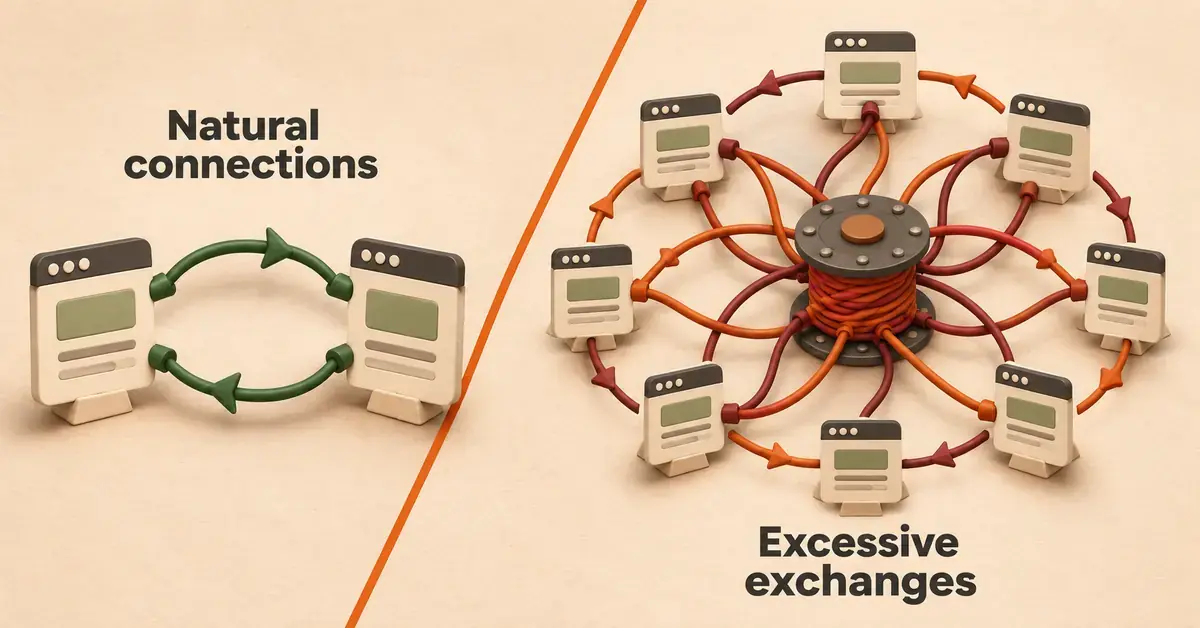
Reciprocal links are not automatically bad for SEO. A handful of mutual links between genuinely related websites is normal and happens naturally across the web. What Google treats as a problem is the excessive, orchestrated version of link swapping — pages and partnerships that exist mainly to trade links and inflate rankings. That is the line this guide shows you how to recognise, using Google’s own wording rather than second-hand SEO folklore.
What is a reciprocal link?
A reciprocal link is a two-way link: Site A links to Site B, and Site B links back to Site A. The exchange can be direct (two sites linking to each other) or indirect in a three-way arrangement, where Site A links to Site B, Site B links to Site C, and Site C links back to Site A to disguise the swap.
Reciprocal links appear constantly for ordinary reasons. Two businesses that partner on a project link to each other. A blog links to a tool it recommends, and the tool’s site lists the blog as a case study. A supplier and a retailer reference one another. None of that is a scheme — it is how real relationships show up online. The problem starts when the links exist only to pass ranking credit, not because a reader would ever want to follow them.
What Google actually says about link exchanges
Google names link exchanges directly in its spam policies. The “Link spam” section defines the category as “the practice of creating links to or from a site primarily for the purpose of manipulating search rankings,” and lists this specific example:
“Excessive link exchanges (‘Link to me and I’ll link to you’) or partner pages exclusively for the sake of cross-linking.”
Two words in that line do the heavy lifting: excessive and exclusively. Google is not banning every mutual link. It is targeting link exchanges done at scale and partner pages that have no purpose other than cross-linking. A single reciprocal link that genuinely helps a reader is not what the policy describes.
Google’s spam policies also make clear how violations are handled. The company says it detects policy-breaking practices “both through automated systems and, as needed, human review,” which “can result in a manual action,” and that “sites that violate our policies may rank lower in results or not appear in results at all.” In other words, manipulative links are first filtered out automatically, and only patterns that look deliberate and large-scale risk a manual penalty.
When reciprocal links are perfectly normal
Google has repeatedly confirmed that mutual links are not inherently harmful. In a July 2021 Search Central office-hours session, Google’s John Mueller explained that a straightforward “you link to me and I’ll link to you” deal is “essentially against our webmaster guidelines,” but he framed the risk around systematic behaviour, not the occasional mutual link. He said Google’s algorithms simply “try to ignore those links” in most cases.
Mueller has also pushed back on the fear that linking to or from small sites is dangerous. In November 2021 he wrote: “Every site starts off small. Getting a link from a small or new site is fine & doesn’t cause problems. Similarly, linking to small or new sites is fine.”
So these common situations are not something to worry about:
- You cite a source and that source happens to link back to you elsewhere.
- You and a project partner, client, or supplier link to each other because the relationship is real.
- Your business is listed on a genuine industry association or chamber of commerce page that you also link to.
- A small or local site links to you and you return the favour once, because the link makes sense for readers.
When link exchanges cross the line
The danger is in scale, intent, and disguise — not in the existence of a mutual link. A link exchange crosses into link-scheme territory when it shows these traits:
- Volume. A large share of your backlinks are reciprocal because you arranged them, rather than earned them. Mueller warned that if swapped links make up “the majority of the links to your website,” Google’s web spam team “might apply manual action.”
- Dedicated cross-link pages. “Links” or “partners” pages that exist only to host outgoing links in exchange for links back — exactly the “partner pages exclusively for the sake of cross-linking” that Google calls out.
- Three-way and link-ring schemes. Rotating links through several sites to hide the direct swap. The disguise is itself a signal of manipulative intent.
- Payment or trades. Exchanging money, products, or services for links that pass ranking credit. Google’s policy treats paid links as spam unless they are marked with rel=”nofollow” or rel=”sponsored”.
- Irrelevant partners. Swapping links with sites that have nothing to do with your topic, purely for the link.
- Identical, keyword-stuffed anchor text used on both sides, which looks engineered rather than editorial.
Notably, Mueller said topical relevance does not rescue a systematic exchange. Asked whether it was acceptable if the two sites were topically relevant, he replied: “It doesn’t matter… If you’re doing this systematically then we think that’s a bad idea.” Relevance makes a link more useful to readers, but it does not launder an arrangement built purely to trade ranking signals.
What happens if you get caught
There are two outcomes, and they are very different in severity.
The links are devalued. This is by far the most common result. Google’s systems recognise the pattern and simply stop counting the swapped links. You lose any ranking benefit you hoped for, but there is no direct punishment — the links just do nothing.
A manual action is applied. This is reserved for sites where manipulative links look deliberate and dominant. A reviewer flags the site, and you receive an “unnatural links” notice in Google Search Console. Rankings can drop sharply until you clean up the links and file a reconsideration request. If you ever receive such a notice, our guide to recovering from an unnatural links penalty walks through the steps, and you may need to disavow toxic backlinks you cannot get removed.
It is also worth understanding how Google finds these patterns in the first place. Its machine-learning spam system looks at link profiles as a whole, and recent Google link spam updates have made it better at neutralising orchestrated exchanges automatically — which is exactly why most reciprocal spam now gets ignored rather than penalised.
How many link swaps are too many?
There is no official percentage. You will see figures online claiming that a profile becomes risky once reciprocal links pass “60–80%,” but none of those numbers come from Google, and Google has never published a threshold. Treat any specific percentage you read as a guess.
What Google has actually said is qualitative: trouble starts when swapped links become “the majority” of your profile and when the exchange is “systematic.” The practical takeaway is to stop counting and start asking a simpler question about each link: would this link exist if ranking credit were not involved? If the honest answer is no, it is the kind of link Google is trying to discount.
Checklist
Flag a reciprocal link as risky when it shows any of these signs:
- It sits on a “links” or “partners” page that exists only to swap links.
- You agreed to link back purely so the other site would link to you.
- It is part of a three-way or rotating arrangement meant to hide the swap.
- Money, products, or services changed hands and the link is not marked nofollow or sponsored.
- The partner site is unrelated to your topic.
- Both sides use the same keyword-rich anchor text.
- Arranged swaps make up a large share of your total backlinks.
A link that would exist even without the SEO benefit is almost never the problem.
How link exchanges compare to other link tactics
Reciprocal link abuse is one of several link schemes Google lists, and it helps to see where it sits on the risk scale. Private blog networks and paid-link spam are higher-risk because they are built entirely to manipulate, while earned editorial links carry no risk at all. If you want the full map of safe versus prohibited methods, our comparison of white-hat and black-hat link building covers the whole spectrum; this article zooms in on where link swapping specifically falls.
The key distinction is intent and disclosure. A private blog network is pure manipulation and a clear black-hat tactic. A paid link is fine if disclosed with a nofollow or sponsored attribute, and spam if it passes credit silently. A reciprocal link sits in the grey middle: harmless in small, natural doses, and a scheme once it becomes volume-driven and orchestrated.
Safer alternatives to link swapping
If you were considering link exchanges to grow your backlink profile, the energy is better spent on methods that earn one-way links — the type Google rewards without hesitation. Strong options include:
- Create genuinely linkable content — original research, data, tools, or guides that other sites cite on their own.
- Digital PR and expert commentary, which earn editorial mentions from journalists and bloggers.
- Guest posting on relevant publications, where the link is editorial rather than traded.
- Resource-page and broken-link outreach, where you offer a better page than one already being linked to.
For a structured plan that mixes these tactics, our overview of proven link building strategies explains how to build authority without relying on swaps. The goal is a profile where links point to you because your content earned them, not because you agreed to return the favour.
How to audit the link swaps you already have
You do not need to panic about existing mutual links, but a quick audit is sensible if you have done any link trading in the past:
- Pull your backlink list from Search Console or a backlink tool, then mark which linking domains you also link back to.
- Judge each one on reader value. If a visitor would reasonably click the link, keep it. If it only exists for SEO, flag it.
- Check the volume. If flagged, engineered swaps make up a large share of your profile, that is the pattern Google cares about — reduce it gradually rather than all at once.
- Clean up what you control. Remove or nofollow the outgoing side of swaps that have no editorial purpose, and request removal of incoming ones where you can.
- Disavow only as a last resort, for clearly manipulative links you cannot get removed and that could contribute to a penalty.
Sources
Frequently asked questions
Is a one-off link exchange with a relevant local business okay?
Yes. A single mutual link between two genuinely related businesses is the kind of natural linking Google describes as fine. The risk appears only when swapping becomes a systematic strategy that dominates your backlink profile.
Does a nofollow link swap still count as a link scheme?
No. If both sides mark the exchanged links with rel=”nofollow” or rel=”sponsored”, they do not pass ranking credit, so they fall outside Google’s definition of link spam. Adding the attribute is the safe way to handle any link you arranged rather than earned.
Should I disavow link exchanges I made years ago?
Usually not. Google’s systems already ignore most manipulative links, so disavowing is only worth it for clearly spammy links tied to a manual action or an obvious, large-scale scheme you cannot clean up by hand. For a few old mutual links, no action is needed.
Do reciprocal links pass any SEO value at all?
A natural, relevant mutual link can still pass value like any editorial link. What loses value is the engineered version — high-volume, irrelevant, or disguised swaps — which Google filters out so it passes little or nothing.
