
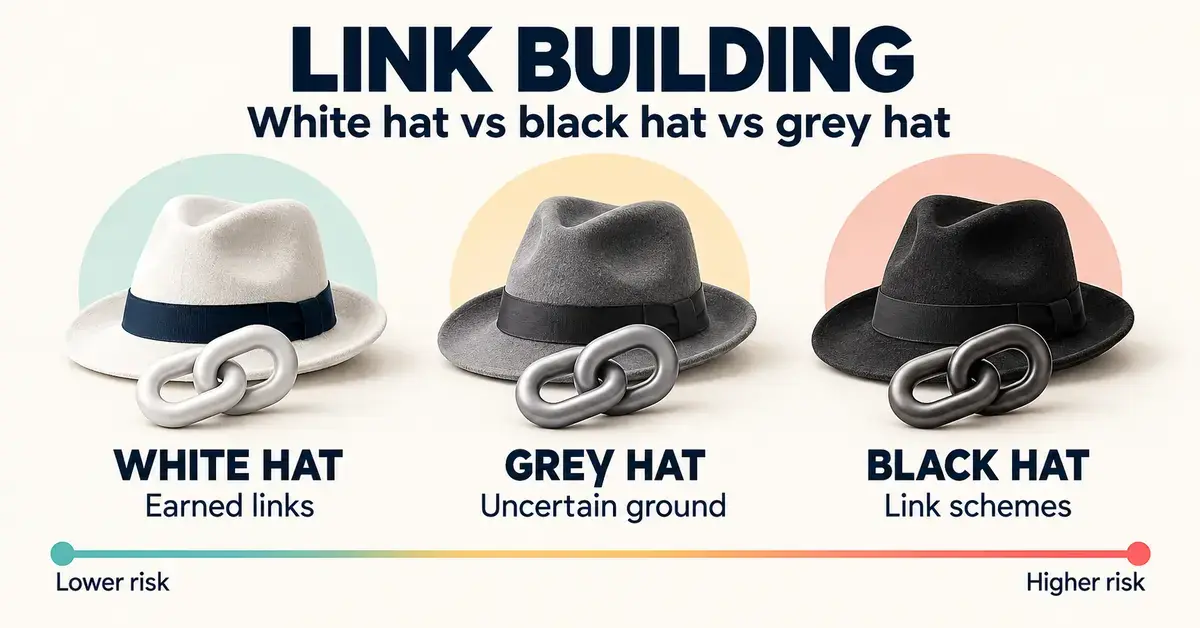
Every backlink you build sits somewhere on a spectrum. At one end is white hat link building — earning links the way Google intends, by publishing content other sites genuinely want to cite. At the other end is black hat link building, which relies on schemes Google explicitly bans. In between sits grey hat link building, a murky middle zone. Understanding where a tactic falls on that spectrum is the single most important skill in modern link building, because it decides whether your rankings compound over years or collapse after the next algorithm update. This guide defines all three approaches, weighs their risk against their sustainability, and shows you how to stay on the safe side.
Key Takeaways
- White hat link building earns editorial backlinks by following Google’s Search Essentials — the safest and most durable approach.
- Black hat relies on link schemes Google explicitly bans (bought followed links, PBNs, link farms, automated spam) and risks manual actions or deindexing.
- Grey hat sits in between: tactics that aren’t clearly banned but are built to manipulate rankings, so they can turn risky after any core or spam update.
- Google permits paid links only when they are qualified with rel=”sponsored” or rel=”nofollow” so they don’t pass ranking credit.
- Judge any tactic by intent, editorial choice and relevance — not by how fast it promises results.
What link building is, and why the “hats” matter
Link building is the practice of getting other websites to link to yours. Each link — called a backlink — acts a little like a citation: when a trusted site links to you, it signals to search engines that your page is worth referencing. Google has used links as a core ranking signal since its earliest days, which is exactly why people try to manipulate them.
The “hat” colour is simply shorthand for how closely a tactic follows Google’s published rules. White hat means fully compliant. Black hat means clearly against the rules. Grey hat means technically-not-banned-but-clearly-manipulative. The borrowed cowboy imagery is informal, but the consequences are not: Google enforces its link policies through both automated systems and human reviewers.
White hat link building: earning links Google rewards
White hat link building is any method of acquiring backlinks that follows Google’s Search Essentials and produces editorial links — links the other site chose to give because your content deserved it. The defining trait is intent: you are trying to be genuinely useful to readers, and the links follow as a by-product.
What counts as white hat?
A tactic is white hat when the linking site made a free editorial choice, the link is relevant to its audience, and you did not pay for or coerce it. Nothing is hidden, nothing is automated at scale, and the link would still make sense to a human editor.
Common white hat tactics
- Digital PR: creating newsworthy stories, surveys or data that journalists and bloggers cite naturally.
- Original data studies: publishing statistics or research that others reference because the numbers are hard to find elsewhere.
- Broken link building: finding dead links on relevant pages and suggesting your working resource as a replacement.
- Unlinked brand mention reclamation: asking sites that already mention your brand to turn that mention into a link.
- Expert quotes and journalist requests: contributing genuine expertise to articles in exchange for attribution.
- Resource-page outreach: earning a spot on curated lists your content genuinely belongs on.
- Relevant guest contributions: writing real, valuable articles for vetted sites in your niche — for exposure and audience, not just for the link.
If you want a fuller playbook, our guide to durable white-hat link building strategies breaks these tactics down step by step.
Why white hat is the most sustainable
White hat links keep their value through core and spam updates because they are the kind of link Google is trying to reward, not detect. There is no footprint to catch, no disclosure to hide and no reason for the linking site to remove the link later. It is slower and takes more effort, but the equity you build compounds instead of evaporating.
Black hat link building: what to avoid
Black hat link building means using “link schemes” — tactics Google’s spam policies explicitly prohibit because their only purpose is to manipulate rankings rather than help users. We describe these so you can recognise and steer clear of them, not so you can use them; every one carries a real risk of penalty.
What Google classifies as a link scheme
According to Google’s spam policies, link schemes include buying or selling links that pass ranking credit (including exchanging money, goods, services or free products for links), excessive reciprocal link exchanges, large-scale article marketing with keyword-rich anchor text, using automated programs to create links, and requiring a link as a condition of a contract or terms of service. Advertorials or native ads that pass ranking credit without being marked also count.
Tactics that fall in the black-hat category
- Buying followed links purely to pass PageRank.
- Private blog networks (PBNs) — networks of sites built solely to link to a “money” site. Our breakdown of PBNs, link farms and cheap backlinks explains why these collapse.
- Link farms: pages that exist only to host outbound links with no real content.
- Comment and forum spam: dropping optimised links in discussions and comment sections.
- Automated link-building tools that blast links across thousands of sites.
- Hacked or injected links placed on sites without the owner’s consent.
The consequences of black hat
Black hat carries two kinds of penalty. A manual action happens when a human reviewer at Google flags your site; it appears as a notification in Google Search Console and can suppress rankings until you clean up and request reconsideration. An algorithmic penalty is automatic — systems such as SpamBrain and the long-running Penguin logic devalue or discount manipulative links with no notice. In the worst cases sites are deindexed entirely. Because Google can now detect both sides of a paid-link transaction, tactics that worked years ago are increasingly liabilities rather than shortcuts.
Grey hat link building: the risky middle ground
Grey hat link building covers tactics that are not explicitly banned but are clearly built to manipulate rankings rather than to help users. The problem is intent: the tactic lives in a loophole today, so its risk depends entirely on whether Google decides to close the loophole tomorrow.
What makes a tactic grey rather than white?
The tell is that you are optimising for the search engine first and the reader second. The link might come from a real site and look natural, but it exists because you engineered it — not because an editor independently decided your content was worth citing.
Examples of grey hat tactics
- Buying expired domains to redirect their old link equity to your site.
- Scaled guest posting where the article exists only to carry a link, published across many sites for volume.
- Exact-match anchor building — repeatedly using your target keyword as the clickable link text, which creates an unnatural pattern.
- Undisclosed paid placements on real publications that pass ranking credit without a sponsored or nofollow tag.
Why grey hat is a gamble
Grey hat can deliver faster results, but it trades durability for speed. When Google tightens a spam policy or rolls out a core update, tactics that were merely “risky” become penalised overnight, and the links you paid for can turn into a cleanup project. You are effectively betting that enforcement will not catch up with you — a bet that gets harder to win every year.
Link Building Comparison
| Approach | Typical tactics | Penalty risk | Long-term sustainability |
|---|---|---|---|
| White hat | Digital PR, original data studies, broken-link building, earned editorial links, relevant guest contributions | Very low | High — links keep their value through updates |
| Grey hat | Expired-domain redirects, scaled guest posting for links, exact-match anchor building, undisclosed paid placements | Medium and rising | Unpredictable — can be devalued or penalised after an update |
| Black hat | Bought followed links, PBNs, link farms, comment and forum spam, automated link tools, hacked-site links | High | Low — often ends in manual actions, ranking loss or deindexing |
How to tell which side a tactic falls on
You rarely need a rulebook to place a tactic — four quick questions usually settle it:
- Intent: Are you doing this mainly to help a reader, or mainly to move a ranking? Ranking-first intent leans grey or black.
- Editorial choice: Did the other site freely decide to link, or did you pay, trade or automate the link into existence?
- Relevance: Would the link still make sense to a human editor who had never heard of SEO?
- Disclosure: If money changed hands, is the link honestly marked so it does not pass ranking credit?
What about paid links? The compliance angle
Paid links are not automatically against the rules — passing ranking credit through them is. Google’s guidance is explicit: it is fine to buy links for advertising or sponsorship as long as they are qualified with a rel=”sponsored” attribute (for ads and paid placements) or rel=”nofollow”, so the link does not influence search rankings. User-generated links, such as those in comments, should carry rel=”ugc”. These attributes can be combined, and our editorial policy explains how we label paid links on this site.
This is the line that separates a compliant sponsorship from a link scheme. A paid link that is properly marked is advertising; a paid followed link bought to boost rankings is a violation, no matter how legitimate the host site looks. If you are weighing a purchase, read our honest take on whether buying backlinks is safe before you spend anything, and see how to buy backlinks in Canada the compliant way. If you inherit a toxic backlink profile, Google’s disavow tool lets you tell it to ignore specific links — though it is an advanced feature that can harm your site if misused.
Common mistakes to avoid
- Chasing volume over relevance: a hundred links from unrelated sites are worth less — and are riskier — than a handful from authorities in your niche.
- Over-optimising anchor text: a backlink profile stuffed with exact-match keywords looks engineered and can trigger a penalty.
- Buying followed links: the most common way well-meaning site owners drift into black hat without realising it.
- Assuming grey hat is “safe enough”: untested loopholes are penalties waiting for the next update.
- Never auditing your profile: if you don’t monitor incoming links, you won’t spot a negative-SEO attack or a bad batch until rankings drop.
- Ignoring disclosure: failing to tag sponsored or affiliate links is one of the easiest violations for Google to detect.
Who should use which approach?
For any real business that wants rankings to last, white hat is the only approach that makes sense — it is the sole method with no built-in expiry date. Grey hat suits, at best, experimental or throwaway projects where the owner accepts that the site may be penalised. Black hat has no legitimate use case for a site you care about; the potential upside is temporary and the downside can be permanent. The safest strategy is simple: build things worth linking to, earn links honestly, and mark any paid link so it never pretends to be an editorial vote.
Disclaimer
This article is educational and is not affiliated with or endorsed by Google. Search engines change their policies and enforcement over time, and no link-building approach can guarantee specific rankings or results. Always check Google’s current documentation before making decisions, and treat any tactic that promises to “beat” the guidelines with caution.
Sources
- Google Search Central — Spam policies for Google web search (link spam)
- Google Search Central — Ways to prevent links from influencing search results (rel sponsored/nofollow/ugc)
- Google Search Central — Search Essentials
- Google Search Console Help — Manual Actions report
- Google Search Console Help — Disavow links to your site
Frequently Asked Questions (FAQ)
Is white hat link building slower than black hat?
Usually, yes. Earning editorial links through content, outreach and relationships takes more time and effort than buying or automating links. The trade-off is durability: white hat links tend to keep their value and won’t trigger a penalty, so the results compound instead of collapsing.
Is guest posting white hat or grey hat?
It depends on intent. A genuine, valuable article on a relevant site your audience reads is white hat. Publishing thin articles at scale purely to plant keyword-rich links is grey hat and can be treated as a link scheme by Google.
Can I get penalised for links I didn’t build?
It’s possible but uncommon. Google’s systems generally ignore spammy inbound links rather than penalising you for them. If you spot a pattern of clearly manipulative links pointing at your site, you can use Google’s disavow tool — carefully, as misuse can hurt your rankings.
Are paid links always against Google’s rules?
No. Paying for a link is only a violation when the link passes ranking credit. If a paid or sponsored link is marked with rel=”sponsored” or rel=”nofollow”, it complies with Google’s policies because it doesn’t influence search rankings.
How do I know if a tactic is grey hat?
Ask whether you’re doing it mainly to help readers or mainly to move a ranking, and whether the linking site chose to link freely. If the honest answer is that you engineered the link to manipulate rankings and it isn’t clearly disclosed, it’s grey hat at best.
