
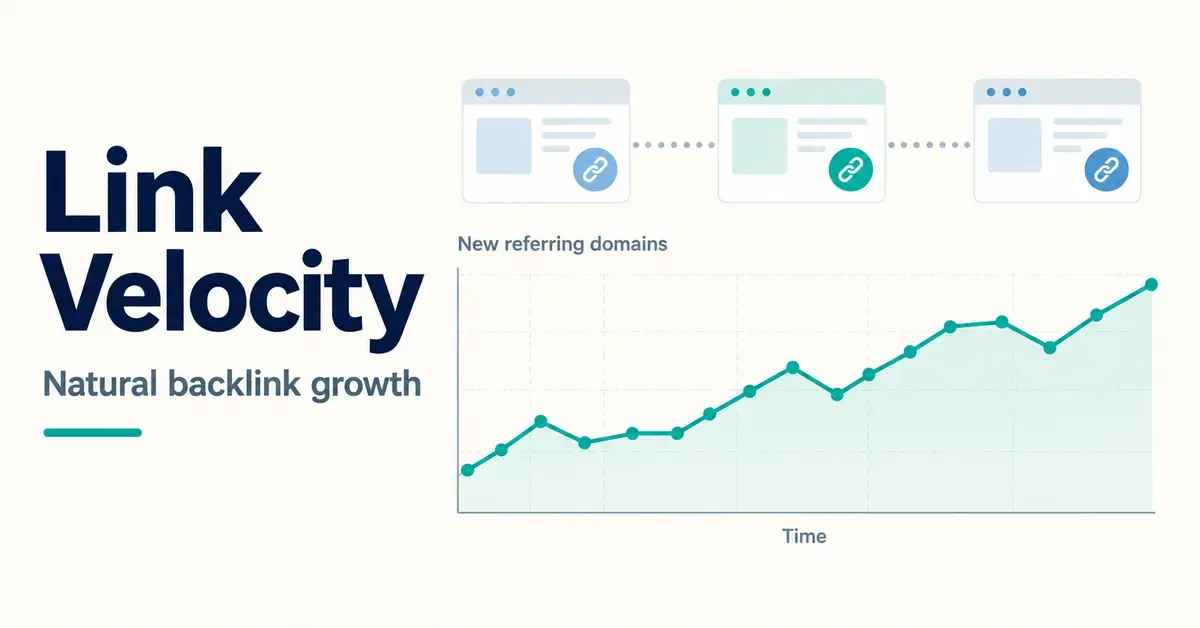
Link velocity is the rate at which your website gains (or loses) backlinks over a set period, usually measured as new referring domains per month. It is one of the most misunderstood ideas in search engine optimization (SEO). Some marketers treat it as a hard ranking factor that triggers automatic penalties, while Google’s own representatives have called the term “made-up.” This guide explains what the metric actually measures, what a natural backlink growth rate looks like, where the penalty myth came from, and how to monitor your own profile without chasing a number that may not matter.
What is link velocity?
Put simply, it is the speed at which a website or page acquires backlinks over time. A backlink is simply a link from one website to another, and this metric tracks how quickly those links accumulate. Most SEO tools express it as new referring domains per month — the count of unique websites linking to you — because that is harder to inflate than the raw total of individual links. If you want a refresher on the underlying concept, start with our plain-English guide to what backlinks are.
The term covers both the speed and the pattern of acquisition. A site can gain the same number of links in a smooth upward curve or in one overnight burst, and those two shapes tell very different stories about how the links were earned.
Key Points
- Definition: the rate a site gains or loses backlinks, usually measured as new referring domains per month.
- Not an official signal: Google does not recognise “link velocity”; Gary Illyes called it a “made-up term” and John Mueller stresses link quality over speed.
- Pattern beats pace: Spikes are only risky when paired with low-quality, irrelevant or over-optimised links — not when growth is simply fast.
- Natural looks like: steady-but-uneven growth, diverse relevant sources, varied anchors, and jumps that match a real cause such as viral content or PR.
- Measure the trend: track referring domains over several months with a backlink tool; one month in isolation means little.
How do you calculate your backlink growth rate?
The basic calculation compares your referring-domain count between two points in time. In plain terms:
- Monthly link velocity = (referring domains at end of month) − (referring domains at start of month).
- Average velocity = (domains gained over several months) ÷ (number of months), which smooths out one-off bumps.
For example, if you had 180 referring domains on 1 September and 192 on 30 September, your September figure was 12 new referring domains. Measured over a quarter, three readings of 12, 9 and 15 give an average of roughly 12 per month — a steady, predictable pace. Most practitioners track referring domains rather than total backlinks, because a single news story syndicated across one network can add hundreds of links from just a handful of real sources.
Does Google use link velocity as a ranking factor?
Google does not officially recognise it as a ranking signal. This is the single most important thing to understand about the topic, because a great deal of SEO advice is built on the opposite assumption. Google’s Gary Illyes described “link velocity” as a “made-up term” in a public Q&A, and Search Advocate John Mueller has repeatedly said it is the quality and naturalness of links, not the speed at which they arrive, that determines whether they cause a problem.
Mueller’s position is roughly this: it is not so much a matter of how many links you get in a given period — if the links are unnatural or manipulative, they are problematic regardless of timing, and if they are genuinely earned, a fast pace is not something Google needs to act on. In other words, there is no public evidence of a dedicated “velocity” dial that demotes a site purely for growing quickly.
Where did the “too many links too fast” penalty myth come from?
The idea traces back to a Google patent titled Information Retrieval Based on Historical Data (US7346839B2), first filed in 2003. The patent notes that “a spiky rate of growth in the number of back links… may signal an attempt to spam,” and that the search engine could lower a document’s score in response. SEOs read that line and concluded that gaining links too fast causes a penalty.
Two caveats matter. First, a patent describes what a company could build, not what is definitely running in production today. Second, and more importantly, the passage distinguishes smooth, natural growth from spiky, synthetic patterns that play out over months — it is not describing a short-term count threshold that trips an alarm the moment you cross it. The practical takeaway is that unnatural patterns, not raw speed, are the concern.
What does a natural backlink growth rate look like?
A natural backlink growth rate looks like steady, slightly uneven growth that tracks your real-world activity. There is no universal “correct” number of links per month, because the right pace depends entirely on your site’s size, age, niche and publishing cadence. A brand-new local business and a national publisher should look nothing alike. Instead of a magic figure, look for these characteristics.
It is consistent but imperfect
Genuinely earned links arrive at an irregular but ongoing trickle — a few one month, a dozen the next — because real people discover and cite your content at their own pace. A perfectly flat line that suddenly jumps, then goes dead, looks more engineered than a slightly bumpy upward curve.
It comes from diverse, relevant sources
Natural profiles collect links from many different domains, link types and page contexts: editorial mentions, resource pages, directories, forums and so on. If every new link comes from the same handful of sites, the same footer, or the same unrelated niche, the pattern looks coordinated regardless of how fast or slow it is.
It matches a cause
Healthy spikes usually have an obvious trigger — a viral post, a research study, a product launch, or a press mention. When a jump in links lines up with something that actually happened, it reads as earned attention, not manipulation.
It scales with your content and promotion
If you publish and promote more, the pace of new links should rise accordingly. Growth that keeps climbing while your content output and outreach stay flat is one of the patterns that looks artificial over time.
When is a backlink spike a problem?
A spike is only a problem when it is paired with signals of manipulation, not when it is large on its own. A sudden surge from a viral article or a national news pickup is normal and often helps rankings. The same-sized surge becomes risky when it shows the fingerprints of paid or automated link schemes. The table below contrasts the two.
Comparison
| Signal | Natural / healthy spike | Unnatural / risky spike |
|---|---|---|
| Trigger | Viral post, PR, study, product launch | No real-world cause; links appear from nowhere |
| Source diversity | Many different, independent domains | Same network, footprint or link farm |
| Relevance | Sites related to your topic or industry | Unrelated or off-topic sites |
| Anchor text | Mixed: branded, URL, generic, partial-match | Repeated exact-match keyword anchors |
| Link quality | Editorial links from trusted pages | Low-authority, spun or paid-at-scale pages |
| Pattern over time | Spike, then continued steady growth | One burst, then silence — repeated |
The lesson is that velocity is a symptom, not a disease. Spammy links are penalised because they are spammy — low quality, irrelevant, over-optimised or bought at scale — and such campaigns simply happen to produce dramatic velocity curves. Focusing on the curve alone misses the point; focus on the quality of each link instead. Our guide to backlink quality covers the signals that actually matter.
How to keep backlink growth natural
You keep the pace natural by earning links through genuine value and consistent promotion rather than by rationing or forcing them. A few practical habits:
- Publish and promote on a steady schedule. A regular content and outreach rhythm produces a naturally regular link curve without any artificial throttling.
- Prioritise relevance and authority over counts. One editorial link from a trusted site in your field is worth more than fifty from unrelated directories, and it keeps your profile looking organic.
- Vary your anchor text. A natural profile mixes branded, URL, generic and partial-match anchors; a flood of identical keyword-rich anchors is a classic manipulation signal. See our notes on anchor text optimization.
- Diversify sources. Earn links from a range of domains, formats and contexts rather than repeatedly from the same network.
- Do not stop and start. A one-off burst followed by total silence looks more suspicious than slower, continuous growth.
If you are considering shortcuts, read our honest assessment of whether buying backlinks is safe before you commit budget — paid link bursts are exactly the kind of pattern that pairs high velocity with low quality.
What are the most common mistakes with backlink growth?
The biggest mistake is treating the growth rate as a target to hit rather than an outcome to observe. Chasing a specific number distorts your strategy. Other frequent errors include:
- Deliberately slowing down good link building out of fear of a penalty that is not supported by evidence, and losing momentum in the process.
- Buying large link packages that all land at once from the same low-quality network, producing both a spike and a toxic profile.
- Judging velocity by total backlinks instead of referring domains, so a single syndicated mention looks like explosive growth.
- Ignoring negative SEO. A competitor can point a burst of spammy links at your site; the fix is not to panic over the spike but to review the links and, if needed, disavow toxic backlinks.
- Reading one month in isolation. Velocity only means something as a trend across several months, not as a single data point.
How do you monitor new backlinks over time?
You monitor it with a backlink analysis tool that charts referring domains over time. Platforms such as Ahrefs, Semrush and Moz all plot referring pages and referring domains month by month, so you can see the shape of your growth and compare it against competitors to learn what “normal” looks like in your niche. Our roundup of the best backlink tools compares the main options.
Reviewing that data regularly as part of a wider backlink audit is more useful than watching velocity in isolation. An audit checks the quality, relevance and anchor profile behind the numbers — which is where the real risk, or the real opportunity, actually sits.
Who should watch their backlink growth?
The metric is most useful as a diagnostic for site owners, agencies and SEO specialists who want an early warning that something unusual is happening to their backlink profile. A sudden unexplained spike can flag a negative-SEO attack, a scraper copying your content, or an over-aggressive supplier. A long, flat line can flag that your content and outreach have stalled. For everyone else, the headline is simpler: build genuinely useful content, earn links honestly, and let the velocity curve take care of itself.
Sources
Frequently Asked Questions (FAQ)
Is there an ideal number of backlinks to gain per month?
No. There is no universal target, because the right pace depends on your site’s size, age, niche and how much content you publish and promote. A healthy rate for a national publisher would look abnormal for a new local business. Track your own trend and your competitors’ rather than aiming for a fixed figure.
Will Google penalise my site for gaining backlinks too fast?
There is no public evidence of a penalty based on speed alone. Google representatives have said it is the quality and naturalness of links that matters, not the rate. Problems arise when fast growth comes from manipulative, low-quality or paid links — the links are the issue, not the velocity.
Can a sudden spike in backlinks ever be good?
Yes. A spike caused by viral content, a research study, a product launch or a news mention is genuine earned attention and can help rankings. A spike only looks risky when it is paired with low source diversity, irrelevant sites, spun content or identical over-optimised anchor text.
Should I count total backlinks or referring domains?
Referring domains are the better measure. The total backlink count can balloon from a single syndicated article appearing on many pages of one network, which overstates real growth. Counting unique linking domains gives a truer picture of how many independent sources are citing you.
What should I do if a competitor points spammy links at my site?
Do not panic over the spike itself. Review the new links in a backlink tool, and if they are clearly toxic and you cannot have them removed, use Google’s disavow tool to tell Google to ignore them. Most of the time, Google already discounts obvious spam automatically.
