Anchor text optimization is the practice of choosing the clickable words in a link — and managing how often each style of wording appears across your whole backlink profile — so that links read naturally and help both readers and search engines understand the page being linked to. Get it right and your links look earned; lean too hard on the same keyword and you send exactly the signal Google’s spam systems were built to catch. This guide explains the main anchor text types, the ratios experienced link builders aim for, and how to avoid the over-optimization that can put a site under review. It is written as risk-avoidance for anyone buying or building links.
Key Takeaways
- Anchor text optimization means managing the wording of your links so they look natural — not stuffing keywords.
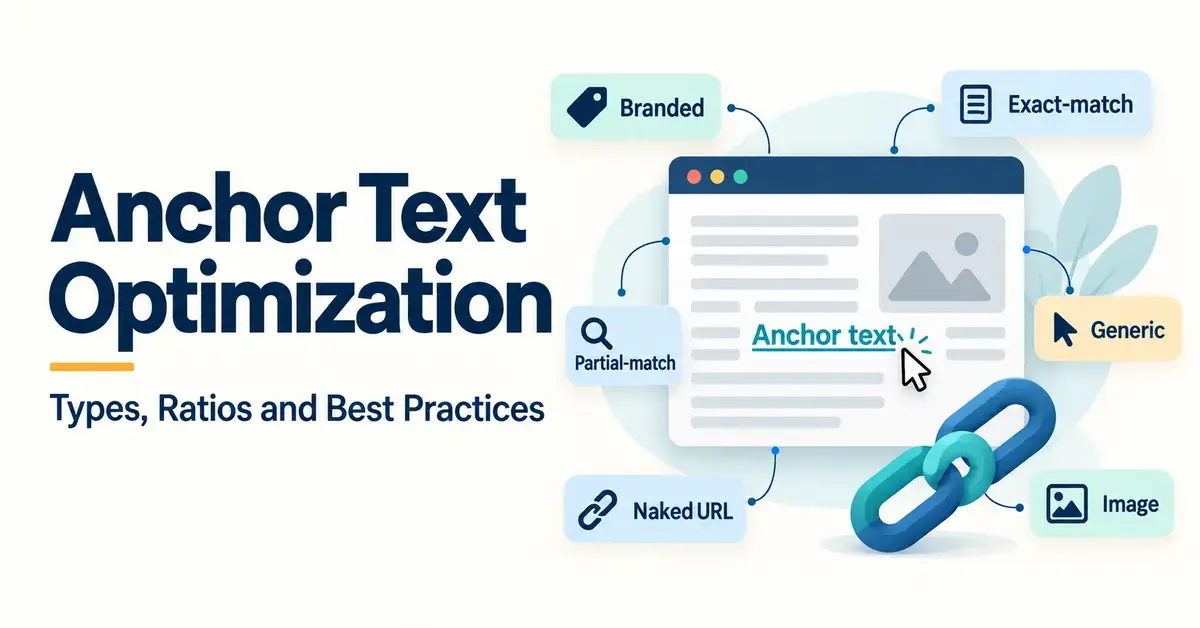
- The main anchor types are branded, exact-match, partial-match, generic, naked URL and image anchors.
- Exact-match anchors carry the most risk; keep them to roughly 1–5% of a profile.
- Over-reliance on exact-match anchors (a common red flag is above ~40%) can trigger review or devaluation, a pattern targeted since Google’s Penguin update in 2012.
- Branded and naked-URL anchors are the safest and should dominate — especially the links pointing to your homepage.
- Ratios are guidelines, not Google rules: natural variety beats a perfectly balanced spreadsheet.
What is anchor text optimization?
Anchor text is the visible, clickable text of a hyperlink — usually shown underlined and in a different colour. In the sentence “read our guide to link building,” the words “guide to link building” are the anchor text. Optimization means deliberately varying that wording across the many links pointing to a site so the overall mix looks like something people wrote by hand, not something engineered to rank.
It is important to separate optimization from keyword stuffing. Optimizing anchor text does not mean cramming your target keyword into as many links as possible — that is the opposite of the goal. It means keeping a natural balance in which your brand name, descriptive phrases, and plain URLs do most of the work, and the exact keyword you want to rank for appears only occasionally. Anchor text optimization applies both to links you earn or build from other sites and to the internal links between your own pages.
Does anchor text still matter for SEO?
Yes, but less than many link buyers assume. Anchor text is one of the signals Google uses to work out what a linked page is about, and Google’s own documentation encourages descriptive, natural link text. At the same time, Ahrefs analysed 384,614 pages across 19,840 keywords and found only a weak correlation (a Spearman value of roughly 0.14) between exact-match anchor text and higher rankings. The practical reading: anchors help search engines understand context, but chasing a specific keyword ratio delivers little upside and plenty of risk.
That is why modern anchor text optimization is mostly a defensive exercise. You are not trying to “win” with keyword anchors; you are trying to avoid an unnatural pattern that looks manipulative. This matters most for people who pay for links, because purchased links are where you actually control the anchor text — and where over-optimization is easiest to create by accident.
The main types of anchor text
There are a handful of anchor text types, and a healthy profile uses all of them. Understanding each one is the foundation of any anchor strategy, so here is what each type is with a plain example.
Branded anchors
A branded anchor is your brand or company name, such as “Backlinks Canada.” These are the safest anchors because real people naturally link to a site by its name. Branded anchors should usually be the single largest slice of a profile.
Exact-match anchors
An exact-match anchor is the precise keyword you want the page to rank for — for example, linking with the words “anchor text optimization.” These carry the most ranking intent and, for that reason, the most risk. Too many exact-match anchors is the classic signature of a manipulated profile.
Partial-match anchors
A partial-match anchor contains your keyword surrounded by other words, such as “this practical guide to anchor text.” It gives search engines context without looking forced, which makes it a safe, useful middle ground.
Generic anchors
Generic anchors are non-descriptive phrases like “click here,” “read more,” or “this website.” They add no keyword signal, but they appear constantly in real writing, so a natural profile always contains some.
Naked URL anchors
A naked URL is the raw web address used as the link text, such as “backlinkscanada.ca.” These are extremely common in citations, references, and forum posts, and they help a profile look organic.
Image anchors
When an image is linked, search engines treat its alt text (the text description of the image) as the anchor. Writing clear, honest alt text is the way to “optimize” an image link. For a broader view of how these link formats fit together, see our overview of the different types of backlinks.
Why is over-optimized anchor text risky?
Over-optimized anchor text is a profile in which too many links use the same keyword-rich wording, and it is risky because it is the exact pattern Google’s link systems are designed to catch. When Google launched the Penguin update on 24 April 2012, one of its main targets was sites that had built large numbers of links using repetitive, keyword-stuffed anchor text to inflate rankings. Penguin later became part of Google’s core algorithm and now works more granularly, often devaluing manipulative links rather than only penalising whole sites.
Google is explicit about this in its spam policies, which list “links with optimized anchor text in articles, guest posts, or press releases distributed on other sites” as a form of link spam. The word that matters is optimized: descriptive links are fine, but links engineered with money-keyword anchors to pass ranking credit are treated as manipulation.
Among link builders, a common rule of thumb is that once exact-match anchors climb past roughly 40% of a profile, the pattern looks deliberate enough to invite scrutiny. That 40% figure is a community heuristic, not an official Google threshold — Google has never published a number — but it is a useful warning line. The safe direction of travel is the opposite: keep exact-match anchors rare and let branded, naked, and partial anchors dominate.
What are safe anchor text ratios?
A safe anchor text ratio keeps branded and naked-URL anchors dominant, uses partial-match anchors for descriptive context, and holds exact-match anchors to a small single-digit share. The table below shows a widely used starting framework for a page’s external backlinks. Treat it as a guardrail, not a target to hit precisely.
Safe Anchor Text Ratios
| Anchor type | Example | Typical safe share | Risk level |
|---|---|---|---|
| Branded | Backlinks Canada | 30–50% | Lowest |
| Partial-match | this guide to anchor text | 15–25% | Low |
| Generic | click here, read more | 10–20% | Low |
| Naked URL | backlinkscanada.ca | 5–15% | Low |
| Exact-match | anchor text optimization | 1–5% | Highest |
| Illustrative external-backlink guardrails, not fixed targets. Homepages should skew even more heavily to branded and naked anchors; inner pages can carry a slightly higher exact-match share. | |||
Two honest caveats belong with any ratio chart. First, these percentages are industry heuristics, not Google rules — Ahrefs, whose own data underpins much of this discussion, explicitly recommends against trying to engineer anchor ratios at all, because natural link building rarely lets you control anchors anyway. Second, real profiles are messy: a genuinely organic page will show odd, uneven numbers, and that unevenness is itself a trust signal. The goal is to stay in a natural-looking range and avoid concentration, not to make a spreadsheet balance to the decimal.
Homepage vs internal-page anchor ratios
Homepages and internal pages should not carry the same anchor mix, because people link to them for different reasons. A homepage is usually cited by name, so its profile should be overwhelmingly branded and naked-URL anchors — often 80% or more — with only a token amount of exact-match wording (a rule of thumb is 5% or less). When keyword anchors dominate a homepage, the profile looks built rather than earned.
Internal pages — blog posts, product pages, and service pages — earn more descriptive links because they are referenced for specific information. They can support a higher share of partial-match and even exact-match anchors than a homepage, but the exact-match slice should still stay limited (commonly capped around 10%). In short: send brand and URL anchors to the homepage, and reserve your descriptive, keyword-bearing anchors for the deeper pages that actually target those keywords. Anchor decisions also depend on where the link sits — our guide to backlink quality covers how source relevance and authority interact with anchor choice.
How to optimize anchor text safely
The safest approach is to prioritise variety and relevance over any single keyword. Work through these practices before placing or buying links:
- Lead with branded and naked anchors. Make your brand name and plain URLs the backbone of the profile, especially for the homepage.
- Ration your exact-match anchors. Use them sparingly — a small single-digit share of the profile — and only on the page that genuinely targets that keyword.
- Let context write the anchor. Choose wording that fits the surrounding sentence naturally; a good anchor makes sense to a reader who never clicks it.
- Match the anchor to the destination. The link text should describe the page it points to, not a keyword you wish that page ranked for.
- Vary wording across a campaign. If you are placing several links, never reuse the same exact phrase on every one; small variations look far more natural.
- Audit before you scale. Check your existing anchor mix before ordering a batch of new links, so you correct imbalances instead of amplifying them.
Common anchor text mistakes to avoid
Most anchor problems come from a few repeated errors, and knowing them helps you avoid an unnatural profile:
- Too many identical exact-match anchors. The single biggest red flag — dozens of links all reading the same money keyword.
- Keyword-stuffed anchors. Cramming several keywords into one link (“best cheap fast anchor text service Canada”) looks manipulative and reads badly.
- Ignoring the homepage-vs-inner-page difference. Pointing keyword anchors at the homepage is a classic over-optimization pattern.
- Buying links with fixed anchor text. Ordering identical anchors in bulk creates the exact footprint Google looks for.
- Anchor-destination mismatch. Using an anchor that promises one thing while the page delivers another hurts trust and can waste the link.
- Chasing a perfect ratio. Micro-managing percentages produces suspiciously tidy profiles; real ones are uneven.
How to audit your anchor text profile
An anchor audit tells you whether your profile is drifting toward over-optimization before it becomes a problem. The process is straightforward: export the full list of links pointing to a page or domain using a backlink tool, categorise each anchor into one of the types above, and calculate the percentage each type represents. Then compare those percentages against the safe ranges and check the homepage separately from your inner pages.
Look for two warning signs in particular: a single exact-match phrase that appears far more often than any other anchor, and an exact-match share that is creeping toward that 40% red-flag zone. If you find either, the fix is not to remove good links — it is to dilute the pattern by earning or building more branded, naked, and partial-match anchors going forward, and to stop ordering the over-used phrase. Re-run the audit periodically, because a profile shifts every time new links appear.
Who should pay closest attention?
Anyone who controls the anchor text of the links pointing to their site should treat this as a priority — and that mostly means people buying or actively building links. When links are earned organically, the wording is out of your hands and tends to average out naturally. When you pay for placements or run outreach campaigns, you choose the anchors, which is precisely where over-optimization is manufactured. If that describes your situation, the ratios and mistakes above are less “nice to know” and more a checklist for protecting the money you are spending.
Sources
Vanliga frågor (FAQ)
What is a good anchor text ratio?
A widely used starting point is roughly 30–50% branded, 15–25% partial-match, 10–20% generic, 5–15% naked URL, and only 1–5% exact-match anchors. Treat these as guardrails rather than exact targets, since genuinely natural profiles are always uneven.
How much exact-match anchor text is too much?
There is no official Google number, but link builders commonly treat an exact-match share above about 40% as a clear red flag. Keeping exact-match anchors to a small single-digit percentage of a page’s profile is the safe, defensive choice.
Does anchor text optimization apply to internal links too?
Yes. Internal links between your own pages use anchor text that helps search engines understand each page, so descriptive, relevant wording helps. Because you fully control internal anchors, avoid using the identical exact-match phrase on every internal link to the same page.
Can I fix an over-optimized anchor profile?
Usually, yes. Rather than deleting good links, dilute the pattern by building more branded, naked-URL, and partial-match anchors over time and stop ordering the over-used phrase. Regular audits let you correct the balance before it becomes damaging.
Does anchor text still affect rankings?
It remains one of the signals search engines use to understand a linked page, but its direct ranking influence is modest — large studies show only a weak correlation between exact-match anchors and higher rankings. That is why the sensible focus today is avoiding manipulation rather than chasing keyword anchors.
