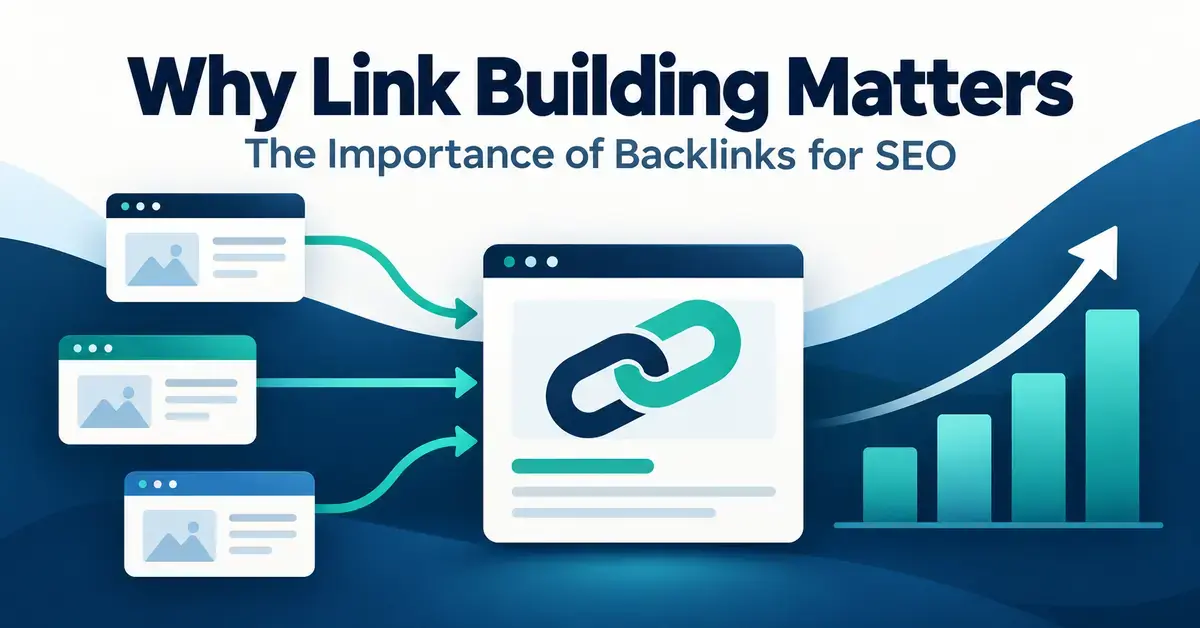
Link building is the practice of earning hyperlinks from other websites back to your own, and it remains one of the most dependable ways to grow visibility in search. This guide explains why link building matters — not as a vague “best practice,” but through the specific, measurable benefits that backlinks deliver: stronger rankings, referral traffic, wider brand reach, better conversions and lasting industry relationships. Every benefit below is tied to published research so you can weigh the evidence, not just the claims.
Key Takeaways
- Link building = earning votes of trust. Search engines treat a backlink from another site as a signal that your page is credible.
- Rankings: Backlinko’s study of 11.8M results found the No.1 result averages 3.8x more backlinks — and about 3x more referring domains — than positions 2–10.
- Low bar to stand out: Ahrefs finds roughly 66% of pages have zero backlinks, so a few quality links can make a real difference.
- Beyond rankings: backlinks also deliver referral traffic, brand reach, conversions and industry relationships.
- Quality over quantity: one link from a relevant, high-authority site outweighs hundreds of weak ones.
- Evergreen: the value of good links compounds over months and years.
What is link building, and why does it matter?
A backlink is simply a link on one website that points to a page on another website. Link building is the process of earning those backlinks on purpose. It matters because search engines treat links as signals of trust: when a reputable site links to your page, it is effectively vouching for it. Google’s original ranking model, PageRank, was built on exactly this idea — that a link works like a vote of confidence from one page to another.
Decades later, links are still central. They help search engines discover new pages, understand how sites relate to one another, and judge which pages deserve to rank. If you are new to the topic, our Link Building Basics hub covers the core concepts in more depth. The sections below focus on the practical payoff: what earning good links actually does for a website.
How do backlinks improve search rankings?
Backlinks are among the strongest signals Google uses to decide which pages rank, and the correlation is well documented. In its analysis of 11.8 million Google search results, Backlinko found that the No. 1 result had, on average, 3.8x more backlinks than the pages ranking in positions 2 through 10. The same study reported that the top result also had roughly three times more referring domains (unique websites linking to it) than the pages below it — the metric that showed the strongest correlation with rankings in the entire dataset.
Two takeaways matter here. First, diversity beats volume: links from many different domains carry more weight than many links from a single domain. Second, the bar is low for most pages. Ahrefs, which crawls roughly a billion pages, has repeatedly found that about 66% of pages have no backlinks at all. If most competing content has zero links, earning even a handful of quality backlinks can be the difference between page one and invisibility. Tools that measure these signals are covered in our backlink analysis tools section.
How do backlinks drive referral traffic?
Beyond rankings, backlinks send visitors directly. When a relevant, well-trafficked page links to yours, some of its readers click through — that is referral traffic, and it arrives whether or not your page ranks in Google. A single link in a widely read article or resource list can deliver a steady stream of visitors for years.
Referral traffic is often higher intent than cold search traffic because the reader arrives already interested in the surrounding topic. A person who clicks a link inside a trusted buying guide, for example, is further along in their decision than someone who typed a broad query. That context is why placement matters: a link buried in a footer behaves very differently from one woven into the body of a relevant article.
How does link building expand brand reach and awareness?
Link building puts your brand in front of new audiences, even when nobody clicks. This is the core benefit of digital PR — earning coverage and links from journalists, bloggers and industry publications. According to BuzzStream’s State of Digital PR research, 48.6% of professionals named digital PR the most effective link-building tactic for 2025, and about 85% of digital PR campaigns produce measurable results within three to six months. On average, a single strong campaign earned links from roughly 42 unique domains.
Each of those placements is a chance for a new audience to encounter your name in an editorial, credible context. Over time, repeated exposure across authoritative sites builds recognition and trust that no single advertisement delivers — and, unlike paid ads, a good editorial link keeps working long after it is published.
Can backlinks improve conversions and revenue?
Yes, mostly indirectly — backlinks improve conversions by bringing more qualified visitors to your site and by borrowing the trust of the sites that link to you. When a respected publication or a relevant niche site points to your page, some of that credibility transfers. Visitors who arrive through a source they already trust tend to be more receptive than strangers who land cold.
The mechanics are straightforward: better rankings and referral links increase qualified traffic; higher trust improves the odds that traffic converts. Backlinks do not replace a strong offer, clear page and good user experience, but they widen the top of the funnel with the kind of visitor who is more likely to sign up, enquire or buy.
How does link building build relationships?
Earning links is fundamentally about people, not just algorithms. The outreach behind a good backlink — a pitch to an editor, a guest article for a peer’s blog, a data study a journalist wants to cite — creates genuine professional relationships. Those relationships compound: an editor who links to you once is far more likely to do so again, and collaborators often become sources of referrals, partnerships and co-marketing well beyond SEO.
This is why sustainable link building looks more like relationship building than list building. If you want structured approaches to earning these links, our link building strategies category walks through the main methods.
Why does quality matter more than quantity?
One link from a high-authority, topically relevant site can outweigh hundreds of links from low-quality or unrelated pages. The research bears this out: because referring-domain diversity and source authority correlate most strongly with rankings, a small number of excellent links usually beats a large pile of weak ones. Low-quality link schemes also carry real risk — Google’s spam policies can devalue or penalise sites that build manipulative links.
The table below summarises how a quality-first approach differs from a quantity-first one.
Backlink Quality vs. Quantity
| Factor | Quality-first approach | Quantity-first approach |
|---|---|---|
| Source authority | Trusted, established sites | Any site that will link |
| Relevance | Topically related to your niche | Often unrelated |
| Referring domains | Many different domains | Many links, few domains |
| Placement | Editorial, within content | Footers, directories, comments |
| Anchor text | Natural and varied | Repetitive, keyword-stuffed |
| SEO effect | Durable ranking and traffic gains | Little value; possible penalty risk |
What are the most common link building mistakes?
The fastest way to waste a link building budget is to chase the wrong signals. The most common mistakes include:
- Buying cheap, spammy links. Bulk links from link farms or private blog networks add risk, not authority, and can trigger devaluation.
- Ignoring relevance. A link from an unrelated site does little; relevance to your topic is a core part of a link’s value.
- Over-optimised anchor text. Repeating the exact keyword in every anchor looks manipulative; natural, varied anchors are safer.
- Prioritising volume over domains. Many links from one site count for far less than links from many different sites.
- Skipping the linkable asset. If your pages offer nothing worth citing — original data, tools, clear guides — outreach has nothing to earn links for.
Who benefits most from link building?
Almost every website benefits, but the impact is largest for newer sites and those in competitive niches. A new domain with few links has the most to gain, because it is starting from the zero-backlink baseline most pages sit at. Businesses in crowded markets need links to stand out against established competitors, and local businesses benefit from links tied to their region — a focus of our Canadian SEO and local link building resources.
The common thread is that link building rewards patience. It is an evergreen investment: the rankings, traffic, reach and relationships it produces keep paying off long after the work is done, which is exactly why it remains a cornerstone of durable SEO.
Sources
Frequently Asked Questions (FAQ)
Why are backlinks important for SEO?
Backlinks act as signals of trust. Search engines treat a link from another site as a vote of confidence, and studies consistently show that pages with more high-quality referring domains tend to rank higher, attract more referral traffic and reach wider audiences.
How many backlinks do I need to rank?
There is no fixed number. Because about two-thirds of pages have no backlinks at all, even a few links from relevant, authoritative sites can lift a page. The right amount depends on how competitive your keyword is and how strong your competitors’ link profiles are.
Are more backlinks always better?
No. Quality and diversity matter more than raw volume. One link from a trusted, relevant site typically outperforms hundreds from low-quality or unrelated pages, and manipulative bulk links can actually harm a site under Google’s spam policies.
Do backlinks help with anything besides rankings?
Yes. Backlinks drive referral traffic, expand brand reach through editorial coverage, support conversions by bringing qualified and trusting visitors, and build professional relationships that lead to further links and partnerships.
How long does link building take to show results?
It varies, but it is a medium-term investment. Digital PR research found that roughly 85% of campaigns produce measurable results within three to six months, and the rankings and traffic gains often continue building well beyond that.
