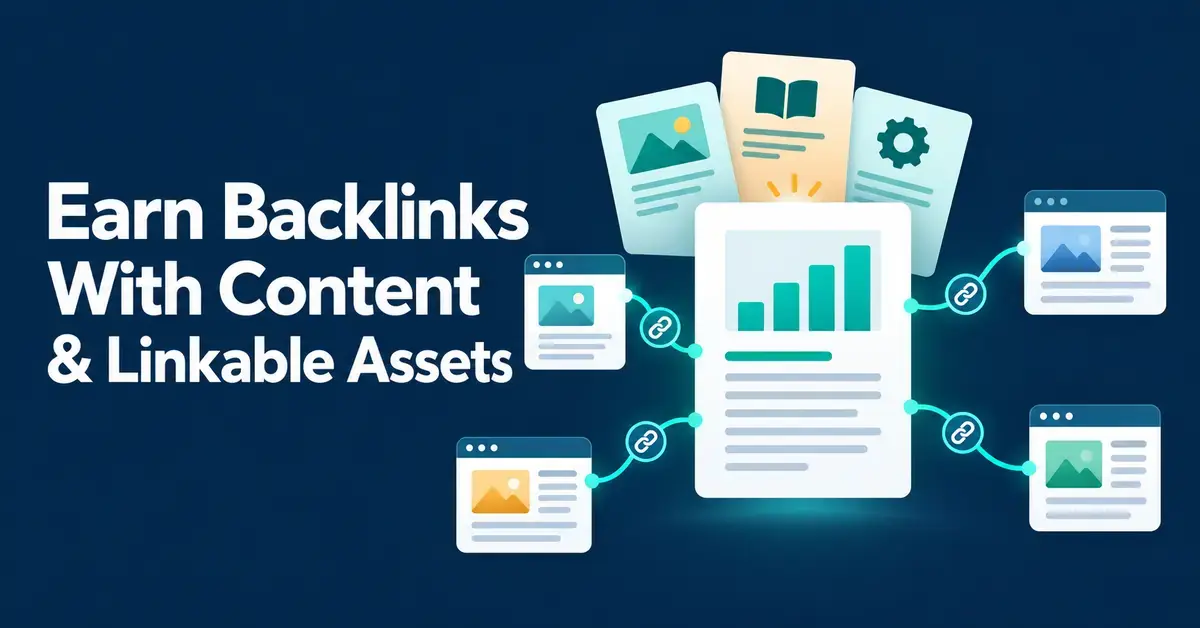
Earning backlinks means getting other websites to link to yours because your content genuinely deserves it—not because you paid for the link, swapped for it, or placed it yourself. The most dependable way to do that is to publish linkable assets: pages so useful, original or authoritative that writers, journalists and site owners choose to cite them on their own. This guide explains how to create content that earns links, how the skyscraper technique fits in (and where it falls short), how to promote an asset so people actually find it, and why earning links is a stronger long-term bet than buying them.
Key Takeaways
- Earn, don’t buy: the most durable backlinks come from content others choose to cite, not from paid placements that break Google’s rules.
- Linkable assets are the engine: original data and studies, free tools, definitive guides, visuals and templates earn the most links.
- Original data wins: statistics must be cited, so research-led content earns links from many domains at once.
- The skyscraper technique still works—within limits: it needs genuinely better content and personalised outreach, not just a longer page.
- Promotion is half the job: outreach, digital PR and mention reclamation turn a good asset into actual links.
- Most pages have no links: roughly two-thirds of pages earn none, so a single strong asset can set you apart.
What does it mean to earn a backlink?
Earning a backlink means another site links to your page voluntarily because it adds value for their readers. That is the distinction Google draws between links you attract and links you manufacture. Search engines treat a backlink as a signal of trust: when a respected site references yours, it is effectively vouching for your content. When that reference is freely given, the signal is genuine; when it is bought or forced, it breaks Google’s guidelines and carries risk.
It helps to separate three approaches that are often blurred together:
- Earned links — someone cites your content without being asked or paid. This is the gold standard and the focus of this guide.
- Built links — you actively pursue placements you have a legitimate claim to, such as pitching a data study to a journalist or reclaiming an unlinked mention. Outreach is involved, but the link is still given on merit.
- Bought links — you pay for placement. This violates Google’s link spam policies and is the riskiest path.
Earning and building sit on the same side of the line: both depend on something worth linking to. Buying does not. If you want the full picture of the tactics in this space, the site’s link building strategies hub collects related guides.
Why does earning backlinks matter so much?
Earning backlinks matters because most content never earns any, and that gap is exactly where opportunity lives. Ahrefs’ analysis of the web has repeatedly found that the majority of pages have no backlinks at all—roughly two-thirds by their count—and that around 96.55% of pages get no organic search traffic from Google. Those two facts are connected: without links and the authority they carry, most pages stay invisible.
Links remain one of Google’s core ranking inputs, but the bar has risen. Google’s emphasis on E-E-A-T (Experience, Expertise, Authoritativeness and Trustworthiness) means a pile of low-quality links no longer moves the needle the way it once did. A handful of editorial links from relevant, trusted sites now outperforms hundreds of scraped or paid ones. Earning links is therefore not just safer than buying them—it is increasingly the only method that reliably works. If you are still mapping out the fundamentals, the link building basics category covers the groundwork.
What is a linkable asset?
A linkable asset is a piece of content created specifically to attract links, because it gives other publishers something they cannot easily produce themselves. A normal blog post informs a reader; a linkable asset becomes a reference that other writers need to point to. The test is simple: would a journalist, blogger or researcher cite this to support a point they are making? If yes, it is a linkable asset. Below are the formats that consistently earn the most links.
Original research and data studies
Original research is the single most link-worthy format because data must be cited. When you survey an audience, analyse a dataset, or publish a proprietary benchmark, every writer who references those numbers has to credit the source—you. This is why data-led campaigns dominate digital PR: industry benchmarks put them at roughly 42% of all digital-PR activity, and a single strong study can earn links from dozens of referring domains. You do not need a huge budget: a focused survey of a few hundred people in your niche, or an analysis of data you already hold, can be enough.
Free tools and calculators
A free tool earns links by solving a specific, repeatable problem. Calculators (mortgage, ROI, tax, unit conversions), generators, checkers and analysers get cited from resource pages, tutorials and roundups because they are genuinely useful to readers again and again. Tools take more effort to build than an article, but they keep earning links for years with little maintenance, which makes their long-term return high.
Definitive guides and reference content
A definitive guide earns links when it becomes the best single explanation of a topic. What separates a linkable guide from a forgettable one is not word count—it is original frameworks, first-hand examples, clear structure and genuine depth that make it the obvious page to cite when someone needs to explain the subject. Aim to be the resource people link to instead of writing their own explanation.
Visual assets and infographics
Visuals earn links by making complex information easy to share and embed. Infographics, original charts, maps and diagrams get picked up when they turn data or a process into something a reader can grasp at a glance. The key is that the visual must carry real information—a well-designed chart built on your own data combines two linkable formats at once.
Templates, checklists and free resources
Templates and checklists earn links by saving people work. A ready-to-use spreadsheet, a downloadable checklist, a policy template or a free dataset gives publishers a practical resource to recommend. These are often the fastest linkable assets to produce, which makes them a good starting point for a smaller site.
Linkable Asset Comparison
| Asset type | Typical effort | Link-earning potential | Best suited to |
|---|---|---|---|
| Original research / data study | High | Very high (data must be cited) | Digital PR, journalist outreach |
| Free tool or calculator | High | High and long-lasting | Resource pages, tutorials, roundups |
| Definitive guide | Medium to high | Medium to high | Becoming the reference on a topic |
| Infographic / visual | Medium | Medium (higher with original data) | Shareable explanations, embeds |
| Template / checklist | Low to medium | Medium | Fast wins for smaller sites |
How does the skyscraper technique work?
The skyscraper technique is a method for earning links by finding content that already attracts them, building something clearly better, and asking the sites that linked to the original to link to yours instead. It was popularised by Brian Dean of Backlinko, whose original case study reported that the approach helped double a site’s organic search traffic in about 14 days.
The three steps
- Find link-worthy content. Identify pages in your niche that have already earned lots of backlinks—these prove demand and give you a list of sites that link to the topic.
- Make something substantially better. Create a superior version: more current data, greater depth, clearer structure, better visuals, or genuine new information—not just a longer copy of what exists.
- Reach out to the right people. Contact the site owners who linked to the original piece and show them why your improved resource is worth linking to instead.
Where the skyscraper technique falls short
The skyscraper technique still works, but it is far less effective than it was a decade ago, and it is important to be realistic. As the tactic became widely copied, reply and placement rates fell sharply—many practitioners now report only low single-digit conversion from outreach to a live link. Expert opinion is split: in one Ahrefs poll a majority of SEOs said it can still work when executed well, yet in the industry’s State of Link Building report only a small minority rated it an effective tactic for the year.
The core limitation is that “make it longer” is not a strategy. If your improved page offers nothing a reader could not get elsewhere—no new data, no new insight—there is no reason to link to it, and mass, impersonal outreach makes it worse. Treat the skyscraper method as one way to package a genuine linkable asset, not as a shortcut that removes the need for one.
How do you promote an asset so it earns links?
Creating a great asset is only half the job; links come when the right people see it. Publishing and waiting rarely works. The promotion methods that consistently turn assets into links are:
- Targeted outreach. Build a short list of sites, writers and resource pages that cover your topic and send personalised, specific pitches—one clear reason your asset helps their audience beats a hundred generic emails.
- Digital PR. Pitch original data or a newsworthy angle to journalists. Data studies work so well here because reporters need citable figures; well-run campaigns regularly earn coverage from dozens of high-authority domains. This is the same discipline the site’s forthcoming digital PR guide covers in depth.
- Journalist request platforms. Respond to reporters actively looking for sources (through services that connect experts with journalists) and offer your data or expertise as a quotable source.
- Unlinked mention reclamation. Find places that already mention your brand or data without linking, and politely ask for the link to be added.
- Internal promotion. Link to the asset from your own relevant pages and share it with your audience so it gains the early traction that makes outreach easier.
Earning vs. buying links: which is the safer long game?
Earning links is the safer and more durable choice because it aligns with how search engines want links to work, while buying them fights against it. Paid links that pass ranking signals violate Google’s link spam policies and can trigger manual actions or algorithmic suppression—meaning money spent can end up costing rankings rather than raising them. Bought links also stop working the moment you stop paying, and they leave footprints that get riskier over time.
Earned links behave differently. Because they sit inside real editorial content on relevant sites, they tend to be more stable, they compound as the asset keeps attracting new citations, and they carry the trust signals Google actually rewards. The honest trade-off is speed: earning links takes longer up front and requires you to create something genuinely valuable. If you want to understand the compliance risks of the alternative, see the site’s buying backlinks and compliance resources. For most sites, the durable path is to invest in assets that keep earning links long after the work is done.
What are the most common mistakes?
Most failed link-earning efforts share the same avoidable errors. Watching for them saves months of wasted work.
- Building the asset, then hoping. Great content with no promotion earns almost nothing. Plan outreach before you publish.
- Mistaking length for value. A longer or prettier version of an existing page is not a reason to link. New data or new insight is.
- Generic, mass outreach. Impersonal blast emails get ignored and can damage your reputation. Fewer, relevant, personalised pitches win more links.
- Choosing topics nobody links to. Confirm that a topic already attracts links before you invest in it; not every subject is link-worthy.
- Ignoring relevance and authority. A handful of links from trusted, on-topic sites is worth more than a flood of unrelated ones.
- Letting assets go stale. Data studies and guides lose their pull as they age. Refresh the numbers and re-promote to keep links coming.
Who should focus on earning backlinks?
Earning backlinks suits any site that can offer real expertise, data or utility—which is most legitimate businesses, publishers and creators. It is especially valuable for sites in competitive niches where paid links are risky and where trust matters, and for smaller or newer sites that cannot outspend larger competitors but can out-teach or out-research them. If your only plan is to produce thin content quickly, earning links will feel slow; if you can commit to making one genuinely useful thing and promoting it well, it is the highest-return strategy available.
A note on results
This article is educational and does not guarantee specific rankings, traffic or link outcomes. Search results depend on many factors outside any single tactic, and Google’s systems and guidelines change over time. Follow official search guidance, avoid schemes that manipulate links, and treat the figures here as benchmarks from cited studies rather than promises.
Sources
Frequently Asked Questions (FAQ)
How long does it take to earn backlinks?
It varies, but earning links is a matter of weeks to months, not days. A strong data study promoted with active outreach can earn links within days of coverage, while a guide or tool may build links gradually over months and years as more people discover and cite it. Earning links is slower than buying them, which is part of why it is more durable.
How many backlinks do I need to rank?
There is no fixed number; relevance and authority matter more than volume. A few editorial links from trusted, on-topic sites can outrank a page with far more low-quality links. The right target depends on how competitive your keyword is—study the pages already ranking to gauge what it takes.
Does the skyscraper technique still work in 2026?
It can, but only when your improved content offers something genuinely new and your outreach is personalised. Reply and placement rates have dropped sharply as the tactic became common, and simply making a page longer no longer earns links. Use it to package a real linkable asset, not as a standalone shortcut.
What is the difference between earning and building links?
Earned links are given entirely voluntarily, with no prompting from you; built links are ones you actively pursue through legitimate outreach, such as pitching a study or reclaiming an unlinked mention. Both rely on genuine merit and both are acceptable—unlike buying links, which breaks Google’s guidelines.
Are free tools better linkable assets than articles?
Free tools often earn links for longer because they solve a repeatable problem and get cited from resource pages year after year, but they cost more to build. Articles, guides and data studies can earn links faster and at lower cost. The best approach is to match the format to your resources and to what your niche actually links to.
