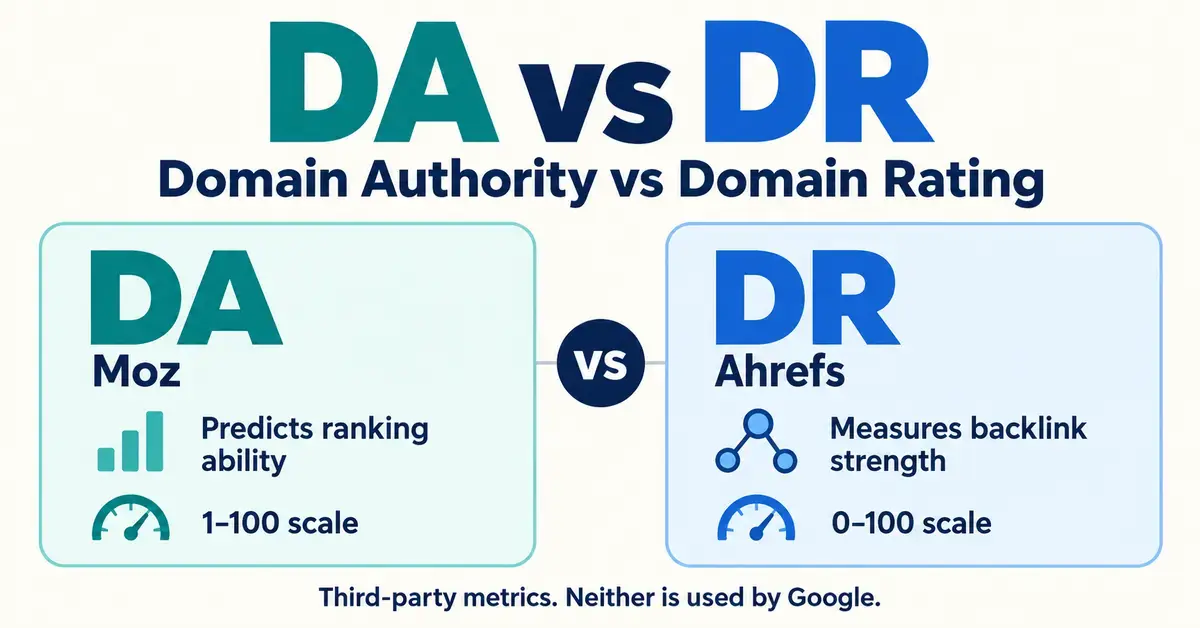
Domain Authority (DA) and Domain Rating (DR) are the two most-quoted numbers in link building, yet both are invented by SEO software companies — Moz and Ahrefs — and neither is used by Google. If you have ever been told a website is “DA 40” or “DR 65” and wondered what that actually means, this guide breaks it down. You will learn what each score measures, how it is calculated, why the two track each other so closely, what counts as a “good” score, and how to use both without letting a single third-party number drive your strategy.
Key Points
- DA (Moz) predicts ranking ability on a 1–100 scale using machine learning; DR (Ahrefs) measures raw backlink strength on a 0–100 scale.
- Both are third-party metrics — Google does not use either one and has no website-authority score of its own.
- DA and DR correlate at about 0.89 with each other, but only about 0.16 and 0.14 with actual Google rankings.
- Both scales are logarithmic: gains get much harder near the top.
- A “good” score is relative — benchmark against the sites already ranking for your keywords, not a fixed number.
The short answer: DA and DR in one minute
DA and DR are both third-party estimates of how strong a website’s backlink profile is, scored from roughly 0 to 100, where higher is stronger. Domain Authority is Moz’s metric and Domain Rating is Ahrefs’ metric. The core difference is what each one is trying to do: Domain Rating measures the raw strength of your backlink profile, while Domain Authority uses machine learning to predict how likely your site is to rank in Google. Both are useful for comparison and screening, but neither is a Google ranking factor and neither should be treated as a grade from a search engine.
What is Domain Authority (DA)?
Domain Authority is a score created by Moz that predicts how likely a website is to rank in search engine results, expressed on a scale from 1 to 100. The higher the score, the stronger Moz’s model thinks the site’s ranking potential is. Because it is a prediction rather than a raw count, DA is best read as a comparative signal — it is most meaningful when you compare one site against another in the same market, not as an absolute measure of quality.
How Moz calculates DA
Moz builds DA from its own web index (Link Explorer) and runs the data through a machine-learning model trained against real search results. The model looks for the mix of link-based signals that best correlates with sites actually appearing in Google’s rankings, then outputs a single 1–100 number. The signals that feed it include:
- Linking root domains — the number of unique websites that link to you, which is generally weighted more heavily than the raw link count.
- Total number of backlinks pointing at the domain.
- The quality and authority of those linking domains.
- Moz’s own trust and spam signals, which discount links from low-quality or spammy sources.
The scale is logarithmic, which is the single most misunderstood thing about DA. Moving from DA 20 to DA 30 is comparatively easy; moving from DA 70 to DA 80 is enormously harder and requires far more high-quality links. A five-point gain at the top of the scale is worth much more work than a five-point gain at the bottom.
How often DA updates — and why it can move on its own
Moz recalculates DA across its whole index on a rolling basis, typically every few weeks. Because the score is relative to the rest of the web, your DA can change even if your own backlinks have not. If Moz crawls more of the web, or the average quality of linking across the internet shifts, the entire curve moves — so a site that read DA 45 one month might read DA 43 the next without losing a single link. Treat month-to-month wobble of a point or two as noise, not a trend.
What is Domain Rating (DR)?
Domain Rating is Ahrefs’ metric for the strength of a website’s backlink profile, on a scale from 0 to 100. Unlike DA, DR does not try to predict rankings or fold in spam and content signals — it is a more direct, narrower measurement of one thing: link equity. That focus makes DR simple to interpret but also means it can overstate a site that has many links but weak content or trust.
How Ahrefs calculates DR
Ahrefs keeps its exact formula private, but the inputs are well documented. DR is driven by:
- The number of unique domains linking to your site (referring domains).
- The DR of those linking sites — a link from a high-DR domain passes more strength than one from a weak domain.
- How many other sites each linking domain points to — a domain that links out to thousands of sites passes less strength per link.
- Follow status — only followed (dofollow) links count toward DR; nofollow links do not pass it.
DR is a site-wide score for the whole domain. Ahrefs also publishes URL Rating (UR), which measures the strength of a single page rather than the entire site — a useful distinction when you are evaluating one specific article or landing page instead of a whole website.
How often DR updates
Ahrefs does not run DR on a fixed clock. Its backlink index refreshes very frequently — new and lost links feed a live index that updates roughly every 15 to 30 minutes — and DR is recalculated from that index. In practice a meaningful gain or loss of links often shows up in your DR within days. That responsiveness is why DR tends to react faster than DA to link-building work or to a lost link.
DA vs DR: the key differences
Both scores answer a similar question — “how strong is this site’s link profile?” — but they are built differently, update on different schedules, and should be read with different expectations. The table below lines them up side by side.
DA vs DR Comparison
| Feature | Domain Authority (DA) | Domain Rating (DR) |
|---|---|---|
| Provider | Moz | Ahrefs |
| Scale | 1–100 (logarithmic) | 0–100 (logarithmic) |
| What it measures | Predicted likelihood of ranking in Google | Raw strength of the backlink profile |
| Method | Machine-learning model trained on search results | Direct link-equity calculation |
| Extra signals | Includes spam and quality signals | Backlinks only (dofollow); ignores content/spam |
| Update speed | Every few weeks; relative to the whole web | Recalculated from an index refreshed every 15–30 min |
| Volatility | Lower; moves slowly | Higher; reacts within days |
| Google ranking factor? | No | No |
The practical takeaway: do not compare a DA number to a DR number directly. A site might be DA 38 and DR 52 at the same time, and neither is “wrong” — they are measuring related but different things on independently calibrated scales. Compare DA to DA and DR to DR, and always compare sites within the same tool.
Why DA and DR correlate about 0.89
DA and DR move together closely because they are largely built from the same raw material: backlinks and referring domains. Independent analyses have put the correlation between the two at roughly 0.89, which is high — in plain terms, a site with a strong DR will almost always have a strong DA, and vice versa. That is why, for quick screening, it rarely matters which one you use as long as you are consistent.
What surprises many people is how weakly either metric correlates with actual Google rankings. A 2022 study by Onely that analysed 2,000 keywords found an average correlation with rankings of just 0.16 for Domain Authority and 0.14 for Domain Rating. In other words, DA and DR predict each other far better than they predict where a page lands in Google. The reason is simple: Google does not use either metric. John Mueller of Google has stated plainly that Google “doesn’t use Domain Authority at all” and does not have a website-authority score of its own. DA and DR overlap with Google’s results because strong link profiles tend to accompany sites that rank — not because Google reads these tools’ numbers.
What is a good DA or DR score?
There is no single “good” score, because both metrics are relative and niche-dependent. That said, the rough ranges below are a reasonable orientation for Domain Authority, and DR maps onto similar bands.
- 1–20: New or lightly-linked sites. A site under six months old is almost always in single digits.
- 21–40: Growing sites with a modest but real backlink profile — roughly average for the web.
- 41–50: Good. The site has earned a solid, credible set of links.
- 51–60: Very good. Established, well-linked sites in competitive spaces.
- 61–100: Excellent — major brands, news outlets and long-established authorities.
Why a “good” score depends on your niche
The number that matters is not a universal threshold but the score you need to compete in your search results. A national finance site may need DA 60+ to rank for its money keywords, while a local Canadian bakery can dominate its town with DA 25. The most useful benchmark costs nothing: search Google for the keyword you want, then check the DA or DR of the pages already ranking in the top five. That range — not a round number you read in a blog post — is your real target. Understanding the difference between raw metrics and genuine backlink analysis and tools is what turns a score into a plan.
How DA and DR compare with other authority metrics
Moz and Ahrefs are not the only companies scoring domains. The main third-party authority metrics all try to estimate the same underlying idea in slightly different ways, and it helps to know which is which so you do not compare numbers that are not comparable.
| Metric | Provider | Scale | What it measures |
|---|---|---|---|
| Domain Authority (DA) | Moz | 1–100 | Predicted ranking ability, via machine learning |
| Domain Rating (DR) | Ahrefs | 0–100 | Raw backlink-profile strength |
| Authority Score | Semrush | 0–100 | Blend of link power, organic traffic and spam signals |
| Trust Flow / Citation Flow | Majestic | 0–100 | Link quality (Trust Flow) vs. link quantity (Citation Flow) |
All of these are estimates built by private companies from their own crawls of the web. None is endorsed or used by Google, and because each vendor crawls a different slice of the internet, the same site can score differently in each tool. Use whichever one your team standardises on, and resist the urge to cherry-pick the tool that flatters a site the most.
Common mistakes when using DA and DR
The metrics are helpful when used as one signal among many. Most of the damage comes from a handful of predictable errors.
- Treating DA or DR as a Google ranking factor. It is not one. Chasing the number instead of rankings, traffic and conversions is optimising for the wrong target.
- Comparing a DA figure to a DR figure. They sit on independently calibrated scales; a DR 50 site is not “better” than a DA 45 site.
- Judging a prospective link purely by domain score. A high-DR site with irrelevant content or a spammy outbound-link farm can be worthless — relevance and real editorial standards matter more than a big number. This is where proper backlink evaluation beats a single metric.
- Panicking over small monthly swings. Both scores drift as the vendors re-index the web. A one- or two-point change is usually noise.
- Buying links to inflate a score. Manipulating DA or DR with paid or low-quality links violates Google’s spam policies and risks a manual action; understand the rules around buying backlinks and compliance before you spend a dollar.
How to raise your DA and DR the right way
Because both scores are downstream of your backlink profile, you raise them the same way you build genuine authority: by earning links from relevant, trustworthy sites. There is no shortcut that is also safe.
- Earn links from relevant, authoritative domains. A handful of strong, on-topic links moves the needle more than hundreds of weak ones.
- Publish content worth citing — original data, useful tools, thorough guides — so links come to you. These fundamentals sit at the heart of link building basics.
- Clean up toxic links. Periodically review your profile and disavow clearly spammy links that could drag on trust signals.
- Be patient. DR reacts within days, but DA and real ranking gains build over months. Consistency beats bursts.
- Focus on outcomes, not the score. If your rankings, traffic and revenue are climbing, a rising DA or DR is a nice confirmation — not the goal itself.
Sources
Frequently Asked Questions (FAQ)
Is DA or DR more accurate?
Neither is “more accurate” because they measure different things. Domain Rating is a cleaner measure of raw backlink strength, while Domain Authority tries to predict ranking ability using machine learning. For screening link prospects, pick one, stay consistent, and compare like with like.
Does Google use Domain Authority or Domain Rating?
No. Both are third-party metrics from Moz and Ahrefs. Google’s John Mueller has said Google does not use Domain Authority and does not have a website-authority score of its own. The metrics overlap with ranking outcomes only because strong link profiles tend to accompany sites that rank.
What is a good DA score for a new website?
Low is normal. A site under six months old is almost always in single digits, and anything into the 20s is healthy early progress. The number that matters is whether you can compete with the DA or DR of the pages already ranking for your target keywords.
Why are my DA and DR so different from each other?
They sit on separate, independently calibrated scales and weight links differently, so a gap of ten or more points between your DA and DR is completely normal. Never subtract one from the other or treat them as the same measurement.
How often do DA and DR update?
Ahrefs refreshes its link index roughly every 15–30 minutes and recalculates DR from it, so DR can change within days of a link change. Moz recalculates DA across its whole index every few weeks, and because the score is relative to the rest of the web it can shift slightly even when your own links have not.
