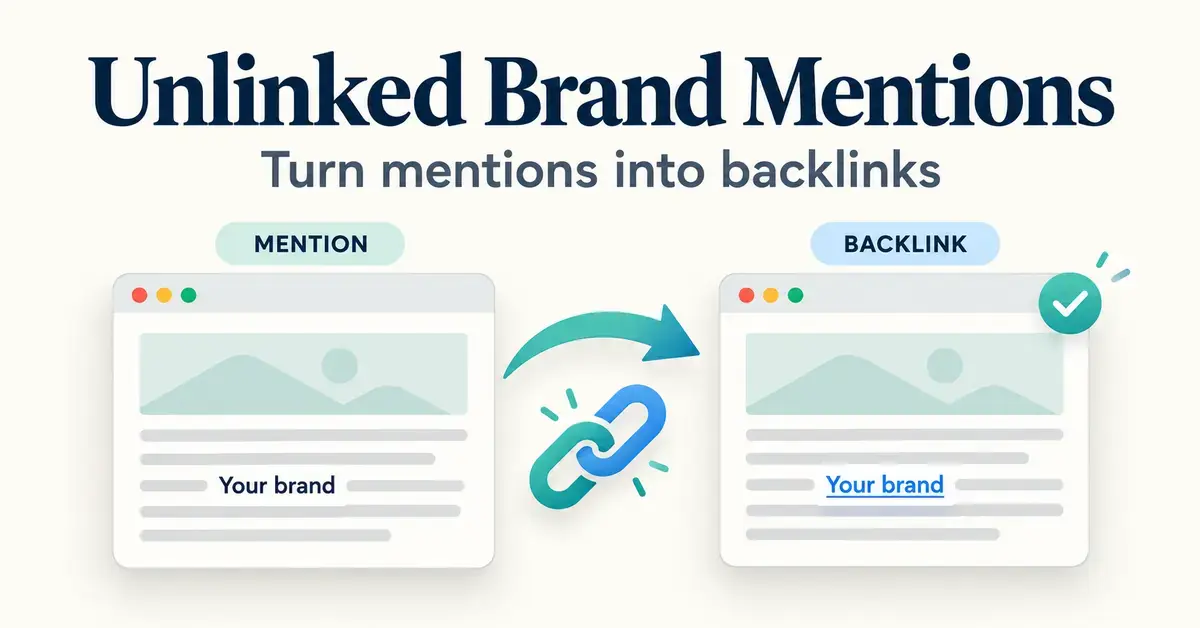
An unlinked brand mention is any place online where someone names your brand, product, or founder but does not link back to your website. Each one is a backlink that is halfway earned: the author already knows you and chose to reference you, so all that is missing is the hyperlink. Turning these mentions into links is called link reclamation, and it is one of the fastest, lowest-risk wins in link building. This guide explains how to find unlinked mentions, decide which ones are worth chasing, and ask for the link without sounding pushy.
Key Points
- What it is: an unlinked brand mention names your brand but does not link to your site — a backlink that is halfway earned.
- Why it works: the author already knows you, so reclamation converts far better than cold outreach and reinforces brand signals used in AI search.
- Find them: monitor with Google Alerts, Ahrefs, Semrush, or Brand24, then filter for pages that mention you without a backlink.
- Qualify them: keep mentions that are on reputable, relevant sites and positive or neutral in tone.
- Ask well: a short, personal thank-you, the sentence you are mentioned in, and the exact URL to link — no pressure.
- Make it routine: review alerts weekly and audit older mentions monthly for a compounding stream of easy links.
What is an unlinked brand mention?
An unlinked brand mention is a reference to your brand in someone else’s content that does not include a clickable link to your site. A blogger might write “tools like BacklinksCanada make this easier” without linking the name, or a journalist might quote your data and credit you by name only. The mention still exists as plain text; it simply is not doing any SEO work because search engines cannot follow it to your domain.
These differ from ordinary link prospects because the relationship is already warm. With cold outreach you are asking a stranger to add something new. With an unlinked mention you are asking someone to complete a reference they have already made — a much smaller, more reasonable request.
Unlinked mentions vs. lost links
Link reclamation covers two related jobs. Unlinked mentions are references that never had a link in the first place. Lost or broken links are backlinks you used to have that were removed, changed, or now point to a dead page. Both are worth recovering, but the outreach differs: for a lost link you remind the author that a link existed; for an unlinked mention you politely ask for one to be added.
Why are unlinked mentions worth reclaiming?
Unlinked mentions are worth reclaiming because they convert into links far more easily than cold prospects and because branded mentions themselves now carry weight in both classic and AI-driven search. The person mentioning you has already vouched for your brand, so the ask is low-friction.
- High conversion. Because the relationship is warm, reclamation requests are widely reported to convert much better than cold link-building emails — industry figures commonly cite roughly 15–40% for warm mention outreach versus around 3–8% for cold requests. Treat these as directional, not guaranteed.
- Relevant, editorial links. The mention already sits in relevant, topical context, so the resulting link is editorially placed rather than manufactured — exactly the kind Google values.
- Mentions matter beyond the link. In a study of 75,000 brands, Ahrefs found that branded web mentions correlated 0.664 with visibility in Google’s AI Overviews, compared with just 0.218 for backlinks — roughly three times stronger. Even before you win the link, the mention is helping search and AI tools understand that your brand exists.
In other words, reclamation gives you a concrete link and reinforces the brand signals that increasingly drive AI search visibility. If you want the wider context for tactics like this, our link building strategies hub collects the active methods for earning links.
How do you find unlinked brand mentions?
You find unlinked mentions by monitoring the web for your brand name and then filtering for pages that mention you without linking. There are two halves to this: ongoing monitoring (catching new mentions as they are published) and one-off audits (digging through mentions that already exist).
Set up monitoring alerts
Monitoring tools scan news sites, blogs, forums, and social platforms for the terms you track and notify you when a new mention appears. Track your brand name, common misspellings, your main product names, and key people such as your founder. Free options like Google Alerts and Talkwalker Alerts email you when a term appears; paid platforms such as Brand24, Mention, and Semrush’s Brand Monitoring app add filtering, source quality data, and — importantly — a way to isolate mentions that have no backlink.
Audit existing mentions
To catch mentions published before you started monitoring, use an SEO tool with a large content index. In Ahrefs Content Explorer you search your brand name “in content,” then apply the “Highlight unlinked” filter and enter your domain, which flags pages that mention you but do not link to you. In Semrush’s Brand Monitoring app you open the mention details and tick “Without backlinks.” Filtering by domain authority (Domain Rating or Authority Score) first helps you spend time on the sites that matter. The tools below compare the common options.
Monitoring Tools
| Tool | Cost | Best for | Unlinked-mention feature |
|---|---|---|---|
| Google Alerts | Free | Simple, ongoing alerts | Emails new mentions; check manually for a link |
| Talkwalker Alerts | Free | Free alerts with wider coverage | Emails new mentions; manual link check |
| Ahrefs Content Explorer | Paid | Auditing existing mentions at scale | “Highlight unlinked” filter plus Ahrefs Alerts |
| Semrush Brand Monitoring | Paid | Filtering and analytics | “Without backlinks” filter in mention details |
| Brand24 | Paid | Real-time media monitoring | Flags mentions and sentiment; backlink filtering |
| Mention | Paid | Web and social listening | Alerts and filters for brand references |
| BrandMentions | Paid | Dedicated mention tracking | Finds mentions and flags which lack a link |
How do you qualify a mention before reaching out?
Qualify each mention before you email so you only spend effort where a link is realistic and worthwhile. Not every mention is worth chasing — some sites are low quality, and some references are negative or off-topic. Run each one through a quick checklist:
- Is the site trustworthy? Check its authority and whether it publishes real editorial content. Skip spammy directories, scraper sites, and link farms — a link from them can do more harm than good.
- Is the mention positive or neutral? A link from a negative review or a complaint can send unwanted context. Prioritise favourable and neutral mentions.
- Is the context relevant? The page should relate to your industry or the thing being mentioned, so the link reads naturally to both readers and search engines.
- Which page should the link point to? Match the link target to the mention. If they referenced your research, link the research; if they named a product, link the product page. A relevant target makes the request easy to accept.
- Can you find the right contact? Identify the author or site owner and a working email or contact form before you invest in a pitch.
How do you write a polite reclamation request?
Write a short, specific, friendly message that thanks the author for the mention and makes adding the link effortless. The goal is to sound like a grateful human, not an SEO chasing a metric. A good request includes four things:
- A genuine thank-you that references the specific article by name — taking the extra 30 seconds to show you actually read it noticeably lifts response rates.
- A gentle pointer to the mention, quoting the sentence where your brand appears so they can find it instantly.
- The exact URL you would like it to link to, so there is no guesswork.
- A low-pressure close that leaves the decision with them and thanks them either way.
Keep it to a few sentences. Something like: “Hi [Name], thanks for mentioning [Brand] in your piece on [topic] — really enjoyed the section on [detail]. I noticed the mention isn’t linked; if it’s useful for your readers, a link to [URL] would point them to the full details. Totally your call, and thanks either way.” Send from a real person’s address, follow up once if you hear nothing after a week or two, and then move on.
What are the most common mistakes?
The most common reclamation mistakes are treating it like cold outreach, chasing low-value mentions, and being pushy. Avoiding them is most of the battle:
- Sending a generic template. A copy-paste email with no reference to the actual article reads as spam and gets ignored. Personalise the first line.
- Requesting the wrong page. Pushing everyone to your homepage when they mentioned a specific study or product weakens the pitch. Match the target to the context.
- Chasing every mention. Low-authority or spammy sites are not worth the link, and aggressively acquiring links from them can look manipulative. Qualify first.
- Being demanding or entitled. Insisting on a link, or following up repeatedly, damages relationships. Ask once, follow up politely at most once, and respect a no.
- Doing it only once. Mentions appear continuously. A single audit misses everything published afterwards, so the tactic works best as a routine.
How often should you do link reclamation?
Run link reclamation as a steady routine rather than a one-time project. A practical cadence is to review monitoring alerts weekly so you catch fresh mentions while the article is new and the author is easy to reach, and to run a fuller audit of older, unlinked mentions monthly or quarterly. Because the pool of mentions grows as your brand earns coverage — much of it from digital PR and outreach — a small recurring habit compounds into a reliable stream of easy links over time. Tracking which requests convert also tells you which types of mentions and sites are worth prioritising.
New to the wider topic? Start with the fundamentals in our link building basics section, and pair reclamation with the monitoring tools covered under backlink analysis & tools.
Disclaimer
This article is general educational information about search engine optimisation, not professional or guaranteed advice. Link reclamation is a legitimate, widely used white-hat tactic, but outreach results vary and no link is ever guaranteed — the decision always rests with the site owner. Always ask respectfully, never pay for or pressure editorial links, and follow Google’s spam policies and link best practices. Figures cited here come from third-party studies and industry reports and may change over time.
Sources
- Ahrefs — How to find and reclaim unlinked mentions
- Semrush — How to find unlinked mentions and turn them into backlinks
- Semrush — Brand Monitoring app documentation
- Koozai — How to find unlinked brand mentions in Ahrefs
- Brand24 — How to find unlinked brand mentions
- Zapier — How to find unlinked mentions and turn them into backlinks
- TDM Insights — Ahrefs study: brand mentions vs backlinks for AI visibility
- Google Alerts
Frequently Asked Questions (FAQ)
What is an unlinked brand mention?
It is any online reference to your brand, product, or team that names you in plain text but does not include a clickable link to your website. The mention exists, but it passes no link value because search engines cannot follow it to your domain.
Are unlinked mentions really worth chasing for SEO?
Yes, for two reasons. They convert into links far more easily than cold prospects because the author already knows your brand, and branded mentions themselves are increasingly linked to visibility in AI-driven search. Reclaiming them earns a relevant editorial link with relatively little effort.
What free tool can I use to find brand mentions?
Google Alerts is the simplest free option: enter your brand name and it emails you when new pages mention it. Talkwalker Alerts works similarly. For deeper audits and the ability to filter mentions that have no backlink, paid tools such as Ahrefs, Semrush, or Brand24 are more thorough.
How do I ask for a link without sounding pushy?
Keep it short and genuine: thank the author, reference the specific article, quote the sentence where you are mentioned, and share the exact URL you would like linked. Leave the decision clearly with them and thank them whether or not they add it. One polite follow-up is fine; more than that is not.
Is link reclamation against Google’s guidelines?
No. Asking a site that already mentions you to add a link is a recognised white-hat practice, because the resulting link is editorial and the author chooses whether to add it. Problems only arise if you buy links, pressure publishers, or chase links from spammy sites — all of which conflict with Google’s spam policies.
