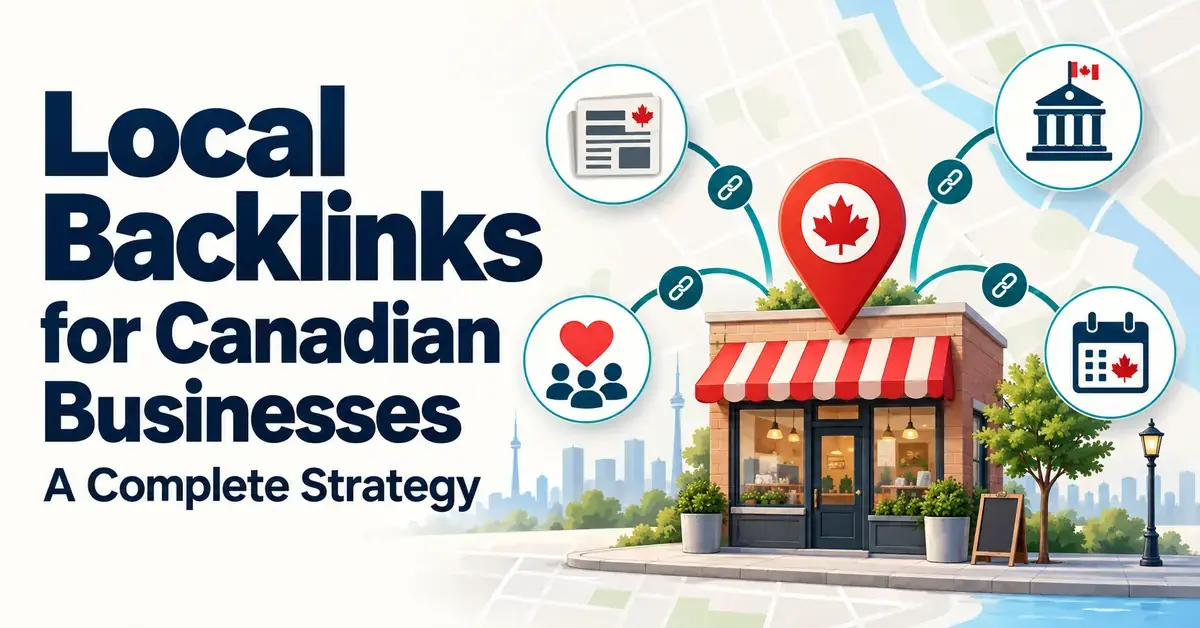
Local backlinks are links to your website from other sites that are tied to your city, region or community — a neighbourhood newspaper, a chamber of commerce member page, a sponsored event, or a charity you support. For a Canadian small or medium-sized business (SMB), these geo-relevant links do something national or offshore links cannot: they tell Google that real organisations in your area recognise your business, which is one of the signals that lifts you in local map and service-area results. This guide explains what local backlinks are, how they influence rankings, exactly where Canadian businesses can find them, and how to earn them without breaking Google’s rules.
Key Takeaways
- Local backlinks come from geo-relevant Canadian sites — chambers, BIAs, local news, sponsorships and community groups.
- They feed Google’s prominence signal, one of the three local ranking factors (relevance, distance, prominence).
- Quality beats quantity: a few trusted local links outperform many generic ones.
- Paid or sponsored links must be marked rel=”sponsored” or rel=”nofollow”; nofollow local links still help.
- Service-area businesses without a storefront benefit especially from links across the areas they serve.
What is a local backlink, and why does it matter in Canada?
A backlink is simply a link from one website to another. A local backlink is a backlink from a site that is geographically or community-connected to your business — for example, your local chamber of commerce, a regional news outlet, a municipal event page, or a nearby non-profit. The value comes from relevance: a link from the Calgary business community is far more meaningful for a Calgary plumber than a link from a generic worldwide directory.
Two terms are worth defining up front. Geo-relevant backlinks are links whose source is clearly associated with a place — the domain, address, content or audience is local. Local SEO backlinks is the broader practice of earning those links specifically to improve how you rank in local search. Both matter because Google tries to show searchers businesses that are genuinely established in the area, not just any business with a big marketing budget.
How do local backlinks influence map and service-area rankings?
Local backlinks feed the “prominence” signal that Google uses to rank businesses in local search. Google publicly states that three main factors decide local ranking: relevance (how well your business profile matches the search), distance (how far you are from the searcher), and prominence (how well-known your business is). Google’s own local-ranking guidance says prominence is based partly on “how many websites link to your business” alongside review count and other signals. In other words, links are one of the few prominence levers you can actively work on.
Where local links fit in the local pack
The “local pack” is the block of two or three business listings with a map that appears near the top of many local searches. You cannot influence distance (the searcher’s location) and relevance is driven mostly by your Google Business Profile — in the Whitespark Local Search Ranking Factors survey, the primary Business Profile category is consistently the single strongest ranking factor. Prominence is where links do their work: a steady stream of quality, geo-relevant backlinks helps Google decide that your business is a well-established, trusted option in the area.
How links help service-area businesses
Service-area businesses (SABs) — plumbers, electricians, cleaners, mobile mechanics — serve customers at their location rather than at a storefront. They often struggle to rank because they may hide their address and cannot rely on foot traffic or physical proximity. Local backlinks are especially useful here: links from organisations across the towns and neighbourhoods you serve reinforce that you genuinely operate in those areas, supporting rankings for “near me” and city-plus-service searches even without a public address.
Where can Canadian businesses find local backlinks?
The best Canadian local links come from organisations that already exist to connect local businesses and communities. The table below compares the main sources; the sections after it explain how to approach each one.
Local Link Source Comparison
| Source | What it is | Typical cost | Usual link type | Geo-relevance | Effort |
|---|---|---|---|---|---|
| Chamber of commerce / board of trade | Member directory profile | Annual membership fee | Nofollow or dofollow | High | Low |
| Business Improvement Area (BIA) | Member listing in a commercial district | Often free for members | Nofollow or dofollow | Very high | Low |
| Local news / community media | Editorial coverage or feature | Free (earned) | Often dofollow | High | High |
| Event / team sponsorship | Sponsor-page listing | Sponsorship fee | Sponsored or nofollow | High | Medium |
| Community org / charity | Partner or supporter mention | Donation or in-kind | Nofollow or dofollow | High | Medium |
| Local directory / citation | Structured NAP listing | Free or low | Nofollow or dofollow | Medium–high | Low |
| Supplier / partner / association | Dealer, partner or member page | Free (existing relationship) | Often dofollow | Medium | Low |
| College / university / institution | Alumni, discount or resource page | Free (relationship) | Often dofollow | High | High |
Chambers of commerce and boards of trade
Chambers of commerce and boards of trade are among the most reliable local link sources in Canada. Most chambers publish an online member directory and give each member a profile page that links back to their website. Because the chamber’s domain is unmistakably tied to your region, the link is highly geo-relevant. Membership usually carries an annual fee and comes with networking and advocacy benefits, so the link is a by-product of a genuine business relationship rather than a paid link scheme. The national Canadian Chamber of Commerce also maintains an association directory, and virtually every city and many towns have their own chamber.
Business Improvement Areas (BIAs)
A Business Improvement Area (BIA) is a defined commercial district whose businesses fund shared marketing, events and streetscape improvements. BIAs frequently list member businesses on their websites. Canada has a dense BIA network: Toronto alone has more than 80 BIAs — among the most of any city in the world — coordinated by the Toronto Association of Business Improvement Areas (TABIA), and Business Improvement Areas of British Columbia (BIABC) has acted as a provincial umbrella since 1991. If your storefront sits inside a BIA, a member listing is often free and firmly local.
Local news and community publications
Coverage in a local newspaper, community magazine or neighbourhood blog can earn a strong editorial backlink and put you in front of nearby customers at the same time. Angles that tend to earn coverage include a new location, local hiring, a community fundraiser, a milestone anniversary, or expert commentary on a local issue. Reporter-request platforms are one way in: since HARO was folded into Connectively and then shut down in late 2024, journalists and sources have moved to alternatives such as Qwoted, Source of Sources and Featured — and SourceBottle, which covers Canada and other non-US markets.
Sponsorships and event partnerships
Sponsoring a local event, team or festival often comes with a listing on a sponsor page that links to your site. A 5K charity run, a minor-league sports team, a school fundraiser or a chamber gala are common examples. Two cautions apply. First, choose sponsorships you would value anyway for the community goodwill and exposure — not just for the link. Second, because a sponsorship is a paid arrangement, the link should technically carry a rel=”sponsored” or rel=”nofollow” attribute; a well-run local organisation may already handle this, and it does not make the link worthless (see the section on link attributes below).
Community organisations, charities and clubs
Non-profits, service clubs (Rotary, Lions), community centres, arts groups and industry meetups frequently thank partners and members with a link. Donating products or services, volunteering, hosting a workshop, or offering a member discount can all lead to a mention. These links are naturally local and, because they reflect real community involvement, they are exactly the kind Google wants to reward.
Local directories and citations
Structured local listings — business directories and citations that publish your name, address and phone number (NAP) — are a related but distinct tactic from the editorial links above. Consistent citations across trusted Canadian directories reinforce your location and often include a link. Because this is a large topic on its own (which directories to prioritise, how to keep NAP data consistent, and how to clean up duplicates), it is best handled alongside a dedicated directories-and-citations resource rather than compressed into this guide.
Suppliers, partners and industry associations
Your existing business relationships are an underused link source. Suppliers, manufacturers and franchisors often have “where to buy”, “find a dealer” or partner pages; local complementary businesses (a photographer and a wedding venue, for example) can cross-refer; and provincial or sector associations you belong to may list members. Ask — many of these links are available simply because no one has requested them.
Colleges, universities and local resource pages
Educational and institutional sites carry strong trust signals. Opportunities include alumni business directories, student-discount pages, co-op and placement partner lists, and local library or municipal “community resources” pages. These are harder to earn and usually require a real relationship (hiring a co-op student, offering a discount, or providing a genuinely useful resource), but a single relevant institutional link can be worth many ordinary ones.
How do you actually earn these local links?
A repeatable process beats one-off bursts of activity. Work through these steps and revisit them each quarter.
- Map your local footprint. List every city, neighbourhood and area you serve, plus the organisations, events and publications active in each.
- Audit what you already have. Check whether your chamber, BIA, suppliers and associations already link to you, and fix any missing or outdated listings first — these are the quickest wins.
- Find realistic targets. For each area, note member directories, sponsor pages, event calendars, community resource pages and local news outlets.
- Create a reason to link. Join, sponsor, donate, offer an expert quote, publish a genuinely useful local resource, or partner on an event — something that earns the mention.
- Reach out personally. Contact the right person with a short, specific message that explains who you are, your local connection, and what you are offering.
- Track and maintain. Record each link, keep your NAP details consistent everywhere, and re-check listings so they do not disappear over time.
Link attributes: do nofollow and sponsored links still help?
Yes — and understanding link attributes keeps you on the right side of Google’s rules. Google asks site owners to label certain links: rel=”sponsored” for links that are advertisements or paid placements, rel=”ugc” for user-generated content such as forum and comment links, and rel=”nofollow” as a general “don’t necessarily endorse” marker. Links without these attributes are treated as normal (“dofollow”) links.
Many legitimate local links — chamber directories, sponsor pages, some news sites — are nofollow or sponsored. That is fine. These links still drive referral traffic, build local awareness, and contribute to the overall picture Google has of your business. The key rule: if you paid for a link or received it through a commercial arrangement, it should be marked sponsored or nofollow. Buying ordinary dofollow links to pass ranking value violates Google’s link-spam policies and puts your site at risk. Aim for a natural mix earned through real local involvement.
How many local backlinks does a business need?
There is no magic number, and quality matters far more than volume. A handful of genuinely local, trusted links — your chamber, a BIA, a respected community news mention, a couple of relevant sponsorships — will usually do more for a small Canadian business than dozens of low-quality directory links. Rather than chasing a total, aim for steady, natural growth: a few new geo-relevant links each quarter from sources a real local customer would also recognise. Consistency and relevance beat a one-time spike every time.
What are the most common local link-building mistakes?
- Buying cheap dofollow links. Paid links that pass ranking value without a sponsored or nofollow tag breach Google’s policies and can trigger penalties.
- Ignoring links you could already claim. Many businesses overlook free listings from their chamber, BIA, suppliers and associations.
- Inconsistent NAP details. Different business names, addresses or phone numbers across listings weaken the location signal that local links are meant to reinforce.
- Chasing volume over relevance. A hundred generic links are worth less than a few from recognised local organisations.
- One-and-done effort. Links disappear and directories change; local link building is ongoing maintenance, not a single project.
- Sponsoring only for the link. If you would not value the exposure or goodwill otherwise, it is a weak use of budget — and the link is usually nofollow anyway.
Who is a local backlink strategy best suited to?
Local link building suits any business that serves customers in specific Canadian places: storefront retailers and restaurants, trades and home-service providers, clinics and professional practices, and multi-location or franchise operators. It is most valuable when you compete for local-intent searches (“near me”, city-plus-service queries) and appear in the map pack. Purely national e-commerce brands with no local footprint will get less from it and should focus on broader link-building strategies instead. For local and service-area businesses, though, geo-relevant links are one of the highest-return, lowest-risk investments in local SEO.
A note on results and Google’s guidelines
This guide is educational and does not guarantee any specific ranking, traffic or revenue outcome. Search results depend on many factors beyond backlinks — including your Google Business Profile, reviews, on-page content and competitors — and Google updates its systems regularly. Build links to earn genuine local visibility and referrals, follow Google’s link-spam policies (mark paid or sponsored links appropriately), and treat any provider promising guaranteed rankings or bulk paid links with caution. When in doubt, favour links that a real local customer would also find useful.
Sources
- Google — Improve your local ranking on Google (relevance, distance, prominence)
- Google Search Central — Qualify your outbound links to Google (nofollow, sponsored, ugc)
- Google Search Central — Spam policies (link spam)
- Whitespark — Local Search Ranking Factors survey
- Canadian Chamber of Commerce
- Toronto Association of Business Improvement Areas (TABIA)
- Business Improvement Areas of British Columbia (BIABC)
- Qwoted — journalist and source platform (HARO alternative)
Frequently Asked Questions (FAQ)
What exactly is a local backlink?
It is a link to your website from another site that is tied to your city, region or community — such as a local chamber of commerce, a regional newspaper, a community organisation, or an event you sponsor. The geographic connection is what makes it more valuable for local search than a generic or offshore link.
Do nofollow chamber and directory links still help my rankings?
Yes. Many local links are nofollow or sponsored, and that is normal and legitimate. They still bring referral traffic, build local awareness, and contribute to how well-known (prominent) Google considers your business. A natural mix of followed and nofollow local links is healthier than only chasing dofollow links.
How many local backlinks does a Canadian small business need?
There is no fixed number. Quality and relevance matter far more than volume — a few trusted, clearly local links usually outperform dozens of low-quality ones. Aim for steady, natural growth of a few geo-relevant links each quarter rather than a single large batch.
Do local backlinks help if I have no storefront?
Yes. Service-area businesses benefit strongly from local links because mentions from organisations across the areas you serve reinforce that you genuinely operate there, supporting “near me” and city-plus-service rankings even when you do not display a public address.
Can I pay for local backlinks?
You can pay for legitimate arrangements like memberships and event sponsorships, but the resulting link should be marked rel=”sponsored” or rel=”nofollow”. Buying ordinary dofollow links purely to boost rankings violates Google’s spam policies and can harm your site, so avoid providers selling bulk paid links.
