
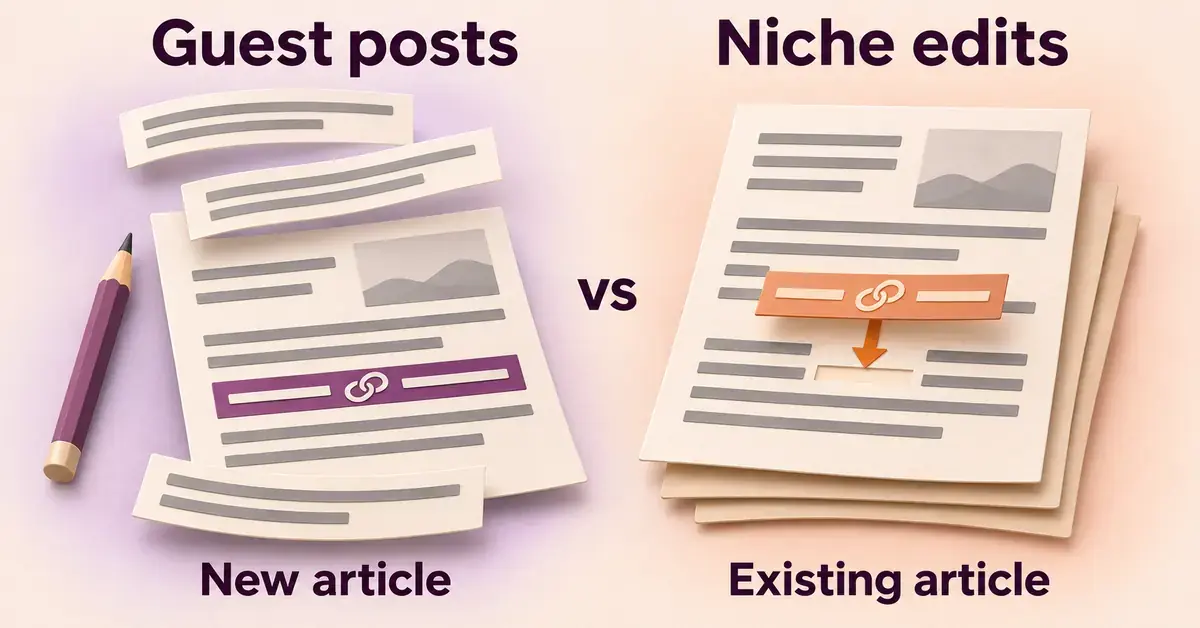
Guest posts and niche edits are the two most common ways to earn a contextual backlink from another website, and in practice both are almost always paid placements. A guest post puts your link inside a brand-new article that you supply to a publisher. A niche edit, also called a link insertion, adds your link to an article that is already published, indexed, and sometimes already ranking. This guide compares niche edits vs guest posts across the factors that actually decide value for money and safety, so you can choose the right fit, or combine them.
Key Points
- Guest post = a new article you supply; niche edit (link insertion) = your link added to an existing, already-indexed page.
- Both are usually paid placements; when money changes hands the link should carry rel=”sponsored” or rel=”nofollow” to stay within Google’s guidelines.
- Niche edits are typically faster and 20–30% cheaper; guest posts offer more content control and brand exposure.
- Authority depends on the host page, not the format — a strong, relevant page matters more than the tactic.
- Main niche-edit risk: the link can be removed later. Main guest-post risk: low-quality “guest post farms” that get devalued.
- Most experienced link builders use a mix of both.
What is a guest post?
A guest post is a new article you write (or commission) that a third-party website publishes, with one or more links back to your site placed naturally inside the content. You control the topic, the wording, the anchor text, and where your link sits, because you are creating the page from scratch.
Guest posting is often used for more than just a link. A byline, an author bio, and a full article on a respected site build brand awareness and topical relevance at the same time. Because the page is new, it has no existing authority of its own; it accumulates value over time as it is crawled, indexed, and (ideally) earns its own signals.
What are niche edits (link insertions)?
A niche edit is a link added to an existing, already-live article on someone else’s site. Instead of publishing new content, the publisher edits a relevant paragraph in a page that is already indexed and inserts your link. The terms niche edit, link insertion, and curated link all describe the same thing.
The appeal is speed and context. The host page already exists in Google’s index, so there is no wait for new content to be discovered, and if the page already ranks or has traffic, your link sits inside proven, relevant content. The trade-off is control: you are fitting a link into copy that was written for another purpose, so your anchor text and surrounding context are constrained by what is already there.
Why the naming matters
Because “niche edit” and “link insertion” are used interchangeably, vendors sometimes blur the line between a genuine edit on a real, maintained website and a link dropped into a dormant page on a private blog network. Those are very different in quality and risk. When you buy, ask specifically whether the placement is an edit to a live, updated, organically-trafficked article. To see where niche edits sit among the wider link landscape, our overview of the types of backlinks puts each format in context.
Guest posts vs niche edits: side-by-side comparison
The two tactics win on different factors. Guest posts lead on content control and brand exposure; niche edits lead on speed and cost. The table below summarises the differences that matter most before we break each one down.
Comparison
| Factor | Guest Posts | Niche Edits (Link Insertions) |
|---|---|---|
| Cost | Higher: ~$295 avg, ~$461 via vendors (BuzzStream, Oct 2026) | Lower: ~$179 avg; ~$200–$600 on trafficked sites (Oct 2026) |
| Speed to value | Weeks — content must be written, published, crawled, indexed | Days — host page is already indexed |
| Authority & equity | Fresh page, builds authority over time | Inherits authority of an existing, sometimes ranking page |
| Editorial control | Full — you control topic, context, and anchor | Limited — you fit into existing copy |
| Brand exposure | High — byline, bio, full article | Low — just the link |
| Main risk | Low-quality guest-post farms get devalued | Link can be edited out or removed later |
| Disclosure | Paid → rel=”sponsored” or rel=”nofollow” | Paid → rel=”sponsored” or rel=”nofollow” |
Cost
Niche edits are usually cheaper than guest posts because there is no content to write. BuzzStream’s pricing data (updated 20 October 2026) puts the average link insertion at $179, within a $20 to $1,500 range, and Reporter Outreach (October 2026) puts insertions on real, trafficked sites at about $200 to $600. Guest posts run higher on average: BuzzStream puts them at $295 when you place them yourself and $461 when bought through a vendor, with premium publications reaching well into four figures. As a rule of thumb, link insertions tend to cost 20 to 30 percent less than guest posts at a comparable authority level. For a fuller breakdown of what drives these numbers, see how much backlinks cost.
Speed and indexing
Niche edits are faster to deliver value. The host article is already indexed, so once the link is added it can be crawled and counted quickly, often within days. A guest post has to be written, approved, published, then crawled and indexed before it can pass any signal, which typically takes weeks and sometimes longer on slower sites. If turnaround is your priority, niche edits usually win.
Authority and link equity
Authority depends far more on the host page than on the format. A niche edit on a strong, relevant, trafficked page can pass meaningful equity immediately because that page already has standing. A guest post starts from zero authority on a fresh URL but can grow over time and lets you target the exact topical context you want. Neither method is inherently “more powerful”; the quality of the site and the relevance of the page decide the outcome.
Risk and stability
Each format carries a different main risk. The biggest niche-edit risk is removal: because you do not own the page, the publisher can later edit, update, or delete the article and your link disappears. The biggest guest-post risk is low quality at scale: “guest post farms” that publish anything for a fee are routinely devalued by Google. Both formats risk penalties if links are unnatural, over-optimised in anchor text, or placed at scale without editorial standards.
Disclosure and compliance
Both guest posts and niche edits are paid placements, and that is the single most important compliance point. Google’s spam policies state that exchanging money for links, or for posts that contain links, is a link scheme when those links pass ranking credit. Buying and selling links is allowed for advertising and sponsorship, but the links must be qualified so they do not pass credit, using rel=”sponsored” (preferred for paid links) or rel=”nofollow”. Whether you buy a guest post or a niche edit, the correct rel attribute should be applied when money, goods, or services changed hands for the placement.
Are guest posts and niche edits against Google’s guidelines?
Neither tactic is banned, but both cross into link-scheme territory when a paid link passes ranking credit without proper disclosure. Google’s guidance is explicit: exchanging money for links is fine for advertising as long as the link carries rel=”sponsored” or rel=”nofollow”. In 2026 Google treats these attributes as hints rather than absolute directives, but applying them is still the honest, policy-aligned signal that the link is sponsored.
The practical takeaway: the format is not the problem, undisclosed paid links that manipulate rankings are. If you are purchasing placements, understand the compliance basics first; our page on how to buy backlinks in Canada covers what to look for and what to avoid.
When to choose guest posts
Guest posts are the stronger choice when your goal is more than a raw link. Pick guest posting when you want:
- Content and context control — you decide the topic, angle, and where the link sits.
- Brand building — a byline and full article put your name in front of a new audience.
- Exact anchor and topical relevance — useful when you need a specific, well-supported context around the link.
- A page you can point other links or traffic to — the new article is an asset in itself.
When to choose niche edits
Niche edits are the stronger choice when speed, efficiency, and existing authority matter most. Pick link insertions when you want:
- Faster results — the page is already indexed, so the link can be counted sooner.
- Lower cost per link — no content-creation fee.
- Placement inside proven pages — links inside articles that already rank or attract traffic.
- Volume — it is easier to secure many insertions across existing pages than to produce many original articles.
Common mistakes to avoid
Both tactics fail in predictable ways. Avoiding these errors matters more than choosing one format over the other.
- Skipping disclosure. Buying a dofollow link with no rel=”sponsored” or rel=”nofollow” is the exact behaviour Google’s link-spam policy targets.
- Chasing metrics over relevance. A high Domain Rating on an off-topic or low-traffic site is worth little; topical fit and real audience matter more.
- Over-optimised anchor text. Repeating exact-match commercial anchors across placements looks manipulative. Vary anchors naturally.
- Buying niche edits on dormant or private-network pages. An edit is only as good as the living, maintained site it sits on.
- Ignoring removal risk. With niche edits, monitor placements; links can be edited out later.
- Relying on “guest post farms.” Sites that publish anything for a fee are routinely devalued; quality and editorial standards matter.
Which is better overall?
Neither is universally better; the right answer depends on your budget, timeline, and goals, and most experienced link builders use both. A common approach is to use niche edits for faster, cost-efficient equity into pages that already perform, and guest posts for brand exposure, editorial control, and long-term topical authority. Combining the two also produces a more natural-looking link profile than leaning entirely on one format.
How to get started safely
Whichever format you choose, the process is similar. Define your target pages and the anchors you need, shortlist sites by topical relevance and genuine traffic rather than headline metrics alone, and confirm every placement is on a real, maintained page. Agree on disclosure up front so paid links carry the correct rel attribute, then track each placement so you notice if a niche edit is later removed. Treat both tactics as advertising spend with SEO benefit, not as a shortcut around Google’s guidelines.
Disclaimer
This article is educational and does not guarantee ranking results. Buying links, whether as guest posts or niche edits, carries SEO risk, and outcomes depend on site quality, relevance, and how placements are executed. Paid links should be disclosed with rel=”sponsored” or rel=”nofollow” in line with Google’s guidelines and our editorial policy. Nothing here is professional, legal, or financial advice.
Sources
- Google Search Central — Spam policies for Google web search (link spam)
- Google Search Central — Qualify your outbound links to Google (rel sponsored/nofollow/ugc)
- BuzzStream — Link building pricing
- PressWhizz — Guest post pricing (real placements analysed)
- Reporter Outreach — Niche edits (link insertions) guide
Frequently asked questions (FAQ)
What is the main difference between a guest post and a niche edit?
A guest post is a brand-new article you supply that a site publishes with your link inside it. A niche edit, or link insertion, adds your link to an article that is already published and indexed. Guest posts give you content control and brand exposure; niche edits are faster and usually cheaper.
Are niche edits safe for SEO?
Niche edits can be safe when placed on real, relevant, maintained pages and disclosed correctly. They become risky when the link is undisclosed and passes ranking credit, when the host page is a dormant private-network article, or when anchor text is over-optimised. The main practical downside is that the publisher can remove the link later.
Which is cheaper, guest posts or niche edits?
Niche edits are generally cheaper because there is no content to write, often costing 20 to 30 percent less than a guest post at a comparable authority level. BuzzStream’s October 2026 data puts the average niche edit at $179 and the average guest post at $295, or $461 through a vendor.
Do I need rel=”sponsored” on paid links?
Yes, when money, goods, or services were exchanged for the link. Google’s spam policy treats paid links that pass ranking credit as a link scheme unless they are qualified with rel=”sponsored” (preferred for paid placements) or rel=”nofollow”. This applies equally to guest posts and niche edits.
Can I use guest posts and niche edits together?
Yes, and many link builders do. Using both produces a more natural link profile: niche edits deliver faster, cost-efficient equity, while guest posts build brand awareness, editorial control, and long-term topical authority. The right mix depends on your budget and timeline.
