
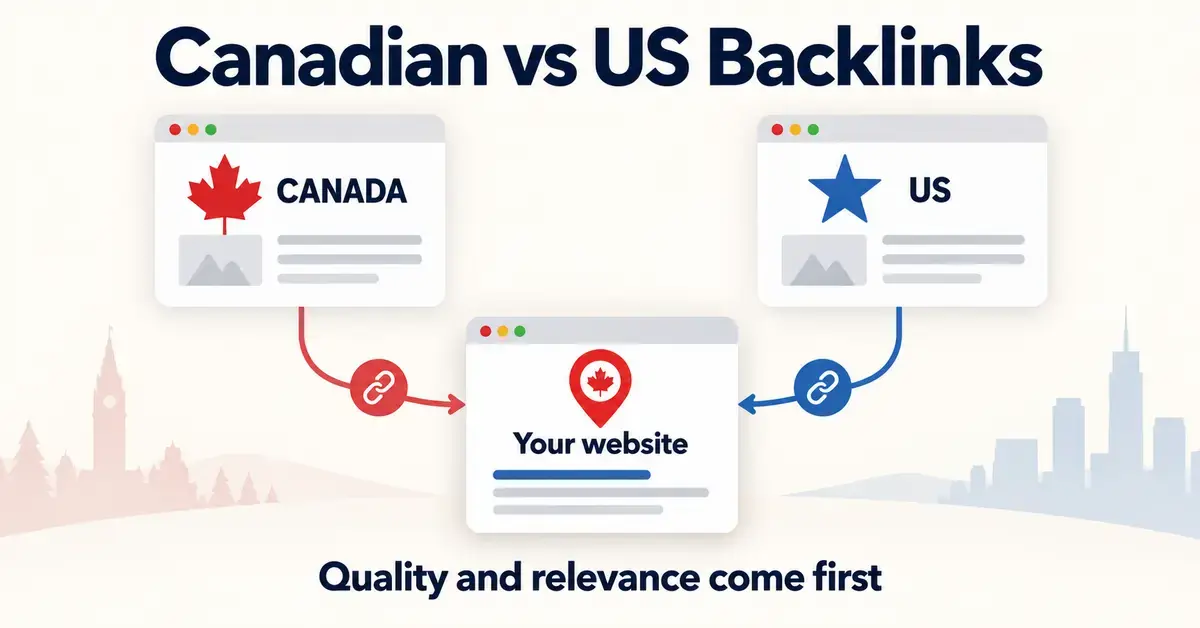
If your site targets Canadian customers, you have probably wondered whether a backlink from a Canadian website counts for more than one from a US website. The short answer is that Google does not have a rule forcing you to earn Canadian links to rank in Canada — link quality and topical relevance come first — but local links do add a geographic relevance signal that can help for Canada-specific and local searches. This guide compares Canadian backlinks vs US backlinks: the real difference between them, how Google reads the location of a link, and when each type is the smarter choice.
Key Points
- You do not need Canadian backlinks to rank in Canada. Google ranks on relevance and authority first; local links are a helpful bonus, not a requirement.
- Local links add geographic relevance, which matters most for local-intent and Canada-specific searches.
- US and other foreign links do not hurt you when they are relevant and high quality.
- Your .ca domain, hreflang and on-page cues are stronger geo-targeting signals than any single backlink.
- The best profiles mix both: Canadian links for local trust, strong international links for authority.
What is the difference between Canadian and US backlinks?
A Canadian backlink is a link to your site from a website that is clearly tied to Canada; a US backlink comes from a site tied to the United States. The “country” of a link is not one single thing — Google infers it from several clues together.
The main signals that make a linking site look Canadian or American are:
- Top-level domain: a country-code domain such as .ca points to Canada, while .us points to the United States. Generic domains such as .com, .org and .net are not tied to any country.
- Stated location and content: a physical address, local phone format, currency (CAD vs USD), spelling (“colour” vs “color”) and references to Canadian cities, provinces or institutions.
- Audience and hosting: where the site’s readers are, and — as a weak hint — where the server is located.
Because most Canadian and American sites publish in English and many use .com, the line between a “Canadian” and a “US” link is often blurry. A Toronto newspaper on a .com domain is still a Canadian source. If you are new to how links are assembled, our primer on what backlinks are covers the anatomy of a link before you weigh its geography.
Do you need Canadian backlinks to rank in Canada?
No — you do not strictly need Canadian backlinks to rank in Canada, but they help in specific situations. Google ranks pages on relevance and authority first, and a strong, topically relevant link from any country can carry real weight. Google’s own representatives have said that links from sites in other countries or other languages are not harmful as long as they are genuine and relevant.
What local links add is a geographic relevance signal. When several Canadian sites link to you, they reinforce that your page is meant for a Canadian audience. That extra signal matters most for queries with local intent — someone searching for a service “near me” or in a named Canadian city — and much less for broad, informational queries where the best answer wins regardless of where its links come from.
So the honest framing is: Canadian backlinks are a helpful accelerant for Canada-focused and local rankings, not a gate you must pass through. A thin link from a low-quality Canadian directory is still worth less than an editorial link from an authoritative US publication in your field.
How Google uses the location of your backlinks
Google treats the geography of your links as one input among many, layered on top of the stronger signals of authority and topical relevance. It helps to separate three things.
Authority and topical relevance come first
A link’s strongest contribution is the trust and topical signal it passes. Links from sites covering the same subject, pointing at a page that genuinely matches the searcher’s intent, are the ones that move rankings. A high-authority, on-topic link helps whether it sits on a Canadian or a US domain. Chasing country match while ignoring relevance is backwards — see our guide to backlink quality for the factors that actually decide a link’s value.
Local relevance is a secondary signal
On top of authority, Google reads local relevance signals: links, mentions and citations from within the target country. For businesses that serve a physical area, a cluster of Canadian links, local citations and reviews helps confirm the page belongs in Canadian and local results. This is where Canadian backlinks earn their keep, and why national brands still invest in them.
Your domain and on-page signals usually outweigh any single link
The clearest geo-targeting signal is not a backlink at all — it is your own domain. A .ca country-code domain tells Google directly that your site is intended for Canada, and it is one of the strongest and hardest-to-override geographic signals you can send. A generic .com, .org or .net site is not tied to a country, so Google leans on your content, your hreflang annotations (tags that declare a page’s language and region) and on-page cues like a Canadian address and CAD pricing.
It is worth knowing that Google removed the manual country-targeting setting from Search Console’s International Targeting report on 22 September 2022 (the report had existed since 2014). You can no longer flip a switch to tell Google “target Canada.” Geo-targeting now flows from your ccTLD, hreflang and local content — and, as a supporting signal, your local links.
When Canadian backlinks matter most
Canadian backlinks pull their weight when the search itself is local or national in nature. Prioritise them if you are in one of these situations:
- Local and brick-and-mortar businesses: a clinic, shop, trades business or restaurant serving a Canadian city benefits from local links, citations and reviews that confirm its service area.
- Canada-specific topics: content about Canadian taxes, regulations, provincial programs, pricing in CAD or Canadian availability reads as more authoritative when Canadian sites vouch for it.
- Competitive national keywords: when you are fighting other Canadian brands for the same terms, locally anchored authority can be the tie-breaker.
- Trust-sensitive niches: links from recognised Canadian institutions, associations, universities and media build the kind of country-level trust that generic links do not.
Good Canadian sources include national and city news outlets, industry associations, provincial and municipal resources, universities and colleges, and reputable local directories. Our deeper guides to local backlinks in Canada and Canadian directories and citations walk through where to find them.
When US backlinks are the better choice
US backlinks are the better target when authority and reach matter more than geography. The United States has a far larger web, so the biggest publications, resource pages and industry sites in most niches are American. A single editorial link from a major US outlet can outweigh a handful of small Canadian links.
Lean on US (or other international) links when:
- You sell digital products, software or services with no geographic boundary, where buyers are spread across North America.
- The most authoritative and on-topic sources in your field are American, and earning them is realistic.
- You are building broad topical authority for informational content rather than chasing “near me” queries.
- You already have a healthy base of Canadian signals (a .ca domain or strong local content) and simply need more authority.
Crucially, US links do not harm your Canadian rankings. The myth that foreign links drag you down is false — a relevant, high-quality link is an asset no matter where it lives.
Canadian vs US backlinks compared
The table below summarises how the two compare across the factors that matter for a Canada-focused site. In practice a healthy profile usually contains both.
Comparison
| Factor | Canadian backlinks (.ca / Canadian sites) | US backlinks (.com / US sites) |
|---|---|---|
| Main benefit | Local and national geographic relevance | Authority and reach from a larger web |
| Best for | Local and brick-and-mortar businesses, Canada-specific topics | Digital products, informational content, broad topical authority |
| Geo-targeting signal | Reinforces Canadian relevance | Neutral on geography; still passes authority |
| Typical sources | Canadian media, associations, universities, local directories, .ca sites | Major US publications, industry resource pages, niche authorities |
| Availability | Smaller pool; harder to find at scale | Larger pool; more high-authority options |
| Google’s view | Helpful local signal, not required | Fully counted; relevant foreign links are not harmful |
| Risk if low quality | Spammy local directories add risk, not value | Spammy or irrelevant links add risk, not value |
How to earn Canadian backlinks the right way
If you have decided local links are worth pursuing, earn them the same way you would earn any good link — through relevance and genuine outreach, not shortcuts.
- Claim local citations first: list your business accurately on Canadian directories and your Google Business Profile, with consistent name, address and phone details.
- Create content Canadians cite: original data, local guides and Canada-specific resources attract links from Canadian blogs, media and associations.
- Do relationship-based outreach: pitch Canadian journalists, industry sites and partners with something genuinely useful, and follow Canada’s anti-spam law when you email.
- Join Canadian communities: associations, chambers of commerce and local event sponsors often provide legitimate, relevant links.
If you do email outreach to Canadian prospects, read our overview of CASL outreach compliance so your campaigns stay within the law.
Common mistakes to avoid
Even well-meaning site owners trip over the same errors when they start weighing Canadian against US links.
- Believing US links hurt you. They do not. Relevant, authoritative links help regardless of country; dropping them to “go all-Canadian” usually weakens your profile.
- Chasing country match over relevance. A low-quality Canadian link is not better than a strong, on-topic US link. Relevance and authority decide value first.
- Building an unnaturally one-country profile. A real Canadian brand naturally attracts a mix of links. An over-engineered, 100% .ca profile can look manufactured.
- Ignoring the signals you fully control. Your domain, hreflang and on-page Canadian cues (address, CAD pricing, local content) do more for geo-targeting than any single backlink — set those up before obsessing over link geography.
- Buying cheap “Canadian” links. Links from spammy local directories or link farms carry risk, not relevance. Quality standards apply to local links exactly as they do to any other.
For the bigger picture on how all of this fits a national strategy, see our hub on link building in Canada.
How to check the geographic mix of your backlinks
You can estimate the country spread of your link profile without any paid tool, then decide whether it matches your goals. Work through these steps:
- Export your referring domains. Pull the list of sites linking to you from a backlink tool or Google Search Console’s “Links” report.
- Sort by top-level domain. Flag the obvious country domains — .ca for Canada, .us, .co.uk and so on — to see your hard geographic signals at a glance.
- Review the .com links individually. Most links will be on generic domains, so judge those by the site itself: its audience, address, currency and whether it reads as Canadian, American or global.
- Match the mix to your intent. A local Canadian business should see meaningful Canadian and local representation; a global digital product can sit comfortably with a mostly international profile.
Do not aim for a magic percentage. The goal is simply to confirm that a Canada-focused site is not invisible to Canadian sources, and that the overall profile looks like something a real brand would earn.
Sources
- Google Search Central — Managing multi-regional and multilingual sites
- Google Search Console Help — The International Targeting report is deprecated
- Search Engine Land — Google Search Console to remove International Targeting report
- Search Engine Journal — Google: Links from sites in other languages are fine
- CIRA — Canadian Presence Requirements for .CA domains
Frequently Asked Questions (FAQ)
Do Canadian backlinks rank better than US backlinks in Canada?
Not automatically. A Canadian link adds a local relevance signal, which helps for Canada-specific and local-intent searches. But a more authoritative, more topically relevant US link can still outperform a weak Canadian one. Quality and relevance come before country.
Will backlinks from the US hurt my rankings in Canada?
No. Links from other countries are not harmful as long as they are genuine, relevant and from quality sites. Removing good US links to build an all-Canadian profile usually does more harm than good.
Does a .ca domain help me rank in Canada?
Yes. A .ca country-code domain is one of the strongest geographic signals you can send — it tells Google your site is intended for Canada. Note that registering a .ca requires meeting CIRA’s Canadian Presence Requirements.
Can a .com site rank well in Canada without Canadian links?
Yes. A generic .com can rank in Canada through relevant, authoritative links plus clear on-page signals such as Canadian content, CAD pricing, a local address and correct hreflang. Canadian links help but are not mandatory.
How many of my backlinks should be Canadian?
There is no fixed ratio. Let your profile grow naturally: prioritise Canadian links if you serve a local or national Canadian audience, and welcome strong international links for authority. A healthy mix usually looks more natural than a one-country profile.
