
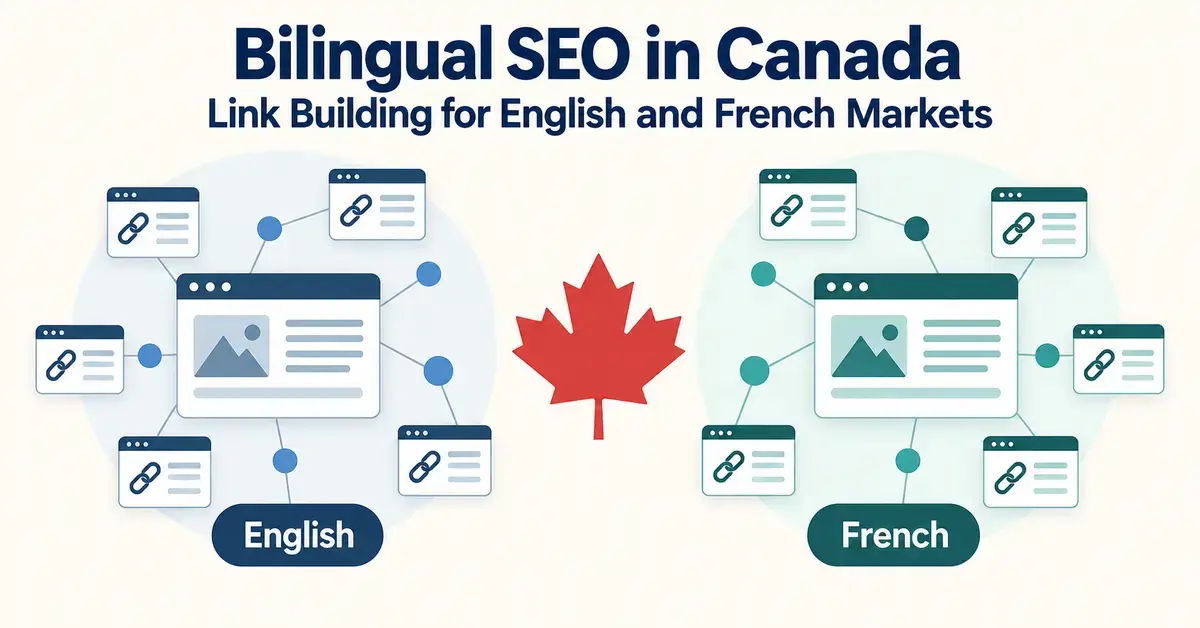
Bilingual SEO in Canada means optimizing a website so it ranks and earns links in both of the country’s official languages: English and French. For link building specifically, it means running two parallel campaigns — one aimed at English-Canadian websites and one aimed at French-Canadian (largely Quebec) websites — while keeping the technical setup clean enough that search engines serve the right language version to the right reader. This guide explains how the two markets differ, how to build links in each, the technical and legal pieces that sit underneath, and the mistakes that quietly waste budget.
Key Points
- Two markets, one country: bilingual SEO in Canada means optimizing and link building for English and French audiences separately.
- French is large: ~10.7 million Canadians can converse in French and ~22% have it as their first official language (2021 Census).
- Separate link ecosystems: English and French backlinks come from largely different publishers; point each link to the matching language URL.
- Technical base matters: reciprocal en-CA / fr-CA hreflang, a consistent URL structure, and a visible language switcher.
- Legal layer: Quebec’s Bill 96 requires French for commercial content aimed at Quebec; the Official Languages Act frames the national expectation.
- Localize, don’t just translate: native French keyword research, content and outreach outperform machine translation.
What is bilingual SEO in Canada?
Bilingual SEO is the practice of making a single brand discoverable to both English-speaking and French-speaking audiences through search. It is not the same as simply translating a website. A translated page can still fail in French search if the keywords, link sources and cultural tone do not match how francophone Canadians actually search and read.
In practice, bilingual SEO has three layers. The first is content: separate English and French pages written (or carefully localized) for each audience. The second is technical: a site structure and hreflang setup that tells Google which page belongs to which language and region. The third — the focus of this guide — is off-page: building backlinks from English and French websites so each language version earns its own authority. A backlink is simply a link from another website pointing to yours; if you are new to the concept, start with this explainer on what backlinks are before going further.
Why does bilingual SEO matter in Canada?
Bilingual SEO matters because a large, distinct French-speaking market sits inside Canada and is easy to miss if you only optimize in English. The numbers from the 2021 Census of Canada make the case:
- French is the first official language spoken by about 22.0% of Canadians, while English covers 76.1%.
- Roughly 10.7 million people can hold a conversation in French (about 29% of the population), and around 7.2 million have French as their mother tongue.
- About 6.6 million Canadians (18.0%) can converse in both English and French.
- In Quebec, 93.7% of residents can conduct a conversation in French — it is the working language of the province, not a niche.
- Outside Quebec, more than 2.7 million people — roughly one in ten — can still hold a conversation in French, with sizeable communities in Ontario and New Brunswick (Canada’s only officially bilingual province).
For link building, this means the French-Canadian web is a largely separate ecosystem of news sites, blogs, directories and associations. A page that ranks well in English will not automatically rank in French, and English backlinks do little to lift a French URL. If you ignore the French side, a competitor who invests in it captures that demand first.
How is bilingual link building different from single-language link building?
Bilingual link building is different because you are earning authority for two separate URLs that live in two separate web communities. The core principles of link building in Canada still apply — relevance, editorial quality, natural placement — but each one has to be executed twice, in two languages, against two sets of publishers.
The main practical differences:
- Two link targets. Your English page and French page usually have different URLs. Links should point to the matching language version, not funnel everything to the English page.
- Two sets of sources. English links come from anglophone Canadian media, blogs and directories; French links come from Quebec and francophone publications. Overlap is small.
- Two anchor-text vocabularies. Anchor text is the clickable text of a link. It has to read naturally in each language, so your French anchors are genuine French phrases, not translated English ones. Our guide to anchor text optimization explains why forced or repetitive anchors are a risk in either language.
- Two outreach approaches. Pitching a Quebec editor in English signals that you do not understand their audience. French outreach, written by someone fluent, converts far better.
Building links for the English-Canadian market
The English-Canadian market is the larger of the two and, for most brands, the easier starting point. The tactics are the familiar ones, applied with a Canadian focus: digital PR and guest contributions to Canadian publications, resource-page and directory placements, and partnerships with complementary Canadian businesses.
Local relevance is a strong signal here. Earning local backlinks in Canada from provincial news outlets, chambers of commerce and regional blogs tells Google your site serves Canadian users specifically, which helps in a market where many results come from US sites. Consistent listings in Canadian directories and citations reinforce the same signal and are a reliable foundation before you chase higher-authority editorial links.
Building links for the French-Canadian market
The French-Canadian market requires its own campaign run in French, aimed at francophone publishers. This is where most non-Quebec brands fall short, which also makes it where the easiest competitive gains are.
Where to find French-language link opportunities
French link prospects cluster in a few places:
- Quebec news and magazine sites and their regional equivalents, which accept expert contributions and cover local business.
- Francophone blogs and niche communities in your industry — these are smaller than their English counterparts but highly relevant.
- French-language and bilingual directories and association listings, including Quebec chambers of commerce and sector bodies.
- Francophone communities outside Quebec, such as Franco-Ontarian and Acadian (New Brunswick) organizations, which run their own media.
How should you handle French outreach?
French outreach should be written in fluent, natural French by someone who understands Quebec business culture — not machine-translated. A polished French pitch respects the publisher and dramatically improves reply rates. Because outreach almost always runs by email, it also has to follow Canada’s Anti-Spam Legislation; see our guide to CASL-compliant outreach for the consent and identification rules that apply to both English and French campaigns.
The technical foundation: hreflang and site structure
The technical layer tells search engines which page is for which language and region, so French searchers see the French URL and English searchers see the English one. Get this wrong and the two versions can compete with each other or be treated as duplicates.
How do en-CA and fr-CA hreflang tags work?
Hreflang is an HTML annotation that labels a page’s language and, optionally, its target country. For Canada you typically use hreflang=”en-ca” for the English-Canadian page and hreflang=”fr-ca” for the French-Canadian page. Each page must also reference itself and all its alternates — the references have to be bidirectional. Google’s guidance is clear on the basics: use absolute URLs, pick one implementation method (HTML tags, HTTP headers or the XML sitemap) rather than mixing them, and keep the set consistent across every page pair.
Two cautions worth repeating. First, Google does not rely on hreflang or the HTML lang attribute to decide what language a page is in — it reads the actual on-page text — so your French pages must genuinely be in French. Second, avoid automatically redirecting visitors by IP or browser language; offer a visible language switcher instead, so crawlers (and users) can reach both versions.
Which URL structure should you use?
Any of the common structures can work as long as it is consistent. The main options are subdirectories (example.ca/en/ and example.ca/fr/), which are the simplest to manage and keep all authority on one domain; subdomains (en.example.ca / fr.example.ca); or separate country-level domains, which are rarely necessary inside a single country. For most Canadian bilingual sites, language subdirectories on one .ca domain are the pragmatic default — easier to maintain and better at pooling the authority your links build.
English vs French Market Comparison
| Factor | English-Canadian market | French-Canadian market |
|---|---|---|
| Primary audience | ~76% first official language English; nationwide | Quebec plus francophone communities in Ontario, New Brunswick and beyond |
| hreflang tag | en-ca | fr-ca |
| Keyword research | Done natively in English | Done natively in French (not translated) |
| Typical link sources | Anglophone Canadian media, blogs, directories | Quebec and francophone media, blogs, association listings |
| Outreach language | English | Fluent, culturally aware French |
| Anchor text | Natural English phrases | Natural French phrases |
| Key legal consideration | Official Languages Act (mainly federal/regulated bodies) | Charter of the French Language / Bill 96 for commercial content |
What legal and compliance rules affect bilingual SEO in Canada?
Two bodies of law shape bilingual content and, indirectly, your link building. Neither is legal advice here — confirm specifics with a qualified advisor — but both are important context.
Quebec’s Charter of the French Language. The Charter (originally Bill 101, 1977) was significantly strengthened by Bill 96, “An Act respecting French, the official and common language of Quebec,” adopted on 1 June 2022. It treats commercial websites, social media, newsletters and catalogues aimed at Quebec as commercial documents that must be available in French, and other-language versions may not be offered on more favourable terms than the French one. Key provisions were phased in through 1 June 2025, and the regulator (the Office québécois de la langue française) can issue notices and fines — reported in the range of CAD 700 to 7,000 for an individual and CAD 3,000 to 30,000 for a company, per day of non-compliance. The practical takeaway for SEO: if you serve Quebec, a strong French version is not optional, which makes French link building a natural extension of a legal requirement.
The federal Official Languages Act. Modernized through Bill C-13, which received royal assent on 20 June 2023, the Act governs English and French in federal institutions and federally regulated private businesses. It does not dictate how a typical private website is built, but it reflects the national expectation that both languages are served — the same expectation your bilingual audience brings to search.
Common mistakes in bilingual SEO and link building
The most common failure is treating the French site as an afterthought. These mistakes recur:
- Machine-translating everything. Automated translation produces text that reads as foreign to francophone users and ranks poorly for real French search terms. Localize instead.
- Translating keywords instead of researching them. French Canadians often search with different words than a literal translation would suggest. Do keyword research natively in each language.
- Pointing all links at the English page. This starves the French URL of authority. Match each link to the language version it supports.
- Reusing one anchor-text list in both languages. Anchors should read naturally in the target language; translated-English anchors look unnatural.
- Broken or one-directional hreflang. Missing self-references or non-reciprocal tags cause Google to ignore the annotations, so the wrong version can surface.
- Auto-redirecting by location. Forcing users (and crawlers) to one language can hide the other version from search entirely.
- Ignoring link quality in the rush to scale French links. A small, relevant French link set beats a pile of low-value directory links; the same link building strategies and quality bar apply in both languages.
Who needs a bilingual link building strategy?
Not every Canadian site needs full bilingual SEO, but many do. You should prioritize it if any of the following is true:
- You sell to or operate in Quebec, where French-first content is both expected and, for commercial material, legally required.
- You are a national brand that wants visibility among the millions of francophone Canadians outside Quebec.
- You are a federal or federally regulated organization with official-languages obligations.
- Your competitors already rank in French, meaning they are capturing searches you cannot see in an English-only rank report.
If your audience is purely regional and English-speaking, a single-language strategy may be enough — but it is worth confirming with French keyword data before deciding.
How do you get started with bilingual link building?
Start by getting the foundation right, then build links language by language:
- Audit your current reach. Check whether you rank for any French terms and whether French pages even exist. Keyword research in each language shows the size of the opportunity.
- Fix the technical base. Decide on a URL structure, create genuine French pages, and implement reciprocal en-CA / fr-CA hreflang with a visible language switcher.
- Map link prospects per language. Build two prospect lists — anglophone Canadian sites and francophone sites — and record the correct target URL for each.
- Run compliant, native outreach. Pitch English publishers in English and French publishers in French, following CASL for every email.
- Measure each language separately. Track rankings, referring domains and traffic for the English and French URLs on their own, so you can see which market needs more investment.
Sources
- Canadian Heritage — Statistics on official languages in Canada (2021 Census)
- Statistics Canada — Ethnicity, Language and Immigration Thematic Series
- Canadian Heritage — Bill C-13 modernizing the Official Languages Act receives Royal Assent
- Office québécois de la langue française
- Éducaloi — Language Laws and Doing Business in Quebec
- Google Search Central — Tell Google about localized versions of your page (hreflang)
Frequently Asked Questions (FAQ)
Is French content legally required for websites in Canada?
Not nationwide, but it effectively is for commercial material aimed at Quebec. Quebec’s Charter of the French Language, strengthened by Bill 96, requires commercial websites and related documents serving Quebec to be available in French and not offer other languages on more favourable terms. Elsewhere in Canada, French is expected by audiences and required of federal and federally regulated bodies, but not mandated for a typical private site.
Can I just translate my English pages into French?
Translation alone is not enough. Effective French SEO needs localized content written for francophone readers, keyword research done natively in French, and links from French-language sites. Machine translation tends to read unnaturally and rank poorly for the terms French Canadians actually use.
What hreflang tags should a Canadian bilingual site use?
Use hreflang=”en-ca” for the English-Canadian page and hreflang=”fr-ca” for the French-Canadian page. Each page must reference itself and its alternate, use absolute URLs, and apply a single implementation method consistently. Google reads the on-page text to confirm language, so the pages must genuinely be in the stated language.
Do English backlinks help my French pages rank?
Only indirectly. Authority can spread across a domain, but a French URL ranks best when it earns its own links from relevant French-language sites with natural French anchor text. Treat the two language versions as separate link-building targets.
How many Canadians speak French?
According to the 2021 Census, about 10.7 million people can hold a conversation in French (roughly 29% of the population), French is the first official language spoken by about 22%, and around 6.6 million Canadians are bilingual in English and French. In Quebec, 93.7% can converse in French.
