
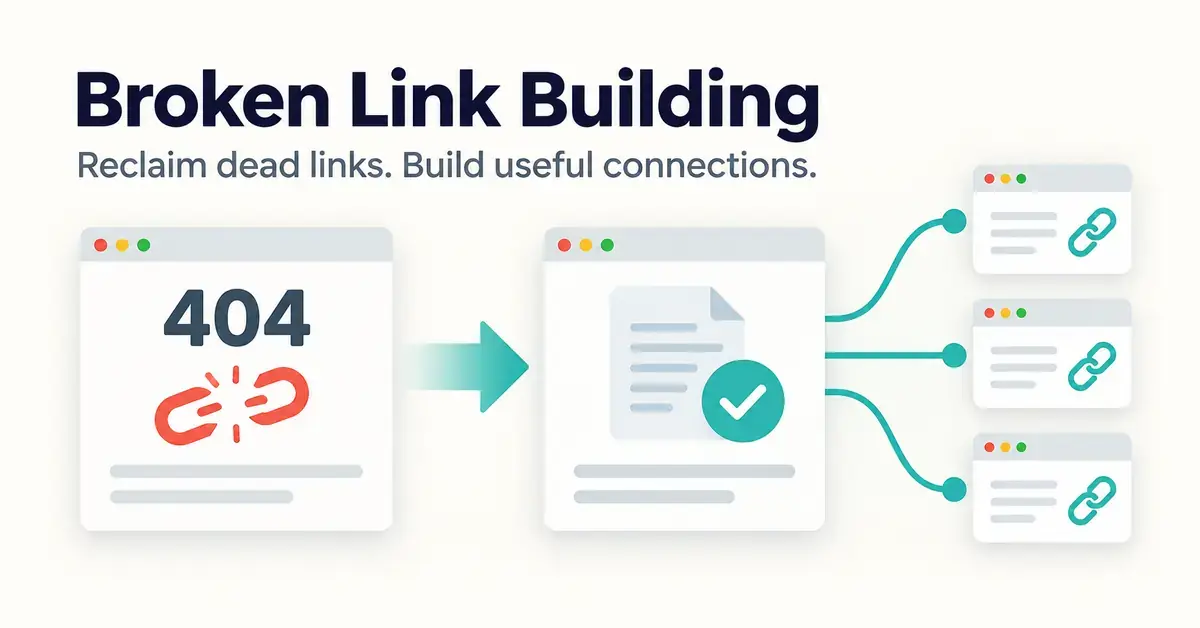
Broken link building is an off-page SEO tactic where you find a dead page on another website that still has links pointing to it, recreate that lost resource on your own site, and then ask the sites linking to the dead page to point to your working version instead. Done well, it is one of the more honest ways to earn links: the website owner fixes a genuine problem on their page, and you get a relevant backlink in return. Done lazily, it wastes hours on emails nobody answers. This guide walks through the full workflow, the tools involved, realistic success rates, and the mistakes that sink most campaigns.
Key Takeaways
- What it is: finding dead pages that still have backlinks, rebuilding the lost resource, and asking the linking sites to point to your version instead.
- Why it works: the web decays constantly — Pew Research found 38% of 2013 webpages were gone within a decade — so new opportunities appear every day.
- The four steps: find broken pages with backlinks, vet them, recreate better content, then do personalised outreach.
- Realistic odds: reply rates sit in the high single digits and roughly 3–8% of emails convert, so it is a numbers game, not a shortcut.
- Biggest pitfalls: thin replacement content, generic mass emails, and skipping the follow-up.
What is broken link building?
In short, it is the practice of turning other people’s dead links into your backlinks. A “broken link” is a hyperlink that points to a page that no longer exists — clicking it returns an error instead of content. When many websites link to a resource that later disappears, every one of those links becomes an opportunity. If you publish a comparable (ideally better) resource, you can contact each linking site and suggest they swap the dead URL for yours.
The appeal is that your pitch solves a real problem for the other site. Broken links frustrate visitors, waste the crawl budget search engines spend on a site, and make a page look neglected. You are not begging for a favour — you are flagging a fault and offering a fix. That framing is why the tactic has stayed popular for well over a decade and still appears among the most widely used link building methods in industry surveys. If you are new to the wider discipline, it helps to first understand what a backlink actually is before you start chasing them.
Why do broken links exist in the first place?
Broken links exist because the web constantly decays — a phenomenon called “link rot.” Pages get deleted, companies rebrand or shut down, URLs change during site migrations, and whole domains expire. None of this is rare. A 2024 study by the Pew Research Center found that 38% of the webpages that existed in 2013 were no longer accessible a decade later, and that roughly a quarter of all pages that existed at any point between 2013 and 2023 had vanished by late 2023. In most cases a single page was removed from an otherwise healthy site.
That steady decay is what makes the tactic a renewable opportunity rather than a one-off trick. New broken links appear every day, especially on older resource pages and “useful links” lists that nobody has audited in years. Your job is to find the broken links that still carry link value and act before someone else does.
Does the tactic still work in 2026?
Yes, broken link building still works, but it is a numbers game with modest hit rates, not a shortcut. The mechanics are unchanged: links still pass authority, and site owners still want to fix errors on their pages. What has changed is that editors receive far more outreach than they used to, so generic templates get ignored.
Set expectations with realistic benchmarks. Across link outreach generally, reply rates in the high single digits (roughly 8–15%) are considered healthy, and the share of emails that actually convert into a placed link usually lands somewhere around 3–8% for a well-run campaign. In practice that means contacting dozens of prospects to earn a single link. The tactic rewards patience, tight targeting, and quality replacement content over blast volume.
Where it shines:
- Niches with lots of reference pages, link roundups, and curated resource lists.
- Topics where an authoritative, evergreen resource can realistically outlive the original.
- Teams willing to invest real hours in prospecting and personalised outreach.
Where it struggles:
- Fast-moving or news-driven niches where nobody maintains resource pages.
- Thin replacement content that is clearly just a link grab.
- Low-volume campaigns that expect wins from a handful of emails.
How it works: a step-by-step guide
The workflow has four stages: find broken pages that have backlinks, vet those opportunities, rebuild the lost resource, and reach out. Each stage filters the previous one, so quality at the top saves wasted effort at the bottom.
Step 1 — Find broken pages that still have backlinks
Start by locating dead pages that other sites still link to. There are several reliable sources:
- Competitor dead pages. In a backlink tool such as Ahrefs or Semrush, enter a competitor’s domain and look at its most-linked pages, then filter for a 404 status. Pages that are both popular and broken are prime targets.
- Broken outbound links on resource pages. Search for resource or “useful links” pages in your niche using operators like intitle:resources “your topic”, then scan each page for dead links with a browser link checker.
- Dead external links on authority sites. Many tools include a report of the broken pages a site links out to — a shortcut to opportunities where the linking site is already high quality.
For every candidate, record the dead URL, the page it sits on, and how many other sites link to that same dead URL. The more independent sites point at a dead resource, the more valuable it is to recreate.
Step 2 — Vet and qualify every opportunity
Vetting is what separates a profitable campaign from a time sink, because most broken links are not worth chasing. Apply filters before you commit to rebuilding anything:
- Relevance. The dead page must relate closely to content you can credibly create. A loose topical match produces weak pitches.
- Link quality. Favour dofollow links from real, trafficked domains and ignore spam. Judging backlink quality correctly keeps you from rebuilding a page just to earn worthless links.
- Link reason. Note why each site linked. “Deep” links cite the resource for a specific reason you can reproduce; “general” links just mention it in passing. Deep linkers convert better because you can address exactly what they valued.
- Volume. Prioritise dead pages with multiple referring domains so one rebuild can earn several links.
Step 3 — Recreate the dead resource, and make it better
Next, rebuild the lost page as content that is at least as good as the original — ideally better. Use the Wayback Machine (part of the Internet Archive) to view what the dead page used to contain: paste the dead URL and open the most recent snapshot from before it disappeared. That shows you the structure, the data, and the points other sites were citing.
Do not copy the archived page. Instead, create a genuinely linkable asset that improves on it — updated figures, clearer explanations, a template or checklist, or better visuals. The goal is to earn links with content that stands on its own merits, so your replacement keeps attracting links long after the campaign ends. Host it at a clean, permanent URL you will not break later.
Step 4 — Reach out to the linking sites
Finally, email each site still linking to the dead page and let them fix a real error. A strong pitch leads with the editor’s problem, not your link: name the exact page, point to the broken link on it, and offer your working resource as a replacement. Keep it short, specific, and honest. Segment your messaging — deep linkers get a pitch about the specific value they cited, while general linkers get a simpler “here’s a live alternative” note. Expect to follow up once or twice; a single polite follow-up measurably lifts reply rates.
Tools for finding dead pages and their backlinks
You can run a small campaign with free tools and scale up with paid ones. The essentials fall into three groups: crawlers and backlink tools to find broken pages, link checkers to confirm the breakage, and the Wayback Machine to recover lost content. The table below compares common options; for a broader rundown see our guide to backlink tools.
Tool Comparison
| Tool | What it does for broken link building | Cost |
|---|---|---|
| Ahrefs | Find competitors’ dead pages with backlinks and broken outbound links | Paid |
| Semrush | Backlink analytics and broken-page discovery across domains | Paid |
| Screaming Frog SEO Spider | Crawl pages to surface broken outbound links | Free up to 500 URLs; paid licence beyond |
| Ahrefs Webmaster Tools | Audit broken links on your own verified site | Free |
| Dead Link Checker | Scan any page or site for broken links | Free |
| Wayback Machine | Recover what a dead page used to contain | Free |
404 vs 410: understanding dead-link status codes
A dead link usually returns one of two HTTP status codes, and knowing the difference helps you judge opportunities. A 404 (Not Found) means the server cannot find the page but it might return; a 410 (Gone) states the page has been removed permanently and is not coming back.
For this tactic, the practical takeaway is the same for both: if the page is dead and other sites still link to it, it is a candidate. You may read on some blogs that 404 “preserves” link equity while 410 “destroys” it. That is an oversimplification. Google’s own documentation says its indexing pipeline treats all 4xx errors (except 429) the same way — it concludes the content no longer exists, stops considering the URL for indexing, and eventually drops it. The main real difference is speed: a 410 signals permanence clearly, so crawlers tend to drop those URLs a little faster. Either way, the external links pointing at the dead page are what you are after, and those live on the other sites, not on the dead page itself.
Writing outreach emails that get replies
Your outreach copy decides the whole campaign, because even perfect prospecting fails if the email reads like a template. A few principles consistently help:
- Lead with their problem. Open by naming the page and the broken link, not your request.
- Be specific and brief. Give the exact URL of the dead link and your replacement in one or two short paragraphs.
- Personalise the first line. A genuine, relevant opening line outperforms generic greetings.
- Follow up once. One courteous follow-up a few days later reliably recovers replies the first email missed; avoid pestering beyond that.
- Make the swap effortless. Quote the broken URL and your URL so the editor can fix it in seconds.
If you are emailing people in Canada, outreach is also a legal matter. Canada’s Anti-Spam Legislation (CASL) governs unsolicited commercial email, so review our notes on CASL-compliant outreach — identify yourself clearly, include a way to opt out, and keep your list targeted rather than mass-blasting.
Common mistakes to avoid
Most failed campaigns fail for predictable reasons. Watch for these:
- Chasing links nobody would want. Rebuilding a page that only attracted spam links wastes the whole effort. Vet first.
- Thin replacement content. If your “resource” is obviously a link grab, editors notice and ignore it. Match or beat the original.
- Copying the archived page. The Wayback Machine is for research, not for duplicating someone else’s work — that creates duplicate-content and copyright problems.
- Generic mass emails. Untargeted blasts tank reply rates and can breach anti-spam rules. Segment and personalise.
- Ignoring quantity. Expecting links from ten emails. Realistic conversion means building a pipeline of dozens of vetted prospects.
- Only checking homepages. Most broken links live on deep pages — blogs, archives, and resource lists — not the front page.
- No follow-up. Sending once and giving up leaves most of your potential wins on the table.
How it compares to other link building tactics
The tactic sits in the middle of the effort-versus-control spectrum. It is more scalable than purely editorial links but more labour-intensive than reclaiming mentions you have already earned. A quick comparison:
- Vs. guest posting: it usually needs no content hosted on the other site, but it depends on finding dead pages, which limits volume.
- Vs. unlinked brand mentions: mention reclamation is easier because the site already references you; fixing dead links works even when nobody knows your brand yet.
- Vs. digital PR: PR can earn higher-authority links at scale but costs more and is less predictable; replacing dead links is cheaper and more repeatable at a smaller scale.
It works best as one tactic inside a broader programme rather than your only method. Pair it with other link building strategies so your backlink profile grows from several independent sources.
Who should use this tactic?
It suits sites that can credibly own an evergreen resource and have time to prospect carefully. That includes niche publishers and B2B companies targeting industry reference pages, content marketers with the hours to find and vet opportunities, and SEOs who want relevant, editorially placed links without paying for them. It is a weaker fit for brand-new sites with no publishing capacity, or for anyone expecting fast results from minimal outreach. If that describes you, start small: find five strong opportunities, build one excellent replacement page, and measure your reply rate before scaling.
Sources
- Ahrefs — Broken Link Building: The Complete Guide
- Ahrefs Help Center — What are broken backlinks
- Pew Research Center — When Online Content Disappears (link rot study, 2024)
- Google Search Central — How HTTP status codes affect Google’s crawlers
- Internet Archive Blog — Gone but Not Forgotten: Recovering the Dead Web
Frequently Asked Questions (FAQ)
Is broken link building a white-hat SEO tactic?
Yes. It relies on creating genuinely useful content and offering it as a fix for a real error on another site. There is no manipulation of search engines involved, so it aligns with search engine guidelines as long as your replacement content earns the link on merit.
How long does a campaign take?
Expect a campaign to run over several weeks. Finding and vetting opportunities takes the first chunk of time, building the replacement resource takes more, and outreach plus follow-ups stretch across one to two weeks before results settle. Links can continue trickling in after that.
How many links can I expect to earn?
Because reply and conversion rates are modest, plan on contacting dozens of prospects per link earned. A tightly targeted campaign against a popular dead page with many referring domains can produce several links from a single replacement, while scattered efforts produce far fewer.
Do I need paid tools to start?
No. You can find broken links with a free browser link checker and a limited crawler, recover lost content with the Wayback Machine, and audit your own site with free webmaster tools. Paid backlink tools mainly speed up prospecting and reveal competitors’ dead pages at scale.
What is the difference between a broken link and a nofollow link?
A broken link points to a page that no longer exists and returns an error, regardless of its attributes. A nofollow link works fine but carries a rel attribute telling search engines not to pass authority through it. They are unrelated concepts: a link can be broken, nofollow, both, or neither.
