
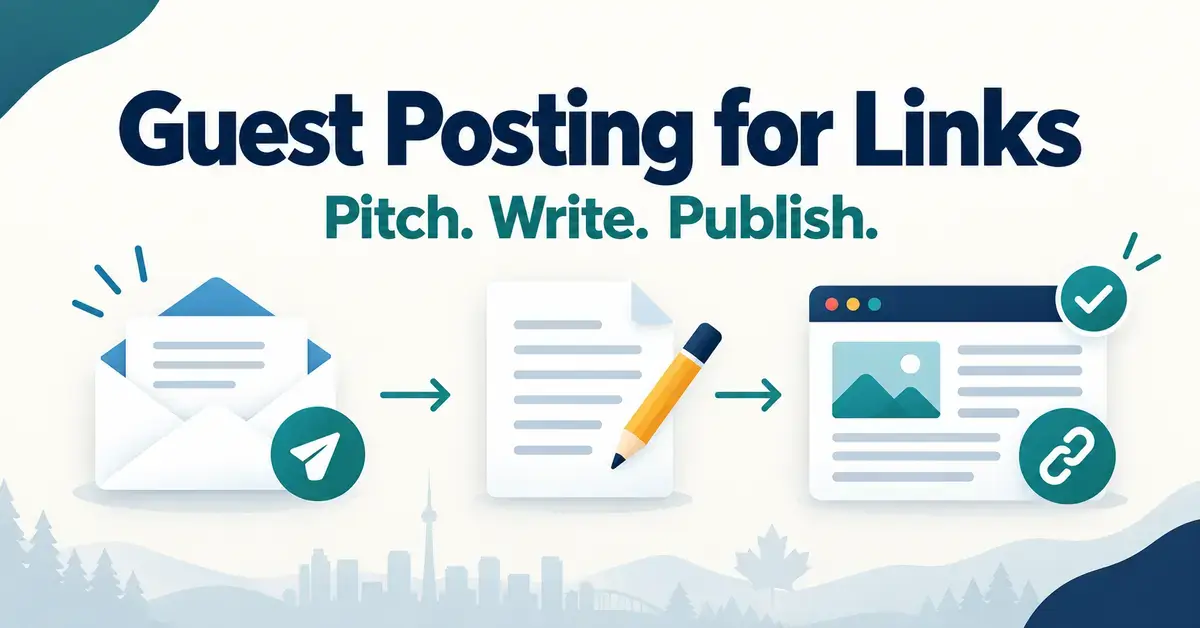
Guest posting means writing an article for someone else’s website, published under your own byline, usually with a link pointing back to your site. Done well, it earns genuine editorial links, referral traffic, and author visibility in your field. Done badly, it trips Google’s link-spam rules and can hurt both you and the site that published you. This guide explains what it is, where it stands with Google today, how to find and pitch sites, how to write a post an editor will actually run, and how to place links the right way, including the Canadian anti-spam rules that apply when you email prospects here.
Key Points
- What it is: writing an article for another site, published under your byline, usually with a link back to yours.
- Google’s line: useful contributor articles are fine; using guest posts mainly to build ranking links is link spam.
- Link tagging: SEO-driven or paid links should use rel=”nofollow” or rel=”sponsored”; only a freely given editorial link stays followed.
- Site selection: relevance and real audience beat volume and third-party authority scores.
- Outreach: short, personal, reader-focused pitches win; most generic emails get no reply, and one follow-up helps.
- Canada: cold outreach must comply with CASL, with sender identity and an unsubscribe option.
What is guest posting?
Also called guest blogging or contributor posting, it means publishing your content on a website you do not own. You write an original article, the host site’s editor reviews and publishes it, and you typically get a short author bio and one or more links, either to your homepage or to a relevant page. The link is the part most SEOs care about, because a link from a relevant, trusted site is one of the clearest signals Google uses to judge authority. If you are new to how links work, our beginner guide to what backlinks are explains referring domains, anchors, and the anatomy of a link before you start.
There are two honest goals for a guest post, and they pull in different directions. The first is marketing: reaching a new audience, building a reputation, and sending interested readers to your site. The second is link building: acquiring a link that helps your pages rank. The two overlap, but Google treats them very differently once link acquisition becomes the main purpose. Understanding that line is the whole game.
Is guest posting still allowed by Google?
Yes, it is allowed, but writing guest articles mainly to manufacture ranking links is against Google’s spam policies. This is the single most misunderstood point in the topic, so it is worth getting exactly right.
Where the “guest blogging is dead” idea comes from
On 20 January 2014, Matt Cutts, then head of Google’s web-spam team, wrote that “if you’re using guest blogging as a way to gain links in 2014, you should probably stop,” because the tactic had “become a more and more spammy practice.” Within a day he clarified that he was not condemning all guest posting: “High-quality multi-author blogs like Boing Boing have been around since the beginning of the web, and they can be compelling, wonderful, and useful.” His target was guest blogging done purely for SEO, not contributing genuinely useful articles to real publications.
What Google penalizes today
Google’s current spam policies list, as an example of link spam, “advertorials or native advertising where payment is received for articles that include links that pass ranking credit, or links with optimized anchor text in articles, guest posts, or press releases distributed on other sites.” In a 2017 reminder about links in large-scale article campaigns, Google named the red flags that mark a campaign as abusive:
- Stuffing keyword-rich links to your site into the articles.
- Publishing the same or very similar articles across many different sites.
- Using writers who do not actually know the subject, producing thin or off-topic pieces.
- Duplicating the full article on your own site without a rel=”canonical” tag.
When Google detects a site publishing or acquiring these links at scale without proper tagging, it can apply algorithmic demotions or a manual action, and that can affect the ranking of the whole domain, both the guest author’s site and the host’s.
When guest posting is fine
It is fine when the article would be worth publishing even if it carried no link at all. In Google’s own words, it does not discourage contributor posts “when these articles inform users, educate another site’s audience, or bring awareness to your cause or company.” If a knowledgeable person writes a genuinely useful piece for a relevant publication, that is content marketing, and any link in it is a side effect rather than the point.
Do guest-post links need to be nofollow?
If you are obtaining the link mainly for SEO, or if any payment or free product changed hands, the link should be qualified so it does not pass ranking credit. Google asks publishers to mark such links with rel=”nofollow”, and to use rel=”sponsored” when the placement is paid. A link the publisher freely chose to add because it genuinely helps readers can stay a normal (followed) link; the distinction is who controls the link and whether it was compensated. Treat a followed guest-post link as a bonus the editor grants, never as something you demand. For more on how the link itself is built, see anchor text optimization and what separates strong from weak links in our guide to backlink quality.
How do you find the right sites to pitch?
Start from relevance, not from a list of “sites that accept guest posts.” The best targets are publications your actual audience already reads, in or next to your niche. Quality beats quantity: a handful of placements on respected, topically relevant sites does more than dozens on generic “write for us” blogs that exist only to sell links.
Quality signals worth checking
- Topical relevance: the site covers your subject or an adjacent one, so your article fits naturally.
- Real audience and engagement: genuine comments, social shares, a newsletter, or an active community, not just archived posts.
- Editorial standards: bylines, editing, original reporting or expertise, and guidelines that ask for quality rather than just a word count and a fee.
- Organic visibility: the site ranks for its own topics and earns links itself. Third-party authority scores can help you compare candidates, but treat them as a rough filter, not proof of value.
- A clean link profile: the site is not plastered with unrelated casino, loan, or pharma guest posts, which signals a link farm.
Red flags to avoid
- Pages titled “guest post” that openly list prices per link or per “dofollow” placement.
- Sites publishing dozens of off-topic articles a day across unrelated niches.
- A footer or author archive stuffed with keyword-rich anchor text to many different companies.
- Private blog networks (PBNs): clusters of sites with the same owner built only to pass links.
Paying a site purely for a followed link is exactly the “buying links for ranking purposes” that Google’s policies name as link spam. If a placement is paid, it should be tagged sponsored; we cover the wider risk picture in our explainer on whether buying backlinks is safe.
How do you pitch a guest post?
A good pitch is short, personal, and about the editor’s readers rather than your links. Most outreach fails simply because it is generic. Backlinko’s analysis of nearly 12 million outreach emails found that only about 8.5% received any reply at all, and that sending a single follow-up increased response rates by roughly 66%. Guest-post pitches do better than cold outreach in general: real campaigns often report reply rates in the mid-teens to low-20s percent range when every email is personalized and relevant.
Writing the pitch email
- Find the right person (the editor or content lead) and use their name. Avoid “Dear webmaster.”
- Open with something specific you genuinely noticed about their site, not flattery that could apply to anyone.
- Propose two or three concrete titles with a one-line angle each, tied to gaps in what they already publish.
- Show you can deliver: link to one or two things you have written before.
- Keep it to a few short sentences and make the ask clear: would any of these be useful to their readers?
Following up
One polite follow-up after five to seven business days is worth sending, because many non-replies are simply missed emails, not rejections. Stop after one or two; repeated chasing damages your reputation more than it helps.
Staying compliant with CASL when you email Canadian sites
Canada’s Anti-Spam Legislation (CASL) applies to any commercial electronic message sent to or from a Canadian address, including outreach email, regardless of where you are based. Penalties can reach up to CAD 1 million for an individual and CAD 10 million for an organization per violation. In practice, cold outreach to a business is generally permitted when the recipient’s business email is published without a statement refusing unsolicited messages and your message is relevant to their role, but every message must identify you (legal name and a physical mailing address) and include a working way to unsubscribe. Because the rules are strict and fact-specific, read our dedicated guide to CASL outreach compliance before you run a campaign, and rely on the official Government of Canada guidance for the current requirements.
How do you write a guest post that gets published?
Write the best article the host site will run this month, not the minimum that carries your link. Editors accept pieces that make them look good to their readers, so the content has to stand on its own.
- Follow the brief exactly: word count, formatting, heading style, image rules, and how they handle links. Ignoring guidelines is the fastest way to a rejection.
- Be original and specific: add data, examples, or first-hand experience the site does not already have. Never recycle a piece you published elsewhere.
- Match their voice and reading level, and keep paragraphs short.
- Link out generously to useful sources, including the host’s own relevant articles, not just back to yourself.
- Keep self-promotion in the byline, where it belongs, rather than the body.
A useful benchmark for in-depth guest articles is roughly 1,000 to 2,000 words, enough to cover a topic properly, but depth should follow the subject, not a target. For ideas you can also pitch as your own on-site content, see how publishers earn backlinks with content.
How do you place the links the right way?
Place links where they genuinely help the reader, with anchor text that reads naturally. One contextual link to a relevant page, plus the byline link, is plenty for most articles. Avoid exact-match, keyword-stuffed anchors pointing at your money pages; that pattern is exactly what Google flags in article campaigns. Let the host set the rel attribute according to their policy and Google’s guidance, and never pressure an editor to make a paid or SEO-driven link followed. If you want a followed editorial link, earn it by being worth citing. Guest posting is one tactic among several, and it works best as part of a broader plan, as our overview of link building strategies explains.
Comparison
| Tactic | What it is | Typical effort | Usual link type | Best for |
|---|---|---|---|---|
| Guest posting | You write an article for another site in your niche | High (writing + outreach) | Byline + contextual; often nofollow if SEO-driven | Authority, referral traffic, relationships |
| Digital PR | Newsworthy data or stories journalists cite | High | Editorial, usually followed | High-authority news links at scale |
| Resource / link insertions | Adding a link to an existing relevant page | Medium | In-content editorial | Topical relevance without a full article |
| Expert-source requests | Answering journalist and blogger queries | Medium | Attribution link, often followed | Credibility and quotable expertise |
| Broken link building | Suggesting your page to replace a dead link | Medium | In-content editorial | Relevant replacements on existing pages |
| Directory & citation listings | Listing your business on reputable directories | Low | Profile link, often nofollow | Local visibility and trust signals |
Common guest-posting mistakes
- Chasing volume over relevance: dozens of links on unrelated “write for us” sites create risk without authority.
- Treating the article as a link wrapper: thin content built around an anchor gets rejected, or published somewhere that hurts you.
- Over-optimized anchor text: repeated exact-match commercial anchors are a classic spam footprint.
- Demanding followed links on paid placements: this is buying links for rankings, which violates Google’s policy and should be tagged sponsored.
- Republishing the same post everywhere: duplicate content across hosts offers no value and signals a spun campaign.
- Ignoring outreach law: non-compliant cold email to Canadian recipients carries real CASL penalties.
- Measuring the wrong thing: counting links instead of referral traffic, brand searches, and ranking movement on the pages that matter.
Who is guest posting right for?
It suits anyone who has real expertise to share and a relevant audience to reach: subject-matter experts, founders, agencies building authority for clients, and content teams that can commit to writing genuinely useful articles. It is a poor fit if your only goal is a cheap followed link fast, or if you cannot produce content good enough for a publication to stake its name on. For context on why links still matter so much to rankings, see our explainer on the importance of link building.
Sources
- Google Search Central — Spam policies for Google web search (Link spam)
- Google Search Central Blog — A reminder about links in large-scale article campaigns (2017)
- Matt Cutts — The decay and fall of guest blogging for SEO (2014)
- Backlinko — We Analyzed 12 Million Outreach Emails (outreach study)
- Respona — Guest Post Outreach: Lessons from Sending 1,000 Emails
- Government of Canada — Canada’s Anti-Spam Legislation (CASL)
Frequently Asked Questions (FAQ)
Is guest posting dead for SEO?
No. What “died” was low-quality guest blogging done purely to manufacture links, which Google has treated as spam since 2014. Contributing genuinely useful articles to relevant, trusted sites still works for reaching audiences, building authority, and earning editorial links.
Should guest-post links be nofollow?
If you obtain the link mainly for SEO, or any payment or free product was involved, yes, it should be qualified, with rel=”nofollow” for guest posts and rel=”sponsored” for paid placements. A link a publisher freely adds because it helps readers can remain followed.
How many guest posts should I publish per month?
There is no magic number. A few placements on highly relevant, respected sites are worth more than many on generic blogs. Scale by how much quality content you can genuinely produce, not by a link quota.
Is paying for guest posts safe?
Paying a site to publish your article is common, but paying for a followed link to influence rankings is link spam under Google’s policies. If money or products change hands, the link should be tagged sponsored or nofollow; otherwise both sites risk a penalty.
How long should a guest post be?
Follow the host’s guidelines first. In-depth guest articles commonly run about 1,000 to 2,000 words, but let the topic decide, enough to cover it well without padding.
