
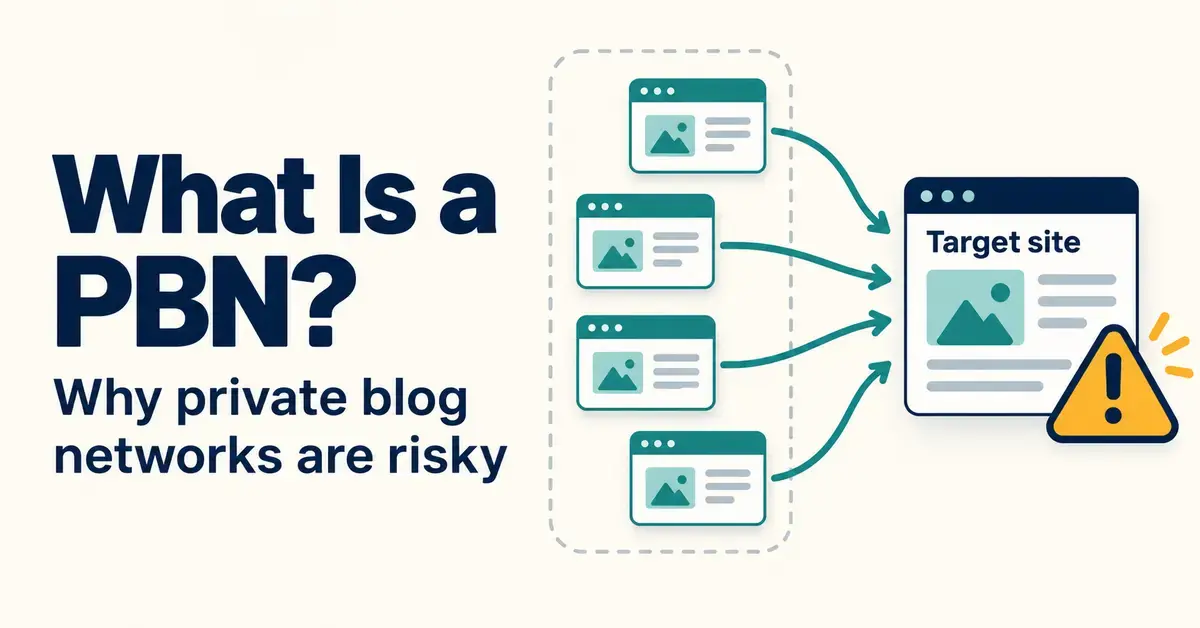
What is a PBN? Short for private blog network, a PBN is a group of websites that one person or company quietly owns and uses to create backlinks, known as PBN links, to a single site they want to push up Google’s rankings. The whole network exists for one job: to pass link “authority” to a target site on demand. Because those links are built to manipulate rankings rather than earned on merit, search engines treat them as spam, and the site that benefits from them can be penalised. This guide explains, in plain English, what a PBN is, how one is put together, why it breaks Google’s rules, how Google catches it, and what to do instead.
First, a quick refresher on the building block involved. If you are new to the topic, start with what backlinks are and how they work — a backlink is simply a link from one website to another, and search engines use them as signals of trust and relevance.
Key Points
- A PBN (private blog network) is a group of sites one owner secretly controls to funnel backlinks to a single “money site.”
- PBNs are usually built on expired domains that still carry old authority, with thin content added to host the links.
- PBN links fall under Google’s link spam policy, and building them on expired domains can also trigger the expired domain abuse policy introduced in March 2024.
- Google catches PBNs through footprints (shared hosting, reused accounts, duplicate templates, unnatural link patterns) and link-pattern analysis.
- Consequences range from links being quietly devalued to a manual action that can demote or deindex the site.
- Safer options — earning editorial links through strong content, digital PR and legitimate citations — hold their value and carry no penalty risk.
What is a PBN in SEO?
A private blog network is a set of separate-looking websites controlled by the same owner, created for the sole purpose of linking to a “money site” — the website the owner actually wants to rank and earn from. The sites in the network are usually dressed up to look like independent, unrelated blogs, but none of them exist to serve a real audience. Their only function is to be a backlink source the owner can switch on whenever they want a ranking boost.
The word “private” is the giveaway. A legitimate blog publishes for readers; a PBN blog publishes to hide the fact that one person controls a web of sites all pointing at the same target. That hidden central control is what separates a PBN from genuine websites that happen to link to you.
How does a PBN work?
A PBN works by stockpiling websites that already look trustworthy to Google, then using them to feed links to a money site. The typical build looks like this:
- Buy expired or auctioned domains. Operators hunt for expired domains — web addresses whose previous owners let them lapse — that still have existing backlinks and measurable authority from their old life. The goal is to inherit that reputation instead of building it from scratch.
- Rebuild a basic site. They put up a simple blog on each domain, often re-using old content or adding thin new articles so the site looks active.
- Insert links to the money site. Within that content they place backlinks to the target site, usually with keyword-rich anchor text (the clickable words in a link) chosen to influence what the money site ranks for.
- Repeat across many domains. One PBN can span a handful to hundreds of domains, so the owner can point a controlled number of links at any page whenever they choose.
The appeal is control. Instead of earning links by convincing real publishers to cite them, the owner can create links on demand, with the exact anchor text they want, pointed at the exact page they want. That control is also precisely why the tactic is fragile, as the next sections explain.
What is a “money site” and “link juice”?
The money site is the website the owner is trying to rank and monetise — a store, a lead-generation page, an affiliate site. Link juice is informal SEO slang for the ranking value that flows through a link from one page to another; Google’s own version of this idea is PageRank, its long-standing method of judging a page partly by the links pointing to it. A PBN is an attempt to manufacture that flow of value artificially rather than earn it.
Why do people use PBNs?
People use PBNs because earning high-quality backlinks is slow, competitive work, and a PBN promises a shortcut. The perceived advantages are:
- Speed: links can be live within hours rather than earned over months.
- Control: the owner chooses the anchor text, the target page and the number of links.
- Cost predictability: once the domains are bought, the owner can place links without paying per placement.
These benefits are real in the short term, which is why PBNs persist. The problem is that every one of them depends on Google failing to notice — and Google has spent more than a decade building systems to notice. That trade-off is the heart of why a PBN is a risky link source rather than a clever one.
Why do PBNs violate Google’s guidelines?
PBN links violate Google’s guidelines because they are, by definition, links created to manipulate rankings — the exact behaviour Google’s spam policies prohibit. Google’s documentation defines link spam as “the practice of creating links to or from a site primarily for the purpose of manipulating search rankings,” and lists buying or selling links for ranking purposes and using automated programs to create links among its examples. A PBN is a machine for doing precisely that.
A second, newer policy catches the way most PBNs are built. In its March 2024 update, Google introduced an expired domain abuse policy, which it defines as buying an expired domain and repurposing it “primarily to manipulate search rankings by hosting content that provides little to no value to users.” Because PBNs are usually assembled on expired domains with thin, link-serving content, they can fall foul of this policy as well as the link spam one.
Note one nuance: Google’s public spam-policy page does not spell out the phrase “private blog network,” but that does not create a loophole. The tactic is covered by the broader link spam and expired domain rules, and Google representatives have repeatedly confirmed that PBN links are treated as spam.
How does Google detect PBNs?
Google detects PBNs by looking for “footprints” — repeated patterns that reveal that supposedly independent sites are actually one network. On its own, no single footprint proves anything; together, they form a recognisable signature. Common footprints include:
- Shared hosting or IP addresses — many “different” blogs living on the same server.
- Reused accounts — the same Google Analytics, AdSense or registrar details across sites.
- Identical templates and plugins — the same theme, layout or setup repeated network-wide.
- Thin or duplicated content — little original writing, often spun or copied.
- Unnatural link patterns — a cluster of sites that link to the same money site with the same keyword-heavy anchor text, and rarely link anywhere else.
- No real audience — no organic traffic, comments, social shares or return visitors.
Operators spend significant effort hiding these footprints with different hosts, varied themes and privacy registration. But Google increasingly identifies manipulative link networks through link-pattern analysis rather than relying on crude technical slip-ups, which means even a “well-hidden” PBN is not safe — it is merely undetected for now. Understanding what makes a backlink high or low quality helps explain why these links look suspicious to an algorithm trained on genuine citations.
What happens if you get caught using a PBN?
If Google catches a site relying on a PBN, the consequences range from quietly losing the links’ value to a full manual penalty. There are two main ways this plays out:
- Algorithmic devaluation. Google may simply stop counting the PBN links, so the rankings they propped up collapse. There is no warning message — the traffic just disappears. John Mueller of Google has noted that when an expired domain is repurposed for something unrelated, Google can reset the value of its old links so they no longer carry weight.
- Manual action. A human reviewer at Google can apply a manual penalty for “unnatural links to your site.” This appears in the Manual Actions report inside Google Search Console (Google’s free toolset for site owners), and it can demote specific pages or your whole site — or remove it from search results entirely, known as being deindexed.
Recovering is slow and uncertain. You generally have to identify and remove or disavow the toxic backlinks using Google’s disavow tool, then file a reconsideration request explaining what you cleaned up. Google warns that blindly disavowing every link is not treated as a good-faith effort. The full process of recovering from a Google penalty can take weeks or months, during which rankings and revenue stay suppressed. In short, the downside dwarfs the short-term upside — which is the core reason PBNs count as a risky link source.
PBN links vs. earned editorial links
The clearest way to weigh a PBN is to compare it with the kind of link Google actually rewards: an editorial link, meaning one a real publisher chose to give you because your content was worth citing. The table below sets the two side by side.
Comparison
| Factor | PBN backlinks | Earned editorial backlinks |
|---|---|---|
| How the link is obtained | Self-created on sites you control | Given freely by an independent publisher |
| Control over anchor text | Full control (a warning sign to Google) | Decided by the publisher, so it looks natural |
| Speed | Fast — live within hours | Slow — weeks or months to earn |
| Google policy status | Violates link spam / expired domain policies | Fully compliant |
| Penalty risk | High — devaluation or manual action | None from the link itself |
| Durability | Can be stripped retroactively at any time | Keeps passing value for years |
| Referral traffic | Little to none (no real audience) | Real readers may click through |
| Long-term cost | Hidden cost of recovery if caught | Upfront effort, lasting asset |
The pattern is consistent: PBNs win on speed and control but lose on safety, durability and trust — the factors that actually sustain rankings over time.
Common mistakes and misconceptions about PBNs
Most PBN trouble starts with beliefs that sound reasonable but are wrong. The most common ones:
- “My PBN is safe because I hid all the footprints.” Hiding footprints lowers short-term detection risk; it does not make the links compliant. The links still violate policy, and detection methods keep improving.
- “I’m buying links from a provider, so the risk is theirs.” The penalty lands on the money site that benefits. If a vendor sells you “high-authority PBN links,” you are the one who pays when Google acts. Think carefully about whether buying backlinks is safe before spending.
- “Expired domains are a legitimate shortcut to authority.” Buying an aged domain and repurposing it to pass links is exactly what Google’s expired domain abuse policy targets.
- “A few PBN links won’t hurt.” Risk scales with reliance, but even a small manipulative pattern can trigger a devaluation or manual action, and you rarely control how a network is later exposed.
- “If rankings went up, the links must be working.” Short-term gains are common; they are also the trap. The value can be stripped retroactively long after you have built your business on it.
Safer alternatives to PBNs
The safer alternative to a PBN is to earn links that publishers would give you anyway — slower to build, but they hold their value and carry no penalty risk. Proven approaches include:
- Create link-worthy content. Original research, data, tools and genuinely useful guides attract citations naturally. See how to earn backlinks with content.
- Digital PR and outreach. Pitch relevant journalists, bloggers and industry sites with something worth linking to, rather than buying a slot.
- Legitimate local citations. For Canadian businesses, reputable directories, local news and industry associations build real, defensible authority.
- Guest contributions on real publications. Writing genuinely for an audience on a site with real readers is editorial; mass guest posts purely for links are not.
These methods compound. A PBN can vanish overnight; an earned link from a trusted publication keeps sending signals and referral traffic for years.
Who still uses PBNs, and should you?
PBNs are still used mainly by operators chasing fast rankings in disposable projects — churn-and-burn affiliate sites, short-lived campaigns, or niches where the owner expects to be penalised eventually and does not care. For anyone building a lasting brand, a client’s reputation or a business that depends on stable Google traffic, the maths does not work: the potential upside is temporary, and the downside is a penalty that can wipe out the asset you were trying to grow. The responsible answer for almost every legitimate website is to avoid PBNs entirely and invest in links you can defend.
Sources
- Google Search Central — Spam policies for Google web search (link spam, expired domain abuse)
- Google Search Central Blog — What web creators should know about the March 2024 core update and new spam policies
- Google Search Console Help — Unnatural links to your site
- Google Search Console Help — Disavow links to your site
- Ahrefs — Private Blog Network (PBN): What It Is and Why You Should Avoid It
Frequently Asked Questions (FAQ)
Is using a PBN illegal?
No. Running a PBN is not against the law; it is against Google’s spam policies. The consequence is not a legal one but a search one — Google can devalue the links or apply a manual penalty that demotes or removes your site from its results.
Can Google really detect a well-hidden PBN?
Often, yes. Google looks for patterns across sites — shared hosting, reused accounts, duplicated templates and unnatural link profiles — and increasingly analyses link patterns directly. Hiding footprints lowers the odds of quick detection but never makes the links compliant or permanently safe.
What is the difference between a PBN and a guest post?
A PBN is a network of sites one owner controls purely to link to their own money site. A genuine guest post is content published on an independent site with a real audience, for that audience’s benefit. The line blurs when guest posts are bought in bulk solely for links, which Google also treats as link spam.
Why are expired domains central to most PBNs?
Expired domains may still carry backlinks and authority from their previous owners, so operators buy them to inherit that reputation instead of earning it. Google’s expired domain abuse policy specifically targets repurposing such domains to manipulate rankings.
What should I do if I already have PBN links pointing at my site?
Audit your backlink profile, try to get the manipulative links removed, and disavow the ones you cannot remove using Google’s disavow tool. If you have a manual action, fix the links first, then submit a reconsideration request explaining the cleanup. Focus future effort on earning editorial links instead.
