
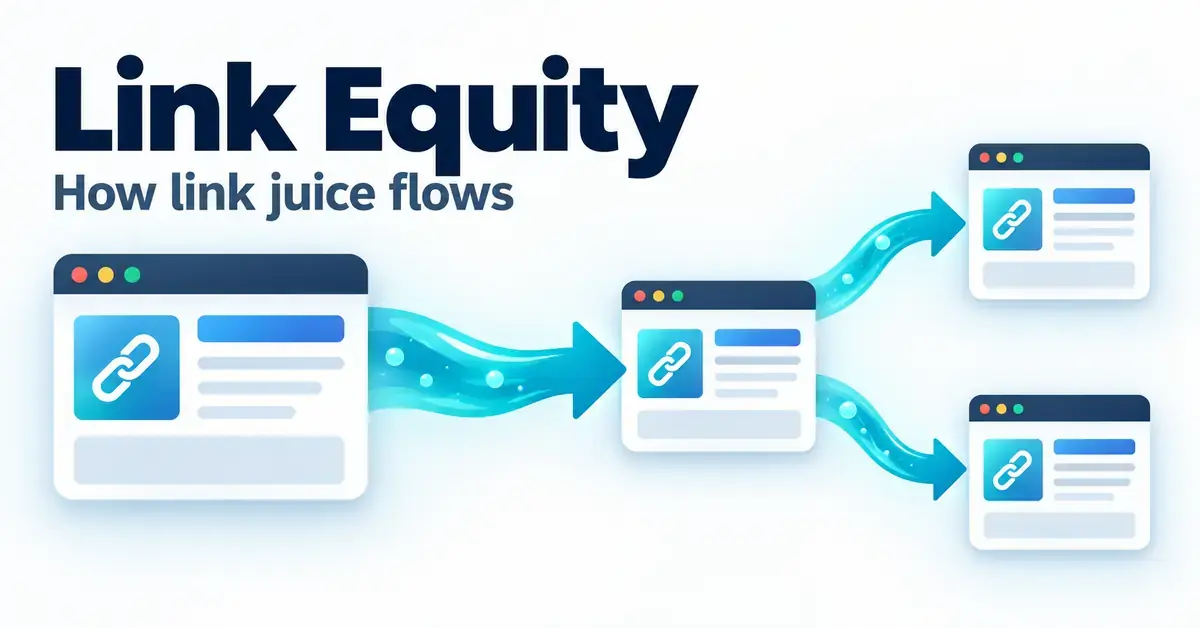
Link equity — the ranking value that one web page passes to another through a hyperlink — is one of the ideas that quietly powers search engine optimization (SEO). Many people know it by its older nickname, link juice. When a trusted page links to yours, a share of that trust can flow across the link and help your page rank higher in Google. This guide explains, in plain English, what link equity actually is, how it moves from page to page, what makes a link pass more or less value, and the common mistakes that waste it. No prior SEO knowledge is required.
Key Takeaways
- Link equity (“link juice”) is the ranking value that passes from one page to another through a hyperlink.
- Only followed (dofollow) links reliably pass equity; nofollow, sponsored and ugc links generally do not.
- A page splits the equity it passes among its outgoing links, so fewer, more relevant links pass more value each.
- Internal links move equity around your own site — a free, low-risk ranking lever you fully control.
- 301 redirects forward equity to an equivalent page, but redirecting to an unrelated page can lose it.
- You can’t see Google’s real score; tools estimate it as DR, DA or Authority Score (0–100).
What is link equity (link juice)?
Put simply, it is the authority or ranking power that passes from one page to another through a link. Search engines treat a link roughly like a vote of confidence: when Page A links to Page B, some of Page A’s credibility can transfer to Page B. The more trusted Page A is, the more valuable that vote becomes.
The term grew up alongside Google’s original ranking idea, PageRank — an algorithm that estimates a page’s importance partly by counting the number and quality of pages linking to it. SEO practitioners in the 2000s nicknamed this transferable value “link juice,” and the more formal label “link equity” stuck. The core principle is simple: links don’t just send visitors, they also send signals, and those signals help search engines decide which pages deserve to rank.
The concept is the thread that ties together three things you will hear about constantly in SEO: backlinks (links from other sites to yours), internal links (links between pages on your own site), and PageRank-style authority. Understanding how equity flows makes all three easier to reason about.
How does ranking value flow between pages?
This value flows along “followed” links, and each page splits the equity it can pass among the links it points to. Picture a page as a reservoir of authority. When it links out, it distributes a portion of that authority through its links. If a page has a lot of authority and links to only a few pages, each of those pages receives a larger share. If the same page links to dozens of pages, the share each one gets is smaller because the value is divided more ways.
Three things shape this flow:
- The source page’s authority. A link from a strong, widely trusted page carries more equity than a link from an obscure one.
- The number of links on the source page. Equity is shared across the outgoing links, so fewer outbound links generally means more value per link.
- Whether the link is followed. Only “followed” links reliably pass equity (more on link attributes below).
There is also a natural decay: value weakens slightly each time it hops from one link to the next, so a page three clicks removed from a strong backlink feels less of its benefit than the page that received the link directly. This is why links pointing to deep, hard-to-reach pages do less for them than links to pages near the top of your site.
What makes one link pass more value than another?
How much equity a single link transfers depends on several factors working together, not on any one setting. The main ones are below.
Authority and trust of the linking page
The authority of the specific page doing the linking matters more than the overall site. A link from a high-quality, relevant page on a reputable domain passes far more value than a link from a thin or spammy page. This is why backlink quality consistently beats raw quantity.
Topical relevance
Relevance strengthens a link’s value. A link from a page about Canadian small-business accounting to your bookkeeping service is worth more than an unrelated link, because it makes contextual sense to search engines and readers alike.
Anchor text
The clickable words of a link — the anchor text — give search engines context about the destination. Descriptive, natural anchors help; over-optimized, repetitive, exact-match anchors can look manipulative. See our guide to anchor text optimization for how to get this balance right.
Link placement
Where the link sits on the page influences its weight. A link within the main body content, in an editorial context, tends to carry more value than one buried in a footer, sidebar, or a long list of links.
Follow status (the rel attribute)
Finally, the link’s rel attribute determines whether equity is meant to pass at all. That is important enough to deserve its own section.
Dofollow vs nofollow, sponsored and ugc links
By default, a link is “dofollow” and is eligible to pass link equity; special rel attributes tell search engines to treat a link differently. There is no actual rel=”dofollow” attribute — “dofollow” simply means a normal link with no restricting attribute. The attributes that change the picture are:
- rel=”nofollow” — introduced by Google in 2005 to fight blog-comment spam. It tells search engines you don’t vouch for the destination and don’t want to pass ranking credit.
- rel=”sponsored” — for paid or advertising links, such as sponsorships and affiliate placements.
- rel=”ugc” — for user-generated content, such as forum posts and blog comments.
Google introduced sponsored and ugc on 10 September 2019. On the same day, Google stopped treating these attributes as strict directives and began treating nofollow, sponsored and ugc as hints for ranking — meaning Google may choose whether to use them as a signal. From 1 March 2020, nofollow also became a hint for crawling and indexing, so Google may occasionally follow such links. In practice, you should still assume a dofollow link is required if you want reliable equity transfer.
Link Attribute Comparison
| Link type | HTML attribute | Typical use | Passes link equity? |
|---|---|---|---|
| Dofollow (standard) | No special rel attribute | Normal editorial links you vouch for | Yes — eligible to pass equity |
| Nofollow | rel=”nofollow” | Links you don’t endorse; introduced 2005 | Treated as a hint since 2020; assume no |
| Sponsored | rel=”sponsored” | Paid, advertising or affiliate links | Hint only; generally no |
| User-generated content | rel=”ugc” | Comments, forum and other user posts | Hint only; generally no |
How internal links spread authority across your site
Internal links pass equity between pages on the same site, which lets you channel authority from strong pages to the pages you most want to rank. When a popular article earns a lot of backlinks, you can share some of that authority with related pages simply by linking to them from within that article. This is one of the most underused, lowest-risk levers in SEO because you control every internal link yourself.
A few practical habits help:
- Keep important pages shallow. Pages reachable within a few clicks of the homepage, for example through a topic index like our link building resources page, receive and retain more equity than pages buried deep in the structure.
- Link from strong pages to priority pages. Identify which of your pages attract the most backlinks, then link outward from them to the pages you want to lift.
- Use descriptive anchor text. Internal anchors should describe the destination clearly rather than relying on “click here.”
- Avoid orphan pages. A page with no internal links pointing to it is hard for search engines to find and receives almost no equity.
Done well, internal linking spreads authority sensibly across your site and reinforces the value of link building you have already done.
Do redirects and canonicals pass ranking value?
Yes — a 301 (permanent) redirect forwards link equity to the destination, and Google has confirmed it does so through canonicalization. When you redirect an old URL to a new one, Google uses the redirect to pick a “canonical” (preferred) URL and concentrates the signals from the old address onto the new one. Google’s John Mueller has explained that both 301 and 302 redirects can forward PageRank this way, so you generally keep the value an old page earned when you move it.
Two cautions apply. First, redirect to a genuinely equivalent page: a 301 that points to an unrelated page (for example, redirecting a deleted product to the homepage) may pass little or no equity, because the destination no longer matches the links’ context. Second, long chains of redirects add friction and should be collapsed where possible so each old URL points straight to its final destination.
How can you estimate a page’s authority?
You can’t see Google’s internal PageRank score, so SEO tools estimate it using their own authority metrics. These are third-party approximations, not official Google numbers, but they are useful for comparing pages and tracking progress over time. The best-known examples are:
- Domain Rating (DR) and URL Rating (UR) from Ahrefs.
- Domain Authority (DA) and Page Authority (PA) from Moz.
- Authority Score from Semrush.
Each is scored on a 0–100 scale, and each is calculated differently, so a site’s DA and DR will rarely match exactly — a point worth understanding before you compare them, which we cover in DA vs DR. To dig into where your equity comes from and which pages hold the most, use a dedicated backlink analysis tool to map your strongest pages and their links.
Common mistakes that waste ranking value
Most wasted equity comes from a handful of avoidable mistakes rather than any single dramatic error. Watch for these:
- Trying to “sculpt” PageRank with nofollow. An old tactic was to nofollow internal links to low-value pages to “save” equity for important ones. Google’s Matt Cutts confirmed in 2009 that this no longer works: if a page could pass value through ten links and you block five, the remaining five do not each receive a bigger share — the blocked value is simply lost. Use nofollow for its intended purposes, not for internal sculpting.
- Chasing quantity over quality. Hundreds of links from weak or irrelevant pages pass little equity and can even look manipulative. A few strong, relevant links usually outperform them.
- Redirecting old pages to the homepage. This throws away the equity those pages earned. Redirect to the closest relevant page instead.
- Leaving valuable pages orphaned. If nothing on your site links to a page, it receives almost no internal equity. Link to it from relevant, well-linked pages.
- Ignoring toxic or spammy inbound links. Low-quality, manipulative links can do harm. Review them and, where necessary, learn how to disavow toxic backlinks.
- Over-optimizing anchor text. Repeating the same exact-match keyword as anchor text across many links looks unnatural and can backfire.
Who needs to understand how links pass value?
Anyone who wants a website to rank — business owners, bloggers, marketers and SEO specialists — benefits from understanding link equity. You do not need to calculate it to use the concept well. If you grasp that followed links from strong, relevant pages pass value, that your internal links move that value around your own site, and that redirects preserve it when handled correctly, you already have the mental model you need. From there, the practical work is earning quality links and linking sensibly, which is the heart of every sound link building strategy.
Sources
- Google Search Central — Qualify your outbound links to Google
- Google Search Central Blog — Evolving “nofollow” — new ways to identify the nature of links
- Ahrefs — Nofollow vs. Follow Links: Everything You Need to Know
- Moz — Link Equity (Learn SEO)
- Search Engine Journal — Google Shares How 301 Redirects Pass PageRank
Frequently Asked Questions (FAQ)
Is “link juice” the same as link equity?
Yes. “Link juice” is the informal, older nickname and “link equity” is the more formal term, but both describe the same thing: the ranking value that passes from one page to another through a link.
Do nofollow links pass any ranking value?
Not reliably. Since 2020 Google treats nofollow as a hint rather than a strict rule, so it may occasionally follow such links, but you should assume a normal (dofollow) link is needed for dependable equity transfer. Nofollow links can still send real visitors and brand exposure.
Do more backlinks always mean more value?
No. The authority and relevance of the linking pages matter far more than the raw count. A handful of strong, topically relevant links typically passes more equity than a large number of weak or unrelated ones.
Do internal links pass authority between your pages?
Yes. Links between pages on your own site distribute equity across your pages, letting you send authority from pages that earn backlinks to the pages you most want to rank. Internal links are fully under your control, which makes them a low-risk way to improve rankings.
Can I see a page’s exact authority score?
Not exactly. Google’s internal scores are private, so SEO tools provide estimates such as Domain Rating, Domain Authority and Authority Score on a 0–100 scale. These are useful for comparison and trend tracking, but they are approximations rather than official figures.
