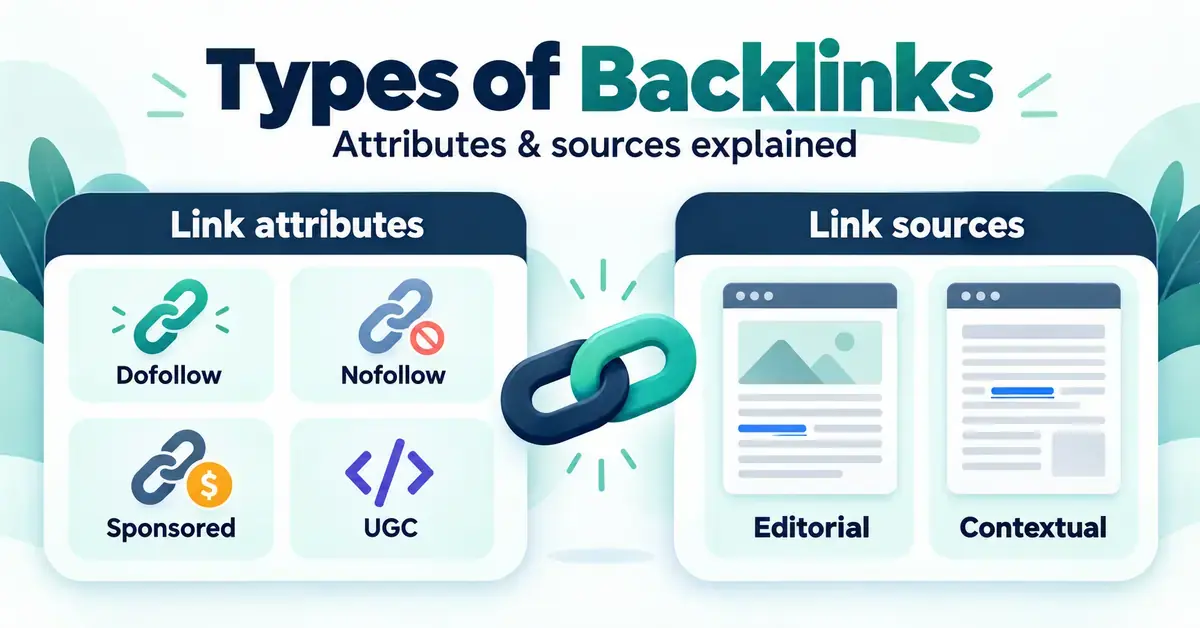
Backlinks are links from one website to another, and they are not all the same. Search engines read extra information attached to each link, and they also weigh where the link sits and how it was earned. Understanding the main types of backlinks helps you tell a valuable link from a worthless or even risky one. This guide sorts every common backlink into two clear groups — link attributes (the rel value in the HTML) and link sources (where and how the link was placed) — and then compares them by SEO value, risk and when each one is appropriate.
Key Points
- Two lenses: classify every backlink by its attribute (the rel value) and by its source (where and how it was placed).
- Attributes: dofollow (default, no rel), rel=”nofollow”, rel=”sponsored” (paid) and rel=”ugc” (user-generated content). Values can be combined, e.g. rel=”ugc sponsored”.
- Hints, not rules: since September 2019 Google treats nofollow, sponsored and ugc as hints rather than strict directives.
- Most valuable: editorial, contextual links earned naturally from relevant, authoritative pages.
- Compliance: any paid or compensated link must carry rel=”sponsored” or rel=”nofollow”, or it breaks Google’s link spam policy.
What are the different types of backlinks?
There are two useful ways to classify backlinks, and most confusion comes from mixing them up. The first is by link attribute — the rel value in the link’s HTML code, which tells search engines how to treat the link (for example dofollow, nofollow, sponsored or UGC). The second is by source — where the link physically appears and how it was obtained (for example an editorial mention inside an article, a guest post, a directory listing or a forum comment).
A single link always has both a source and an attribute. A link inside a blog article (source: editorial) might be a normal dofollow link (attribute), while a link in a blog comment (source: UGC) is usually marked rel=”ugc” (attribute). Keeping the two lenses separate makes it much easier to judge any link you build or receive.
Link attributes: dofollow, nofollow, sponsored and UGC
Link attributes are set with the rel attribute inside the HTML anchor tag. They signal to Google whether the link should be considered when passing ranking credit and why the link exists. There are three official rel values plus the default “dofollow” state.
What is a dofollow link?
A dofollow link is a normal link that can pass ranking credit, and it is simply a link with no special rel value. Despite the name, there is no rel=”dofollow” attribute in HTML — “dofollow” is just the word SEOs use for the default behaviour. When you place an ordinary link like <a href=”https://example.com”>, it is already a dofollow link. These are the links that most directly help the destination page’s rankings, which is why they are the goal of most link building.
What is a nofollow link?
A nofollow link tells Google you do not necessarily endorse the destination or do not want to pass ranking credit to it, using rel=”nofollow”. Google introduced nofollow in 2005 to fight comment spam. According to Google, you should “use the nofollow value when other values don’t apply, and you’d rather Google not associate your site with, or crawl the linked page from, your site.” Nofollow links still send real visitors and can build brand awareness even when they pass little or no direct ranking signal.
What is a sponsored link (rel=”sponsored”)?
A sponsored link marks a paid or compensated placement, using rel=”sponsored”. Google’s guidance is explicit: “Mark links that are advertisements or paid placements (commonly called paid links) with the sponsored value.” This covers ads, affiliate links, sponsorships and any link where money, products or services changed hands. Using this attribute is not optional for paid links — it is a compliance requirement, covered in the paid-links section below.
What is a UGC link (rel=”ugc”)?
A UGC link identifies user-generated content, using rel=”ugc”. Google recommends “marking user-generated content (UGC) links, such as comments and forum posts, with the ugc value.” If you run a blog, forum or any site where visitors can post links, this attribute tells Google those links were placed by users rather than editorially vouched for by you. You can also combine values — for example rel=”ugc sponsored” is valid for a paid link that also came from user-generated content.
Dofollow vs nofollow: what is the difference?
The core difference is that a dofollow link can pass ranking credit while a nofollow link signals that credit should not necessarily be passed. A healthy backlink profile naturally contains both. Sites that link out only with dofollow, or a profile made up almost entirely of nofollow links, can both look unnatural. The practical takeaway: pursue relevant dofollow links for ranking impact, but do not dismiss nofollow links, because they still drive traffic, referrals and visibility, and a mix looks organic.
Does Google treat these attributes as rules or hints?
Google treats sponsored, ugc and nofollow as hints, not strict directives. Since a change announced in September 2019, Google uses these rel values — together with other signals — to better understand which links to consider or exclude, rather than obeying them as absolute commands. In practice that means a nofollow link is not guaranteed to be ignored and a marked page may still be crawled or found through other routes such as sitemaps. Mark your links correctly, but do not assume an attribute gives you total control over how Google reads the link.
Source-based types of backlinks
Source-based types describe where a link lives and how it was earned, which often matters more for SEO value than the attribute alone. The same rel=”nofollow” tag can sit on a spammy comment or a link from a major newspaper, so the source is what separates high-value links from noise.
Editorial backlinks
Editorial backlinks are links a writer or publisher adds naturally because your page genuinely adds value, and they are widely considered the most valuable type. They are earned, not paid for or exchanged, which is exactly what search engines want to reward. Because you cannot simply request them, editorial links usually come from creating content worth citing — original data, useful tools, clear explainers or expert insight.
Contextual backlinks
Contextual backlinks are links placed inside the main body of a piece of content, surrounded by relevant text, rather than in a footer, sidebar or author bio. The surrounding context signals relevance, so search engines generally give body-content links more weight than links stuck in template areas. All editorial links are contextual when they sit inside the article, but not every contextual link is editorial — a link inside a guest post is contextual yet was placed by you, not the publisher.
Guest post backlinks
Guest post backlinks come from articles you write for another website, usually including a link back to your own site. They can be legitimate when the content is genuinely useful and the audience is relevant. They cross into risky territory when they are produced at scale purely for links, or when they use keyword-stuffed anchor text — Google names “links with optimized anchor text in articles or press releases distributed on other sites” as a link-scheme example.
Directory backlinks
Directory backlinks come from business or web directories. Reputable, curated directories — especially niche or local ones — can send real traffic and help local SEO. Low-quality, unmoderated directories that exist only to list links add little and can be a spam signal when built in bulk. Quality and relevance decide whether a directory link helps or hurts.
Forum and comment backlinks
Forum and comment backlinks are placed by users in discussion threads, comment sections or profile fields, and they are typically marked rel=”ugc” or rel=”nofollow”. A relevant link shared in a genuine discussion can drive traffic, but mass-posting links across forums and comments is one of the oldest spam tactics and offers little SEO value. Focus on real participation, not link drops.
Footer, sidebar and sitewide backlinks
Footer, sidebar and sitewide backlinks appear in template areas and therefore repeat on every page of the linking site. Because they are not contextual and are easy to place at scale, they carry little editorial weight, and keyword-rich sitewide links can look manipulative. A single relevant partner link in a footer is usually fine; thousands of identical sitewide links pointing at one site is a classic low-value pattern.
Other common backlink sources
Several other sources appear often in link profiles:
- Profile links: links added to a user profile on a platform or community. Usually low value and often nofollow, but harmless in moderation.
- Social media links: links shared on social platforms. Typically nofollow, so little direct ranking credit, but useful for reach and discovery.
- Press release links: links inside distributed press releases. Google expects these to be qualified (often nofollow or sponsored) and warns against optimized anchor text in them.
- Image links: a linked image; the ALT text acts as the anchor, so descriptive ALT text matters.
- .edu and .gov links: links from education or government domains. There is no special ranking boost from the domain type itself — value comes from relevance and authority, like any other link.
Backlink Types Comparison
| Backlink type | Typical SEO value | Risk level | When it is appropriate |
|---|---|---|---|
| Editorial / contextual | Very high | Very low | Earned naturally from relevant, quality content |
| Guest post (relevant, natural anchors) | Medium–high | Medium | Genuinely useful articles for a relevant audience |
| Reputable / niche & local directory | Low–medium | Low | Curated directories; local SEO and citations |
| Forum & comment (rel=”ugc”) | Low | Medium | Real participation in relevant discussions |
| Footer / sidebar / sitewide | Low | Medium–high | A single relevant partner link, not bulk placements |
| Paid / sponsored (rel=”sponsored”) | Traffic only, no ranking credit | Low if marked, high if unmarked | Advertising and sponsorships, correctly qualified |
| Profile & social | Low (mostly nofollow) | Low | Brand presence and referral traffic |
| Press release | Low | Medium | Real news; qualified links, no keyword-stuffed anchors |
Which backlinks are worth pursuing?
The best backlinks are relevant, editorially placed and contextual, because those are the links search engines most trust. As a rough hierarchy, editorial and contextual links from relevant, authoritative pages sit at the top; qualified guest posts and reputable niche or local directories are useful in moderation; and mass forum, comment, profile and sitewide footer links sit at the bottom because they add little and can look manipulative in volume. Chase relevance and genuine usefulness rather than raw link counts — a handful of trusted editorial links outperforms hundreds of low-quality ones.
Paid links and compliance: the rel=”sponsored” or nofollow requirement
Any paid or compensated link must be qualified with rel=”sponsored” or rel=”nofollow”, or it violates Google’s link spam policy. Google’s spam policies list “buying or selling links for ranking purposes” as link spam, which includes “exchanging money for links, or posts that contain links,” “exchanging goods or services for links,” and “sending someone a product in exchange for them writing about it.”
Crucially, paid links are not banned outright — only unqualified ones are. Google states plainly that “it’s not a violation of our policies to have such links as long as they are qualified with a rel=”nofollow” or rel=”sponsored” attribute value.” This applies to advertising, sponsorships, affiliate links, sponsored guest posts and paid link insertions (niche edits). If money, free products or services were involved, mark the link — otherwise both the site giving and the site receiving the link can be in breach of the guidelines, risking ranking demotions or manual actions.
Common mistakes when building backlinks
Most backlink problems come from a handful of repeated mistakes:
- Leaving paid links unmarked: the single most common compliance error. Any paid or exchanged link without rel=”sponsored” or rel=”nofollow” breaks Google’s rules.
- Chasing volume over relevance: hundreds of low-quality directory, forum or comment links do far less than a few relevant editorial links.
- Over-optimising anchor text: repeating exact-match keyword anchors, especially in guest posts and press releases, is a named link-scheme signal.
- Ignoring nofollow links entirely: they still drive traffic and keep a profile looking natural; an all-dofollow profile can look engineered.
- Buying sitewide footer or template links: thousands of identical sitewide links to one site is a classic manipulative pattern.
- Rushing to disavow: Google largely ignores spammy links on its own. The disavow tool is mainly for cases involving a manual action or a large volume of harmful links you cannot get removed — it is not routine maintenance.
Which backlinks suit which goals?
Match the link type to what you are trying to achieve rather than treating all links as interchangeable. For long-term rankings, prioritise editorial and contextual links from relevant sites. For local visibility, reputable local and niche directories plus local press help most. For referral traffic and brand awareness, social, forum and even nofollow links from busy pages can send real visitors regardless of ranking credit. For advertising and partnerships, use paid placements — correctly marked with rel=”sponsored”. A balanced profile that mixes these sources and attributes, earned steadily over time, is both safer and more effective than any single tactic pushed to the extreme.
Sources
Frequently Asked Questions (FAQ)
Is there really no rel=”dofollow” attribute?
Correct — there is no rel=”dofollow” in HTML. A “dofollow” link is simply an ordinary link with no rel value that restricts it, so it can pass ranking credit by default. “Dofollow” is an informal term SEOs use to describe that normal behaviour.
What is the difference between nofollow, sponsored and UGC?
All three are rel values that qualify a link. Use sponsored for paid or compensated links, ugc for user-generated content such as comments and forum posts, and nofollow as the general option when the others do not apply and you would rather not vouch for the destination.
Do nofollow links help SEO at all?
Nofollow links pass little or no direct ranking credit, but they still have value. They drive referral traffic, build brand visibility and help keep a backlink profile looking natural. Since 2019 Google also treats nofollow as a hint, so such links are not always completely ignored.
Are paid backlinks against Google’s rules?
Paid links are only against the rules when they are unqualified. Google allows advertising and sponsorship links as long as they carry rel=”sponsored” or rel=”nofollow”. Buying or selling links that pass ranking credit without such qualification is a link-spam violation for both sites involved.
Which type of backlink is the most valuable?
Editorial, contextual backlinks from relevant and authoritative pages are generally the most valuable, because they are earned naturally and sit within meaningful content. They are harder to get than directory, forum or profile links, which is part of why search engines trust them more.
