
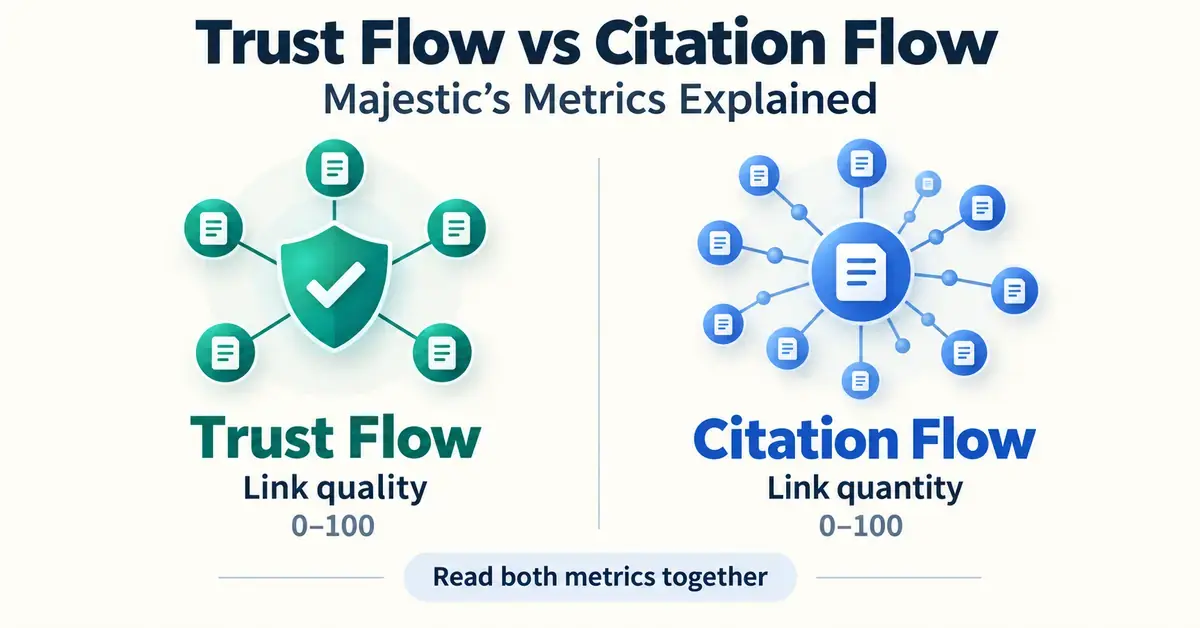
Trust Flow vs Citation Flow is a comparison of two scores from the backlink tool Majestic that describe a website’s link profile in different ways: the first measures the quality of the links pointing at a page, the second their quantity. Both run on a 0–100 scale, they are designed to be read together, and confusing them is one of the most common mistakes in link analysis. This guide explains what each metric means, how Majestic calculates them, what a healthy balance between the two looks like, and how to use them without being misled.
Key Points
- Trust Flow (TF) measures backlink quality — how close a page sits to a curated set of trusted seed sites. Scored 0–100.
- Citation Flow (CF) measures backlink quantity/influence — how many pages link to a URL. Also scored 0–100.
- Read them together: a high CF with a low TF usually signals lots of low-value links.
- Most sites have a higher CF than TF — Majestic confirms this is normal.
- A TF/CF ratio below about 0.5 is a common (unofficial) prompt to audit a link profile.
- Topical Trust Flow shows which subject categories a site’s trust comes from.
- Flow Metrics are a third-party estimate, not a direct Google ranking factor.
What are Majestic’s Flow Metrics?
Flow Metrics are Majestic’s family of link-based scores, introduced in 2012 to summarise a huge backlink graph into a few easy numbers. The two headline metrics are TF and CF. “Flow” is the key word: Majestic models the web as a map of links and lets value flow from one page to the next along those links. A page that receives links from strong pages inherits some of that strength, and then passes a share of it on to the pages it links to.
Because they are relative scores rather than a direct Google ranking factor, Flow Metrics are best used for comparison — one site against another, or a site this month against the same site last month. They are a third-party estimate, not an official signal from any search engine, so treat them as a lens on backlink quality rather than a guarantee of rankings.
What is Citation Flow?
Citation Flow (CF) predicts how influential a URL might be based on how many pages link to it. It is a measure of link volume and connectivity, scored from 0 to 100. The more links a page accumulates — and the more well-connected those linking pages are — the higher its CF climbs.
CF is the direct descendant of Majestic’s older metric, ACRank. Crucially, it does not judge whether the links are good or bad. A page can earn a high score purely from a large number of low-value links — spun directories, scraper sites, forum signatures or automated link networks — because the metric is counting influence, not trustworthiness. That is exactly why it should never be read on its own.
What is Trust Flow?
Trust Flow (TF) measures how trustworthy a page is based on the quality of the sites that link to it. Like CF, it is scored from 0 to 100, but it answers a different question: not “how many links?” but “how good are the neighbours?”
Majestic builds TF by starting with a large, manually reviewed list of trusted seed sites. The logic is simple and powerful: trustworthy sites tend to link to other trustworthy sites. Trust then propagates outward through the link graph — the closer a page sits to those vetted seeds (in terms of how few trusted links separate them), the higher its score. A site covered in links from spammy sources, by contrast, stays low no matter how many links it has, which makes TF far harder to manipulate than a raw link count.
Trust Flow vs Citation Flow: the core difference
The single sentence to remember: Citation Flow counts links; Trust Flow weighs them. A URL could have thousands of inbound links (high CF) that are almost all junk (low TF). Another URL might have far fewer links but earn most of them from respected publications, universities or established brands, giving it a modest CF but a strong TF.
Majestic itself notes that in its tests most backlink profiles show a higher CF than TF — quantity is simply easier to accumulate than quality. The table below sets the two metrics side by side.
Comparison
| Aspect | Trust Flow (TF) | Citation Flow (CF) |
|---|---|---|
| Measures | Link quality / trustworthiness | Link quantity / influence |
| Core question | How good are the linking sites? | How many sites link here? |
| Starting point | Manually reviewed trusted seed sites | Raw link counts (evolved from ACRank) |
| Scale | 0–100 (non-linear) | 0–100 (non-linear) |
| Easy to inflate with junk links? | No — resists manipulation | Yes — counts volume, not quality |
| Typical level | Usually lower | Usually higher |
| Best used for | Judging whether links are trustworthy | Gauging raw link popularity |
How are TF and CF calculated?
Both scores come from an iterative process that passes value through Majestic’s link map, but they start from different places. CF starts with a raw count for every URL Majestic has crawled — many of them created automatically by machines. TF starts only with human-curated, trusted sites. Majestic treats the precise formula as proprietary (Trust Flow is a trademarked metric), so the exact weighting is not published, but the underlying mechanics are well documented.
Seed sites and the flow of trust
TF begins with a seed set of URLs that real editors and reviewers consider trustworthy. During each pass over the link graph, a page with a high score hands a proportional share of its value to the pages it links to. Repeat this many times and trust “settles” across the web: sites a short, clean path from the seeds score highly, while sites reachable only through low-quality intermediaries score poorly. CF uses the same flowing mechanism but seeds it with link counts instead of curated trust.
The role of internal links
Majestic uses internal links (links between pages on the same site) both to discover new pages and to help calculate Flow Metrics. That is worth knowing because a large, well-linked site can show Flow Metrics that partly reflect its own internal structure, not just external endorsement — one more reason to compare scores alongside referring-domain counts rather than in isolation.
What is a good TF to CF ratio?
Read the two numbers as a ratio: the closer TF is to CF, the healthier the link profile tends to be. A site with TF 35 and CF 40 is in good shape — most of its link influence is backed by trust. One with TF 8 and CF 45 is a red flag: lots of links, very little trust, which usually points to spammy or manipulated backlinks.
Many SEOs use a rule of thumb that a TF/CF ratio below roughly 0.5 deserves a closer look. Treat that figure as an informal benchmark used across the industry, not an official Majestic threshold — Majestic publishes no “pass/fail” number. The ratio is a prompt to investigate, not a verdict. A brand-new site with few links, for example, can show an unstable ratio simply because the numbers are tiny.
As a rough feel for the absolute TF numbers you will see: scores above about 50 are reserved for major, widely trusted sites; most healthy small-business and niche sites sit somewhere in the teens to thirties; and a single-digit TF on a site with plenty of links often signals a profile worth auditing. These bands are interpretive guides, not hard cut-offs.
How Majestic scores trust by topic
Topical Trust Flow breaks the overall TF score down by subject category, showing where a site’s trust actually comes from. Majestic categorises the web into topics (such as Health, Business, Computers/Internet or Recreation/Travel) and reports a trust figure for each relevant category at URL, subdomain and domain level.
This matters for relevance. A site might have a solid overall TF, but if its topical trust is concentrated in “Gambling” while you run a medical clinic, a link from it is far less meaningful than the headline number suggests. For link building, a link from a page with strong Topical Trust Flow in your niche is usually worth more than a link from a generically “trusted” but off-topic source.
Fresh Index vs Historic Index: where the numbers come from
Majestic stores its crawl data in two indexes, and the one you query changes the numbers you see. The Fresh Index holds recently discovered links and is refreshed very frequently, while the Historic Index archives effectively every link Majestic has ever crawled — trillions of them, going back over a decade — and is rebuilt on a slower, roughly monthly cycle.
- Fresh Index — best for seeing the current state of a link profile and catching links that have recently appeared or disappeared.
- Historic Index — best for the full picture: competitor link history, long-term growth and links that have since been lost.
Because the two indexes contain different link sets, the same site can show different TF, CF and referring-domain figures depending on which index is selected. Always note which index a screenshot or report is based on before comparing numbers.
How do you check your Flow Metrics?
Flow Metrics are produced by Majestic, so the primary source is Majestic’s own Site Explorer, where you enter a domain or URL and read the scores directly. Many third-party SEO platforms and browser extensions also surface both scores through Majestic’s API, which is handy for checking scores in bulk or alongside other data.
If you are weighing up which platform to invest in, our rundown of the best backlink analysis tools compares Majestic with the main alternatives. Whichever tool you use, pull the score for the specific page you care about — Flow Metrics differ between a homepage, a subdomain and an individual URL.
How to use Flow Metrics when building links
The practical goal is to earn links from pages with healthy TF and topical relevance, not to chase a single big number. A sensible workflow:
- Check the linking page, not just the domain. A trusted domain can still host a weak page; score the exact URL that would link to you.
- Compare TF with CF. A wide gap in favour of CF suggests the prospect’s own links are low quality.
- Read the Topical Trust Flow. Favour sites whose trust sits in your subject area.
- Cross-check with referring domains. A high score built on very few domains is more fragile than a modest score from many.
These metrics also help on the defensive side. A sudden flood of links from low-Trust-Flow sources can drag your profile down, which is when a structured backlink audit and, where needed, a decision to disavow toxic backlinks become relevant. If you are still getting to grips with the basics, our guide to what backlinks are covers the anatomy of a link before you dive into the metrics.
Common mistakes when reading Flow Metrics
- Judging a site by Citation Flow alone. A high CF with low TF is often a sign of bulk, low-value links — the opposite of what you want.
- Treating Flow Metrics as a Google ranking factor. They are Majestic’s estimate, not a signal Google uses. Use them for comparison, not prediction.
- Ignoring the index. Comparing a Fresh Index score with a Historic Index score is not like-for-like.
- Chasing the domain score and forgetting the page. A link lives on a specific URL; score that URL.
- Overlooking Topical Trust Flow. A high generic score in the wrong category can overstate a link’s real relevance.
- Treating the 0.5 ratio as a hard rule. It is a prompt to investigate, especially unreliable on new sites with very few links.
How Flow Metrics compare to DA and DR
TF and CF are Majestic’s answer to the authority-metric question, but they are not the only option. Moz’s Domain Authority and Ahrefs’ Domain Rating measure similar ideas with different data and formulas, which is why the same site can score differently in each tool. The important discipline is to stay within one tool when comparing sites, since the numbers are not interchangeable. Our breakdown of Domain Authority vs Domain Rating explains how those two compare and why no single score should be your only input.
Sources
Frequently Asked Questions (FAQ)
Which metric matters more, TF or CF?
Neither on its own — they are designed to be read together. TF tells you about link quality and CF about link quantity. A strong profile shows both scores reasonably high and close to each other, rather than a large CF propped up by very little trust.
What counts as a good TF score?
There is no official cut-off. As a rough guide, scores above about 50 belong to major, widely trusted sites, while most healthy niche and small-business sites sit in the teens to thirties. Compare a score against direct competitors rather than against an absolute target.
Why is my CF higher than my TF?
That is normal — Majestic reports that most backlink profiles have a higher CF than TF, because links are easier to accumulate than trust. It only becomes a concern when the gap is very wide, which can indicate large numbers of low-quality links.
Are Flow Metrics a Google ranking factor?
No. They are third-party metrics created by Majestic, not signals Google confirms using. They are useful for comparing sites and tracking a link profile over time, but they do not directly determine search rankings.
How often do the Flow Metrics update?
It depends on the index. Majestic’s Fresh Index refreshes very frequently and reflects recently found links, while the Historic Index is rebuilt on a slower, roughly monthly cycle and archives all links ever crawled. The same site can show different scores in each.
