
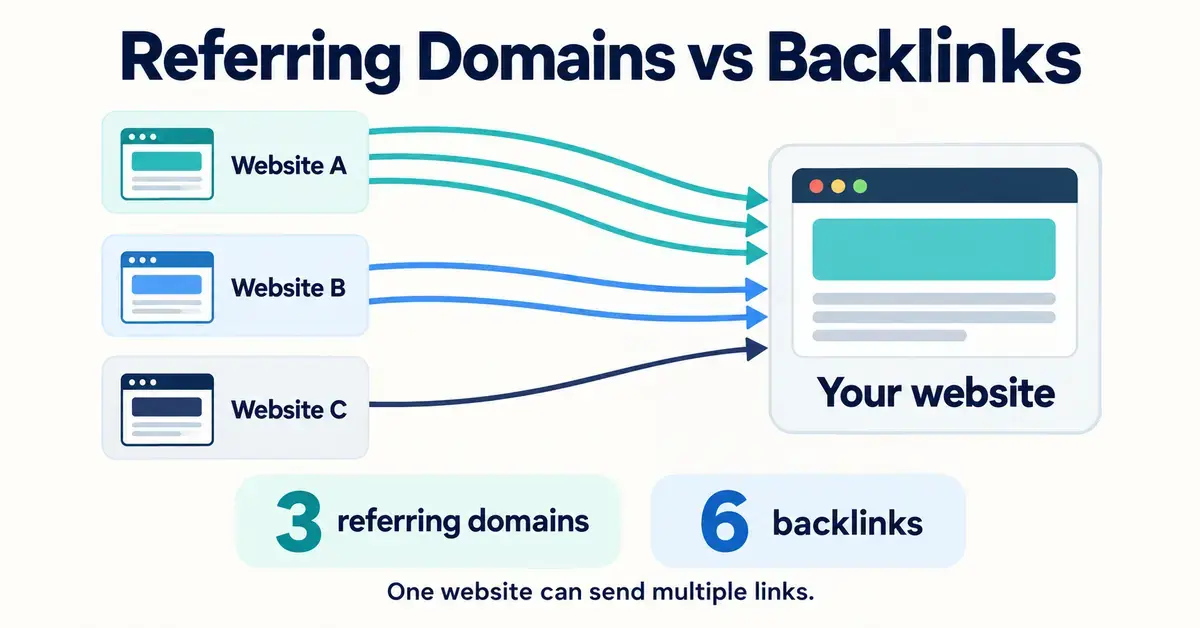
Referring domains and backlinks are two of the most quoted numbers in any link report, and they are easy to confuse. A backlink is a single hyperlink pointing to your site. A referring domain is a unique website that contains at least one of those links. One website can send you dozens of backlinks, but it still counts as a single domain. Understanding that gap is the key to reading a link profile correctly and to deciding where your link-building effort should go.
This guide on referring domains vs backlinks explains exactly how the two metrics differ, why the referring-domain count is almost always smaller than the backlink count, what large ranking studies actually show, how tools like Ahrefs and Semrush count each one, and the mistakes that make people chase the wrong number.
Key Takeaways
- Backlink = one individual link pointing to your site.
- Referring domain = one unique website that contains at least one backlink to you.
- One site can send many backlinks but counts only once as a domain, so that count is almost always the smaller number.
- Referring-domain diversity correlates with rankings more strongly than raw backlink volume.
- Google weighs the relevance and quality of each link, not the total count.
- Grow your domain count by earning links from new, independent, relevant sites — not more links from the same source.
What are backlinks and referring domains?
A backlink is any clickable hyperlink on another website that points to a page on your site. If you are new to the concept, our beginner explainer on what backlinks are walks through the anatomy of a link, including the anchor text and the rel attribute.
A referring domain is the website that the backlink lives on. Ahrefs defines it plainly: referring domains are “domains from which the target website or web page has one or more backlinks.” So the domain is the source, and a backlink is one specific link coming from that source.
Put simply: backlinks measure how many links point to you; referring domains measure how many different websites those links come from.
Referring domains vs backlinks: what is the key difference?
The core difference is that the domain number counts unique sources while backlinks count individual links, regardless of how many come from the same source. Ahrefs illustrates it with a clear example: a page that receives two links from the New York Times has two backlinks but only one referring domain. If one link comes from the New York Times and another from Forbes, that is two backlinks from two domains.
Because of this, the two numbers answer different questions. Backlinks tell you the total volume of links. The domain count tells you how broadly your content is endorsed across the web. The table below sums up the practical differences.
Comparison
| Aspect | Referring domains | Backlinks |
|---|---|---|
| What it counts | Unique websites linking to you | Every individual link pointing to you |
| One site links 10 times | Counts as 1 | Counts as 10 |
| Typical size of the number | Usually lower | Usually higher |
| Best signal of | Breadth of independent endorsement | Total link volume |
| Easy to inflate? | Harder — needs genuinely new sites | Easier — repeated links from one site |
| Correlation with rankings | Stronger | Weaker on its own |
Why can one referring domain produce many backlinks?
A single website can link to you many times, and each link is counted as a separate backlink while the site itself still counts once. This happens constantly and is completely normal:
- Site-wide links — a link in a footer, sidebar or navigation menu appears on every page of a site, so one partner can generate hundreds of backlinks from one domain.
- Multiple articles — a publisher that mentions you in several posts over time creates one new backlink per post, all from the same site.
- Author bios and templates — a recurring author box or a repeated resource list can repeat the same link across many URLs.
This is why the referring-domain number is almost always lower than the backlink number. If a report shows 5,000 backlinks from only 40 websites, the profile is narrow: a handful of sites are repeating the same link many times rather than many independent sites choosing to link to you.
Which matters more for SEO — referring domains or backlinks?
The number of linking sites generally matters more, because search engines value a broad consensus of independent sources over a large pile of links from a few places. Fifty links from fifty different reputable websites signal that many editors independently found your content worth citing. Fifty links from a single website only show that one site likes you — and search engines heavily discount repeated links from the same source.
That said, the two metrics are complementary rather than rivals. Backlinks still carry signals such as anchor text, placement and the authority of the specific page they sit on. A healthy profile grows both numbers together: more linking sites, each contributing relevant, quality links. For a deeper look at what separates a strong link from a weak one, see our guide to backlink quality.
What do ranking studies actually show?
Independent analyses repeatedly find that the number of unique referring domains correlates with rankings more strongly than the raw backlink count. Backlinko’s large-scale study of Google results reported that the number of domains linking to a page correlated with rankings more than any other factor they measured, and that top-ranking pages tend to be linked from more sites than lower-ranking ones. Ahrefs’ own large correlation work points in the same direction: referring-domain diversity lines up with rankings and organic traffic better than sheer link volume.
Correlation is not proof of causation, and no study should be read as a formula. But the pattern is consistent enough to be useful: a site with 200 backlinks spread across 150 domains usually sends a stronger authority signal than a site with 500 backlinks concentrated on 10 domains.
What does Google itself say?
Google’s position is that the total number of links does not matter to its algorithm. Google’s John Mueller has stated plainly that the sheer count of backlinks is not a ranking factor, and that one good link from a relevant site can outweigh millions of low-quality ones. What Google weighs is the relevance and quality of each link. This reinforces the practical lesson: chase relevant links from new, trustworthy domains rather than a bigger raw number. To understand why link building matters at all, see our overview of the importance of link building.
How do SEO tools count referring domains and backlinks?
Each tool crawls the web independently, so the exact figures differ, but the counting logic is broadly consistent. Ahrefs, for example, defines a backlink as any crawlable HTML link from one site to another. It generally does not count:
- Links triggered only by JavaScript that do not resolve to a crawlable HTML link.
- Links inside iframes or built purely from images without a real href.
- Links in sections blocked from crawling (for example by robots rules).
Tools count them at the root-domain level, so many subpages or subdomains of one site usually collapse into a single entry in most reports. Because every tool has its own crawler and index size, the same site can show different totals in Ahrefs, Semrush and Moz — so compare trends within one tool rather than absolute numbers across tools. Our rundown of the best backlink tools covers how the major platforms differ.
Do nofollow links count?
Most tools include nofollow links in both the backlink and referring-domain totals, because they still report every link they can crawl. A nofollow link tells search engines not to pass ranking credit by default, but it is still a real link from a real site in your report. That is why a high referring-domain count can still be weak if most of those domains are nofollow, low-quality or irrelevant. Reading the mix matters as much as reading the totals, which is the job of a proper backlink audit.
How many referring domains do you need to rank?
There is no universal number, because the right target depends on your niche, your competitors and the difficulty of the keywords you want to rank for. The reliable method is relative, not absolute:
- Identify the pages already ranking on page one for your target keyword.
- Check how many sites link to each of those pages, not just the whole site.
- Use the typical range as a benchmark to aim for, then focus on quality and relevance within it.
A low-competition local query might need only a handful of relevant linking sites, while a competitive commercial term can require many more. Chasing a round number in isolation is a mistake; benchmarking against the actual results you are competing with is far more reliable.
Common mistakes people make with these metrics
The biggest mistake is treating a large backlink count as proof of a strong profile. Here are the errors that follow from confusing the two numbers:
- Celebrating backlink volume alone. Thousands of links from a few sites — often site-wide footer links — look impressive but add little. Always read the referring-domain count alongside it.
- Ignoring the quality behind the domains. A high referring-domain number built from spammy, irrelevant or paid link networks can do more harm than good and may need to be disavowed.
- Buying bulk links from one source. One vendor placing many links on their own network inflates backlinks but barely moves the domain count — and search engines discount it.
- Comparing raw totals across different tools. Different crawlers produce different numbers; comparing Ahrefs to Semrush head-to-head is misleading.
- Confusing referring domains with authority scores. The domain count measures breadth, not strength. Metrics like Domain Authority and Domain Rating are separate estimates — see DA vs DR for how those work.
How to grow your referring domains the right way
The most durable way to raise your referring-domain count is to earn links from new, independent websites rather than repeating links from sites you already have. Practical tactics include:
- Publishing genuinely useful, linkable content that other sites in your field want to cite.
- Earning editorial coverage, guest contributions and mentions across different publishers.
- Getting listed in relevant, trustworthy directories and resource pages.
- Building relationships with sites you have not yet been linked from, instead of asking existing partners for more links.
Each new website that links to you broadens the base of independent endorsement behind your pages. For a structured approach, our link building guide lays out the methods step by step.
Sources
Frequently Asked Questions (FAQ)
Are referring domains the same as backlinks?
No. A backlink is one individual hyperlink pointing to your site, while a referring domain is a unique website that contains one or more of those links. One site can produce many backlinks.
Which is more important, referring domains or backlinks?
The domain count is generally the stronger signal, because links from many different websites show broad, independent endorsement. Backlinks still matter for anchor text and link quality, so the healthiest profiles grow both together.
Can you have more referring domains than backlinks?
No. The referring-domain count can never exceed the backlink count, because every linking site must contain at least one backlink. In practice the domain count is almost always the smaller number.
How many referring domains do I need to rank?
There is no fixed number. Check how many sites link to the pages currently ranking for your keyword have, use that as a benchmark, and prioritise relevant, quality links rather than hitting an arbitrary total.
Do nofollow links count as referring domains?
Yes, most SEO tools include nofollow links in both the backlink and referring-domain totals. However, nofollow links usually do not pass ranking credit by default, so a referring-domain count made up mostly of nofollow or low-quality sources is weaker than the number suggests.
